
Playlist
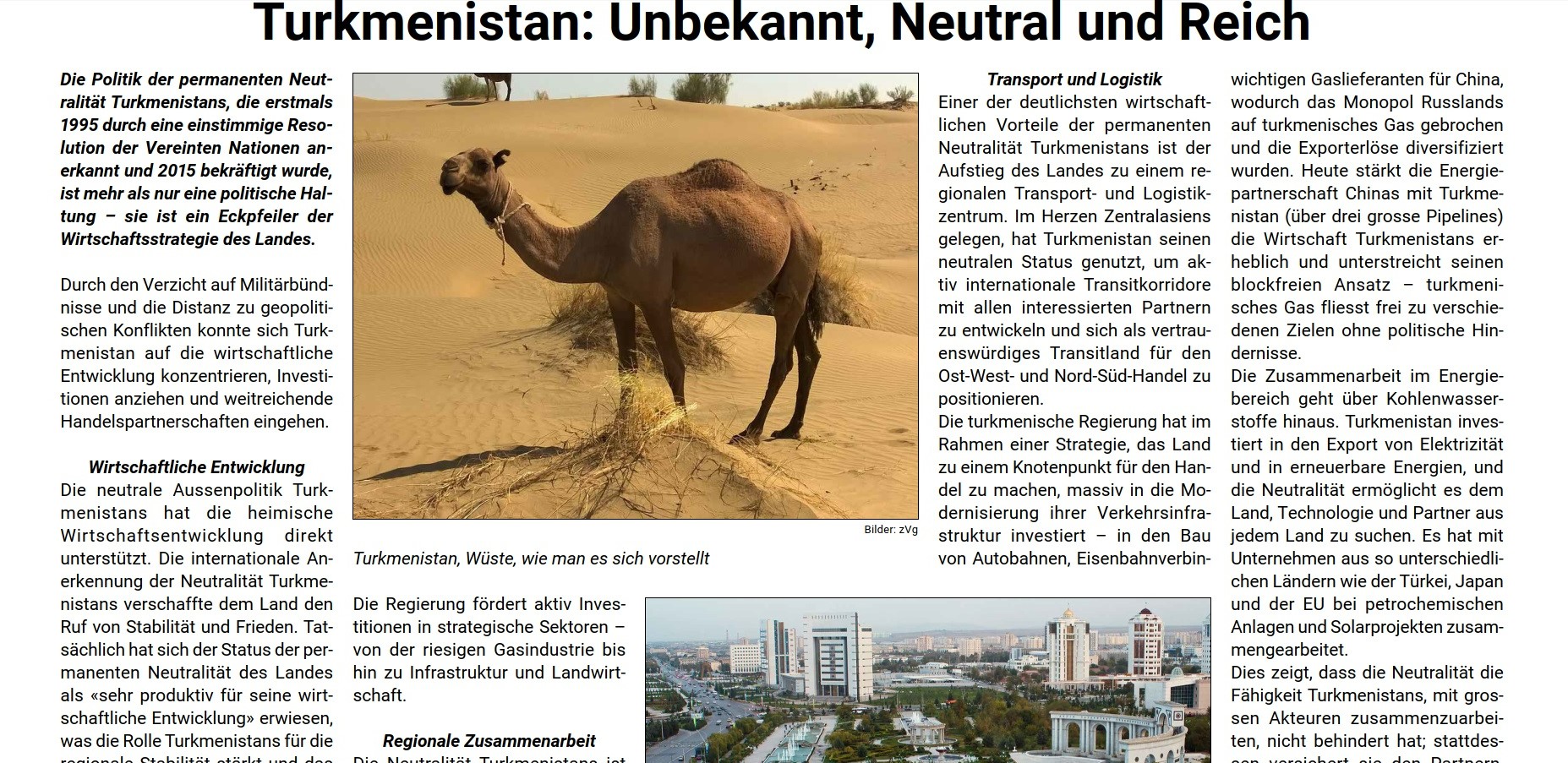
The Swiss magazine Umwelt Zeitung has released an analytical feature titled “Turkmenistan: Independent, Neutral, and Prosperous,” underscoring the significance of neutrality in the country’s long-term economic model.
Yurie Moaru, Vice-President of the Joint Chamber of Commerce Switzerland – Eastern Europe, Central Asia, and South Caucasus, argues that Turkmenistan's permanent neutrality is more than a foreign policy principle — it’s a foundation for economic credibility and resilience.
According to Moaru, Turkmenistan’s choice to remain outside military alliances and geopolitical confrontations has allowed it to focus on domestic growth, thereby cultivating an image of peace and predictability that attracts international investment.
The article cites positive forecasts from global institutions: Fitch Ratings affirmed the country’s BB- credit rating with a stable outlook, and the International Monetary Fund projects Turkmenistan's economic growth at 6.2% in 2024 — more than double the regional average.
Energy is highlighted as a key sector where neutrality has had direct benefits. With the world’s fourth-largest natural gas reserves, Turkmenistan has leveraged its neutral diplomacy to diversify export routes — notably becoming a major gas supplier to China, free from political interference or restrictions.
The article also notes Turkmenistan’s strategic role as a transport and logistics hub, particularly through the East-West and North-South corridors. Key investments include the modernized Turkmenbashi port on the Caspian Sea and transcontinental rail links.
Strong ties with neighboring countries are another success attributed to neutrality. Examples include energy and water cooperation with Uzbekistan, and a major rail project with Kazakhstan connecting Central Asia to the Persian Gulf.
Finally, it recalls that in 2023, the UN — at Turkmenistan’s initiative — declared a World Sustainable Transport Day, affirming the country’s global leadership in sustainable connectivity.
Also read




Ecological Shift: Golden Jackals Pro Projected to Inhabit 75% of the European Continent
Today in 06:53Once restricted mainly to the Balkans and the Black Sea coastal regions, golden jackals are rapidly expanding their footprint across Europe. According to a landmark study by an international research team published in Nature Ecology & Evolution, these adaptable predators could eventually inhabit up to 75% of the European continent—nearly a sixfold expansion from their historical range. Scientists arrived at these conclusions after monitoring nearly 9,000 sampling sites across multiple European nations.
Recent sightings and acoustic tracking confirm that jackals have established populations in the Czech Republic, the Baltic region, and even Scandinavia. The species thrives in areas with mild winters, mixed agricultural landscapes, and proximity to water sources. Regional climate warming has transformed previously uninhabitable northern areas into suitable habitats, while farming landscapes offer abundant food sources and coverage.
Biologists attribute this unprecedented expansion primarily to the historical decline of wolf populations, which naturally suppress jackal numbers and limit their movement. Smaller than wolves but slightly larger than foxes, jackals feed on small rodents, carrion, plants, and fruits. Their high ecological adaptability allows them to settle efficiently into newly colonized territories without human interference.
However, their entry into Western and Southern Europe, including countries like France and Spain, poses potential ecological consequences. Environmentalists warn that the arrival of jackals could disrupt local ecosystems and threaten endangered ground-nesting steppe birds and smaller wildlife across the Iberian Peninsula.
Also read




Blitz