
Playlist
Kazakhstan’s Higgsfield AI Becomes First Billion-Dollar Tech Unicorn in the Country
11 Oct. 07:21On October 11, 2025, Kazakhstan’s artificial intelligence startup Higgsfield AI officially surpassed a $1 billion valuation, making it the country’s first-ever unicorn. The announcement came from founder and CEO Alex Mashrabov, who noted that no local company had reached this milestone in the past 15 years.
Product Offering and Recent Milestones
Higgsfield AI provides access to both proprietary and third-party AI models via subscription-based services. The startup recently acquired Alibaba’s Wan 2.5 model for $100 million, enhancing its ability to generate promotional videos and trailers with dynamic, AI-driven camera motion.
Founder Background and Financial Success
Mashrabov previously led the generative AI division at Snap Inc. He emphasized that reaching unicorn status is a historic moment for Kazakhstan’s tech ecosystem. Higgsfield AI currently reports annual revenues exceeding $50 million.
Investor Backing and Regional Impact
The company has secured backing from major international investors, including Menlo Ventures, known for funding top AI firms like Anthropic.
Experts believe Higgsfield AI’s rise will inspire further innovation across Central Asia and draw increased interest from global venture capital into the region’s tech scene.
Also read



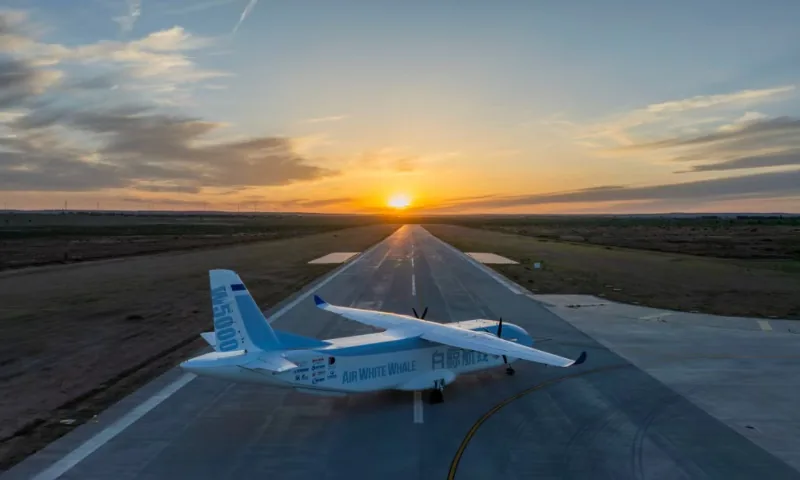
World’s Largest Unmanned Cargo Aircraft Completes Maiden Flight in China
17 Nov. 16:55The Chinese-developed W5000, billed by its creators at Air White Whale as the world’s largest unmanned cargo plane, has successfully completed its maiden test flight in Inner Mongolia. Boasting a 65-cubic-meter cargo hold, the aircraft is engineered to carry payloads of up to five tons across distances reaching 2,600 kilometers.
During the trial, the aircraft lifted off after a roughly 600-meter runway roll, climbed to an altitude of 2,000 meters, and remained airborne for about 30 minutes before making a smooth landing. Operating entirely without onboard pilots, the W5000 relies on autonomous flight controls monitored by ground-based specialists, who verified the seamless integration of its propulsion, avionics, and data-link systems.
Powered by a domestically produced turboprop engine, the airframe consists of nearly 65% carbon-fiber composite materials. This lightweight structural design reduces overall empty weight while maximizing the share of takeoff mass dedicated to freight.
Developers envision deploying the W5000 for regional logistics, temperature-controlled deliveries, and emergency relief operations. Because the design eliminates cockpit equipment and flight crew expenses while cutting fuel burn, the manufacturer estimates per-ton-kilometer shipping costs will be over 60% lower than those of comparable manned cargo aircraft.
Also read



Blitz