
Playlist

Eighty-Eight Global Partners Sign New Delhi Declaration on the Future of Artificial Intelligence
23 Feb. 10:29Following a high-level summit in India, the New Delhi Declaration on Artificial Intelligence was formally endorsed by 88 nations and major international organizations. The document establishes a unified global framework for the governance and ethical deployment of AI technologies. Participants emphasized the crucial role of AI in driving economic transformation and underlined the necessity of building open, accessible ecosystems that foster innovation while protecting public interests.
The agreement focuses on establishing shared goals for managing the rapid advancement of digital intelligence. Leaders at the summit confirmed that international cooperation is essential to ensure that AI systems are developed in a transparent and responsible manner. By signing this declaration, the signatory parties commit to a strategic vision where technological progress aligns with human values and social welfare, promoting a balanced approach to the opportunities and challenges posed by automation.
The urgency of this collective action is highlighted by the warnings of tech visionaries like Elon Musk, who suggests that AI could surpass human cognitive abilities as early as 2030. In this context, the New Delhi Declaration serves as a vital blueprint for navigating the transition toward a more advanced technological era. The global community now looks toward implementing these guidelines to ensure that the evolution of artificial intelligence remains a force for positive change across the globe.
Also read



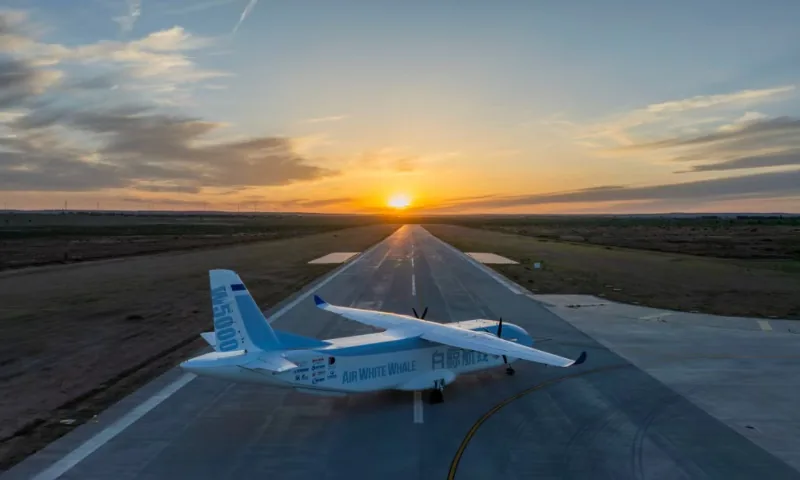
World’s Largest Unmanned Cargo Aircraft Completes Maiden Flight in China
17 Nov. 16:55The Chinese-developed W5000, billed by its creators at Air White Whale as the world’s largest unmanned cargo plane, has successfully completed its maiden test flight in Inner Mongolia. Boasting a 65-cubic-meter cargo hold, the aircraft is engineered to carry payloads of up to five tons across distances reaching 2,600 kilometers.
During the trial, the aircraft lifted off after a roughly 600-meter runway roll, climbed to an altitude of 2,000 meters, and remained airborne for about 30 minutes before making a smooth landing. Operating entirely without onboard pilots, the W5000 relies on autonomous flight controls monitored by ground-based specialists, who verified the seamless integration of its propulsion, avionics, and data-link systems.
Powered by a domestically produced turboprop engine, the airframe consists of nearly 65% carbon-fiber composite materials. This lightweight structural design reduces overall empty weight while maximizing the share of takeoff mass dedicated to freight.
Developers envision deploying the W5000 for regional logistics, temperature-controlled deliveries, and emergency relief operations. Because the design eliminates cockpit equipment and flight crew expenses while cutting fuel burn, the manufacturer estimates per-ton-kilometer shipping costs will be over 60% lower than those of comparable manned cargo aircraft.
Also read




Blitz