
Playlist
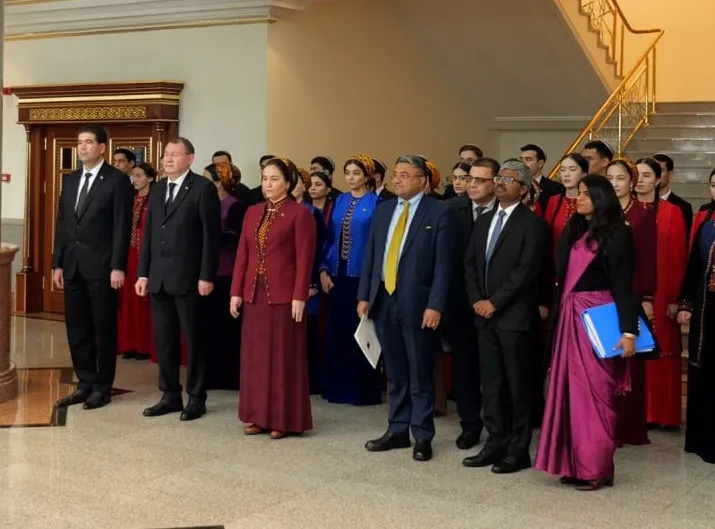
Turkmenistan strengthens medical education with the opening of an Ayurveda classroom
22 Jan. 09:50Turkmenistan has taken another step in advancing its healthcare education system. On January 20, a dedicated Ayurveda classroom was officially inaugurated at the State Medical University of Turkmenistan named after Myrat Garryyev. The opening ceremony gathered guests from India, faculty members of the university, and students studying medicine in Turkmenistan.
Welcoming remarks were delivered by the Rector of the State Medical University of Turkmenistan, Nargozel Myratnazarova, along with Sibi George, Secretary of the Ministry of External Affairs of the Republic of India.
Ayurveda, one of India’s oldest traditional medical systems, is currently studied and practiced by medical professionals across the globe. The establishment of a specialized educational space in Turkmenistan reflects the successful development of Turkmen–Indian cooperation in the healthcare sector. The foundation for this collaboration was laid during the official visit of Indian Prime Minister Narendra Modi to Turkmenistan in 2015.
As part of bilateral initiatives, a Yoga and Traditional Medicine Center operates in Ashgabat. Experts from the center conduct academic courses at the university in Turkmenistan for students specializing in “Healthcare and Alternative Medicine” and “Sports Medicine,” focusing on Ayurvedic principles, yoga therapy, and the use of medicinal plants.
Also read


Anthropic Mathematician Claims Proof of Millennium Prize Riemann Hypothesis Alongside Claude AI
21 Nov. 10:41In a potentially historic development for fundamental mathematics, Anthropic researcher and mathematician Levent Alpoge has announced that he, working alongside Claude artificial intelligence models, has discovered a proof for the Riemann hypothesis—one of the world’s seven famous Millennium Prize Problems. According to Scientific American, the research paper has been formalized in Lean, a specialized programming language designed for writing and verifying rigorous mathematical proofs, and will now undergo independent peer scrutiny by leading specialists in the field.
Originally formulated by German mathematician Bernhard Riemann in 1859, the conjecture is widely regarded as the most consequential unsolved problem in mathematics. Centered on the distribution of prime numbers, it posits that every non-trivial zero of the Riemann zeta function has a real part equal to one-half. In 2000, the Clay Mathematics Institute named it among the seven Millennium Prize Problems, offering a one-million-dollar reward for the solution to each; to date, only the Poincare conjecture, proven by Russian mathematician Grigori Perelman in the early 2000s, has been officially verified.
Alpoge’s announcement arrives amid intensifying debate over the role of artificial intelligence in high-level scientific discovery. Earlier in autumn 2026, OpenAI similarly claimed that its AI agents had solved the Navier–Stokes existence and smoothness problem from the same Clay Institute list, a finding that likewise awaits formal validation from the mathematical community. Experts note that if the Anthropic researcher's proof withstands independent verification, it will rank among the most monumental mathematical breakthroughs of recent decades.
Also read


Blitz