
Playlist
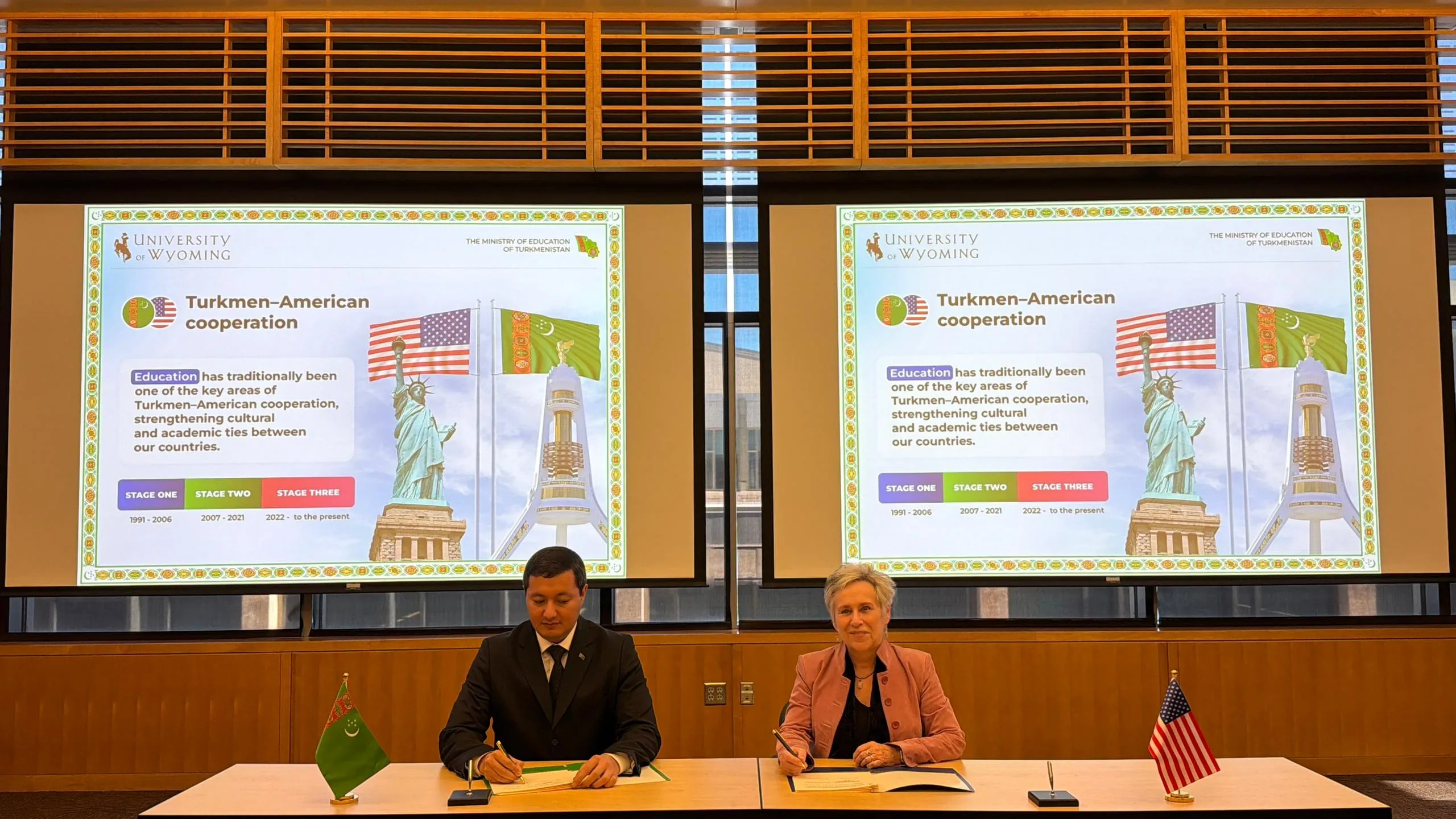
Two Turkmen Universities Sign Memorandums of Understanding with the University of Wyoming
25 Oct. 12:42During a working visit to the United States, a Turkmen delegation led by Deputy Minister of Education Azat Ataev visited the University of Wyoming (UW). The program included a welcome session, meetings with university leadership, thematic discussions, presentations for the campus community, and a final coordination meeting with UW’s international team.
Key areas of cooperation were discussed, including the preparation and signing of memorandums of understanding, launching joint academic modules and exchanges, and using UW’s digital learning platforms (WyoCourses/Canvas) for co-teaching and resource sharing.
At the College of Business, the delegations reviewed practical learning opportunities: a trading lab with market analytics stations, a “student fund” model for real-data strategy practice, and courses in business analytics, behavioral accounting, and blockchain technologies.
During the education session, discussions focused on language training, inclusive education, modern preschool and primary teaching approaches, joint online classes, guest lectures, and summer schools. Parties agreed to develop unified syllabi, share teaching materials, and set up UW’s digital environment for co-teaching and monitoring student progress.
As a result of the visit, memorandums were signed between the Turkmen State Institute of World Languages named after D. Azadi and the University of Wyoming, as well as between the Turkmen State Financial Institute and the University of Wyoming. Pilot projects for the upcoming semester will include modules on business analytics and financial literacy, blockchain case studies, COIL sessions on language training and inclusive pedagogy, and the development of “roadmaps” for faculty exchanges and summer schools.
Both sides emphasized the importance of practical results and regular progress updates. Previously, it was reported that Turkmenistan and the University of Montana plan to launch joint short-term courses.
Also read

Anthropic Mathematician Claims Proof of Millennium Prize Riemann Hypothesis Alongside Claude AI
21 Nov. 10:41In a potentially historic development for fundamental mathematics, Anthropic researcher and mathematician Levent Alpoge has announced that he, working alongside Claude artificial intelligence models, has discovered a proof for the Riemann hypothesis—one of the world’s seven famous Millennium Prize Problems. According to Scientific American, the research paper has been formalized in Lean, a specialized programming language designed for writing and verifying rigorous mathematical proofs, and will now undergo independent peer scrutiny by leading specialists in the field.
Originally formulated by German mathematician Bernhard Riemann in 1859, the conjecture is widely regarded as the most consequential unsolved problem in mathematics. Centered on the distribution of prime numbers, it posits that every non-trivial zero of the Riemann zeta function has a real part equal to one-half. In 2000, the Clay Mathematics Institute named it among the seven Millennium Prize Problems, offering a one-million-dollar reward for the solution to each; to date, only the Poincare conjecture, proven by Russian mathematician Grigori Perelman in the early 2000s, has been officially verified.
Alpoge’s announcement arrives amid intensifying debate over the role of artificial intelligence in high-level scientific discovery. Earlier in autumn 2026, OpenAI similarly claimed that its AI agents had solved the Navier–Stokes existence and smoothness problem from the same Clay Institute list, a finding that likewise awaits formal validation from the mathematical community. Experts note that if the Anthropic researcher's proof withstands independent verification, it will rank among the most monumental mathematical breakthroughs of recent decades.
Also read

Blitz