
Playlist
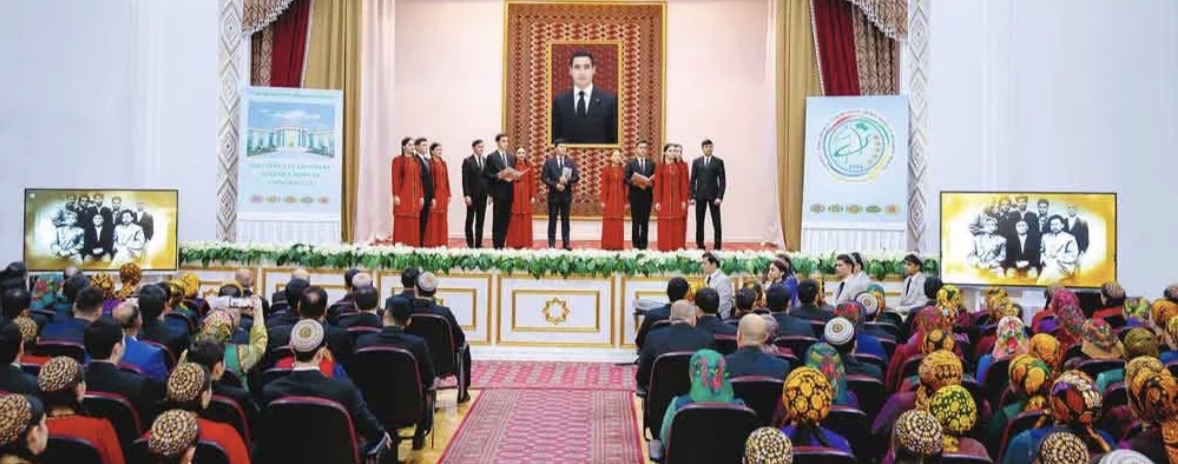
A scientific and creative conference titled "Mäti Köseýew — A Scholar of Literature" was held at Magtymguly Turkmen State University to honor the 120th anniversary of the birth of the renowned literary scholar and laureate of the Magtymguly International Prize, Mäti Köseýew. The event was attended by faculty members and students from several prestigious institutions, including the Dovletmammet Azadi Turkmen National Institute of World Languages and the Turkmen State Institute of Culture. The gathering highlighted the enduring significance of Köseýew's academic contributions to the nation’s cultural identity.
The conference began with an award ceremony for the winners of a book-reading competition, organized to mark the first anniversary of the "State Program for the Development of the Library System in Turkmenistan for 2025–2029." Following the awards, speakers reflected on Köseýew's monumental role in establishing a scientific framework for studying Turkmen folklore and classical literature. A key highlight was the professor’s instrumental role in founding the Magtymguly Pyragy Museum at the university in 1959, which remains a vital center for literary research.
Scholars at the conference emphasized that Mäti Köseýew’s research on historical figures such as Bayram Khan, Dovletmammet Azadi, and Magtymguly Pyragy serves as a primary source for modern academics. His extensive work in collecting and preserving national epics like "Gorkut Ata" and "Görogly," as well as numerous classic "destans" (romances), was noted as a service of immense value to the Turkmen people. Professor Köseýew is particularly celebrated for his deep devotion to Magtymguly’s poetry, having dedicated much of his life to collecting and refining the poet’s original manuscripts.
The event also focused on Köseýew's legacy as a mentor and educator. During his years at the university, he supervised the academic journeys of many prominent contemporary scholars and journalists, fostering a new generation of intellectuals. The conference featured artistic performances and musical compositions by students, creating a vibrant atmosphere that blended academic rigor with cultural celebration. A book exhibition arranged alongside the meeting allowed participants to explore the extensive published works of the legendary scholar.
Also read

Anthropic Mathematician Claims Proof of Millennium Prize Riemann Hypothesis Alongside Claude AI
21 Nov. 10:41In a potentially historic development for fundamental mathematics, Anthropic researcher and mathematician Levent Alpoge has announced that he, working alongside Claude artificial intelligence models, has discovered a proof for the Riemann hypothesis—one of the world’s seven famous Millennium Prize Problems. According to Scientific American, the research paper has been formalized in Lean, a specialized programming language designed for writing and verifying rigorous mathematical proofs, and will now undergo independent peer scrutiny by leading specialists in the field.
Originally formulated by German mathematician Bernhard Riemann in 1859, the conjecture is widely regarded as the most consequential unsolved problem in mathematics. Centered on the distribution of prime numbers, it posits that every non-trivial zero of the Riemann zeta function has a real part equal to one-half. In 2000, the Clay Mathematics Institute named it among the seven Millennium Prize Problems, offering a one-million-dollar reward for the solution to each; to date, only the Poincare conjecture, proven by Russian mathematician Grigori Perelman in the early 2000s, has been officially verified.
Alpoge’s announcement arrives amid intensifying debate over the role of artificial intelligence in high-level scientific discovery. Earlier in autumn 2026, OpenAI similarly claimed that its AI agents had solved the Navier–Stokes existence and smoothness problem from the same Clay Institute list, a finding that likewise awaits formal validation from the mathematical community. Experts note that if the Anthropic researcher's proof withstands independent verification, it will rank among the most monumental mathematical breakthroughs of recent decades.
Blitz