
Playlist
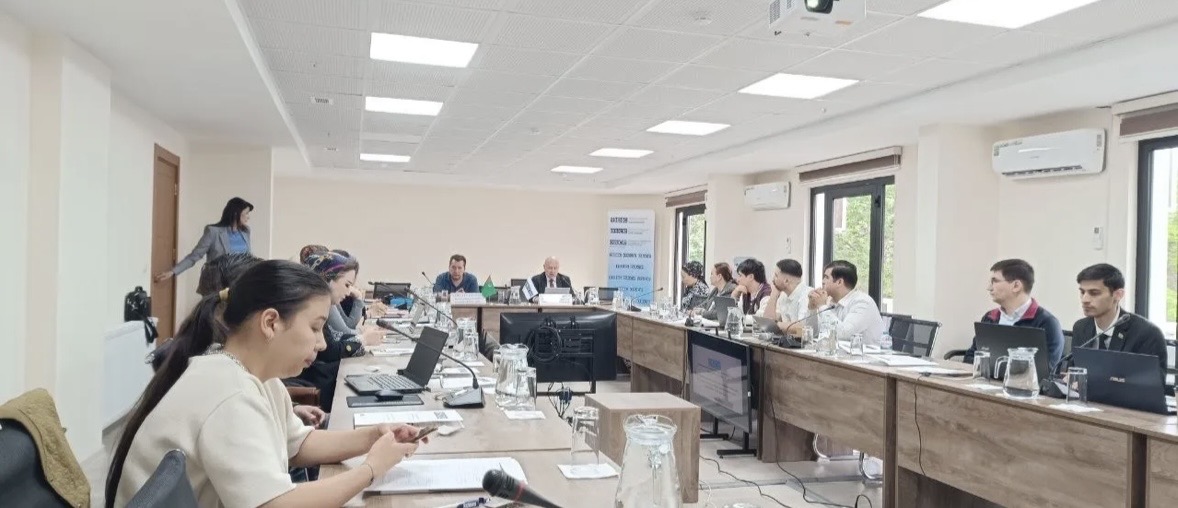
Ashgabat Media Workshop Explores the Integration of Artificial Intelligence and Digital Storytelling
24 Apr. 08:02The OSCE Centre in Ashgabat conducted an intensive three-day practical training on multimedia journalism from April 21 to 23. The program equipped media professionals with cutting-edge digital tools, focusing on infographics, neural network operations, and the automation of editorial tasks through fine-tuned language models. This initiative aimed to modernize newsroom workflows and enhance the quality of digital content production in line with international standards.
The curriculum prioritized the transformation of traditional reporting into engaging digital experiences. Experts shared insights on evolving media consumption patterns and introduced advanced storytelling techniques to present complex information effectively. A significant focus was placed on data visualization, demonstrating how artificial intelligence can empower journalists to generate high-quality visual content and interactive graphics without requiring extensive design backgrounds.
A key highlight of the training was a deep dive into prompt engineering and the utilization of Large Language Models (LLM) for journalistic purposes. Participants learned to streamline routine operations—such as data sorting, initial drafting, and formatting—by delegating these tasks to AI systems. This technological shift is designed to allow journalists to focus more on investigative reporting and high-level analytical content, thereby increasing the overall efficiency of media outlets.
The workshop concluded with a technical session on mobile journalism, highlighting professional-grade photo and video capture using smartphones. Through practical exercises and expert evaluations of individual projects, participants gained hands-on experience in creating comprehensive multimedia packages. The event culminated in a certificate ceremony, marking a significant step toward the digital transformation of the regional media landscape.
Also read



Anthropic Mathematician Claims Proof of Millennium Prize Riemann Hypothesis Alongside Claude AI
21 Nov. 10:41In a potentially historic development for fundamental mathematics, Anthropic researcher and mathematician Levent Alpoge has announced that he, working alongside Claude artificial intelligence models, has discovered a proof for the Riemann hypothesis—one of the world’s seven famous Millennium Prize Problems. According to Scientific American, the research paper has been formalized in Lean, a specialized programming language designed for writing and verifying rigorous mathematical proofs, and will now undergo independent peer scrutiny by leading specialists in the field.
Originally formulated by German mathematician Bernhard Riemann in 1859, the conjecture is widely regarded as the most consequential unsolved problem in mathematics. Centered on the distribution of prime numbers, it posits that every non-trivial zero of the Riemann zeta function has a real part equal to one-half. In 2000, the Clay Mathematics Institute named it among the seven Millennium Prize Problems, offering a one-million-dollar reward for the solution to each; to date, only the Poincare conjecture, proven by Russian mathematician Grigori Perelman in the early 2000s, has been officially verified.
Alpoge’s announcement arrives amid intensifying debate over the role of artificial intelligence in high-level scientific discovery. Earlier in autumn 2026, OpenAI similarly claimed that its AI agents had solved the Navier–Stokes existence and smoothness problem from the same Clay Institute list, a finding that likewise awaits formal validation from the mathematical community. Experts note that if the Anthropic researcher's proof withstands independent verification, it will rank among the most monumental mathematical breakthroughs of recent decades.
Blitz