
Playlist
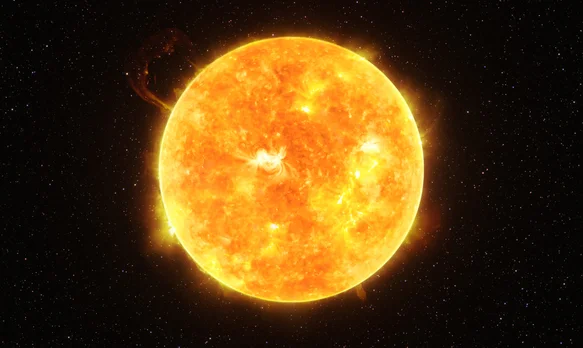
A new active region has emerged on the Sun, rapidly growing in size. This zone is considered especially dangerous as it crossed the central solar meridian on the night of August 30. Scientists warn that over the next 48 hours, this region could pose the greatest threat to Earth during its entire existence.
This region has been categorized as Beta-Gamma-Delta, the highest level of complexity among solar spots. No particle eruptions have occurred yet, but this region is heating the Sun's corona, increasing thermal radiation. Experts from IKI RAN suggest that this could be a sign of energy accumulation, which often precedes major solar flares.
Recently, one of the largest solar flares since June 20 occurred. It was classified as the fourth level of power out of five possible levels. Scientists report that solar activity has sharply intensified, with several large active centers emerging on the visible side of the Sun.
It was also previously reported that a proton stream pierced Earth's atmosphere as a result of a powerful M1.1 solar flare lasting for 16 minutes. The consequence of this flare was the penetration of low-energy protons into near-Earth space, but their concentration does not exceed natural background levels, according to experts.
Also read


Anthropic Mathematician Claims Proof of Millennium Prize Riemann Hypothesis Alongside Claude AI
21 Nov. 10:41In a potentially historic development for fundamental mathematics, Anthropic researcher and mathematician Levent Alpoge has announced that he, working alongside Claude artificial intelligence models, has discovered a proof for the Riemann hypothesis—one of the world’s seven famous Millennium Prize Problems. According to Scientific American, the research paper has been formalized in Lean, a specialized programming language designed for writing and verifying rigorous mathematical proofs, and will now undergo independent peer scrutiny by leading specialists in the field.
Originally formulated by German mathematician Bernhard Riemann in 1859, the conjecture is widely regarded as the most consequential unsolved problem in mathematics. Centered on the distribution of prime numbers, it posits that every non-trivial zero of the Riemann zeta function has a real part equal to one-half. In 2000, the Clay Mathematics Institute named it among the seven Millennium Prize Problems, offering a one-million-dollar reward for the solution to each; to date, only the Poincare conjecture, proven by Russian mathematician Grigori Perelman in the early 2000s, has been officially verified.
Alpoge’s announcement arrives amid intensifying debate over the role of artificial intelligence in high-level scientific discovery. Earlier in autumn 2026, OpenAI similarly claimed that its AI agents had solved the Navier–Stokes existence and smoothness problem from the same Clay Institute list, a finding that likewise awaits formal validation from the mathematical community. Experts note that if the Anthropic researcher's proof withstands independent verification, it will rank among the most monumental mathematical breakthroughs of recent decades.
Also read




Blitz