
Playlist
Turkmen Universities Strengthen Their Positions in the UI GreenMetric 2025 Environmental Ranking
08 Dec. 05:59In the 2025 edition of UI GreenMetric, a global ranking system assessing universities’ environmental sustainability, two Turkmen institutions demonstrated notable advancement.
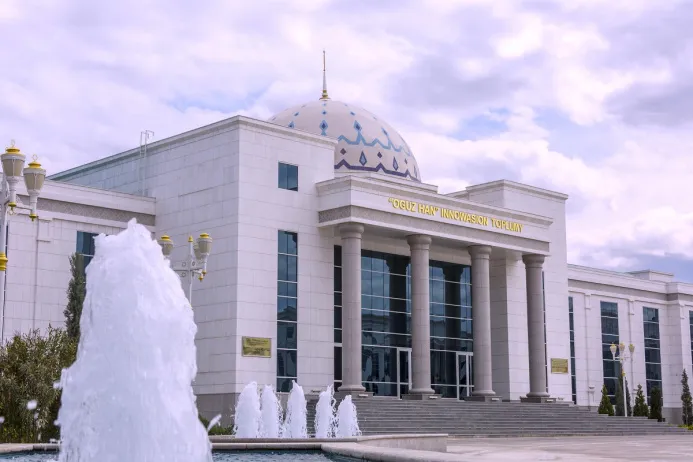
Oguz Khan Engineering and Technology University rose to 306th place among 1,745 universities representing 105 countries. With a score of 7,675 points, the university entered the prestigious “Gold Category” and maintained its leadership among Turkmen participants for the third consecutive year. Over four years, the university has consistently climbed the ranking, progressing from 637th place in 2022 to its current position.
The Turkmen Agricultural Institute also achieved a remarkable improvement, moving up 73 positions to rank 653rd. Its score of 6,377.5 points placed the institution within the “Silver Category.”
The UI GreenMetric framework evaluates universities across six areas: sustainable infrastructure, energy and climate initiatives, waste management, water resource efficiency, eco-friendly transportation, and environmental education and research.
Also read


Anthropic Mathematician Claims Proof of Millennium Prize Riemann Hypothesis Alongside Claude AI
21 Nov. 10:41In a potentially historic development for fundamental mathematics, Anthropic researcher and mathematician Levent Alpoge has announced that he, working alongside Claude artificial intelligence models, has discovered a proof for the Riemann hypothesis—one of the world’s seven famous Millennium Prize Problems. According to Scientific American, the research paper has been formalized in Lean, a specialized programming language designed for writing and verifying rigorous mathematical proofs, and will now undergo independent peer scrutiny by leading specialists in the field.
Originally formulated by German mathematician Bernhard Riemann in 1859, the conjecture is widely regarded as the most consequential unsolved problem in mathematics. Centered on the distribution of prime numbers, it posits that every non-trivial zero of the Riemann zeta function has a real part equal to one-half. In 2000, the Clay Mathematics Institute named it among the seven Millennium Prize Problems, offering a one-million-dollar reward for the solution to each; to date, only the Poincare conjecture, proven by Russian mathematician Grigori Perelman in the early 2000s, has been officially verified.
Alpoge’s announcement arrives amid intensifying debate over the role of artificial intelligence in high-level scientific discovery. Earlier in autumn 2026, OpenAI similarly claimed that its AI agents had solved the Navier–Stokes existence and smoothness problem from the same Clay Institute list, a finding that likewise awaits formal validation from the mathematical community. Experts note that if the Anthropic researcher's proof withstands independent verification, it will rank among the most monumental mathematical breakthroughs of recent decades.
Also read



Blitz