
Playlist
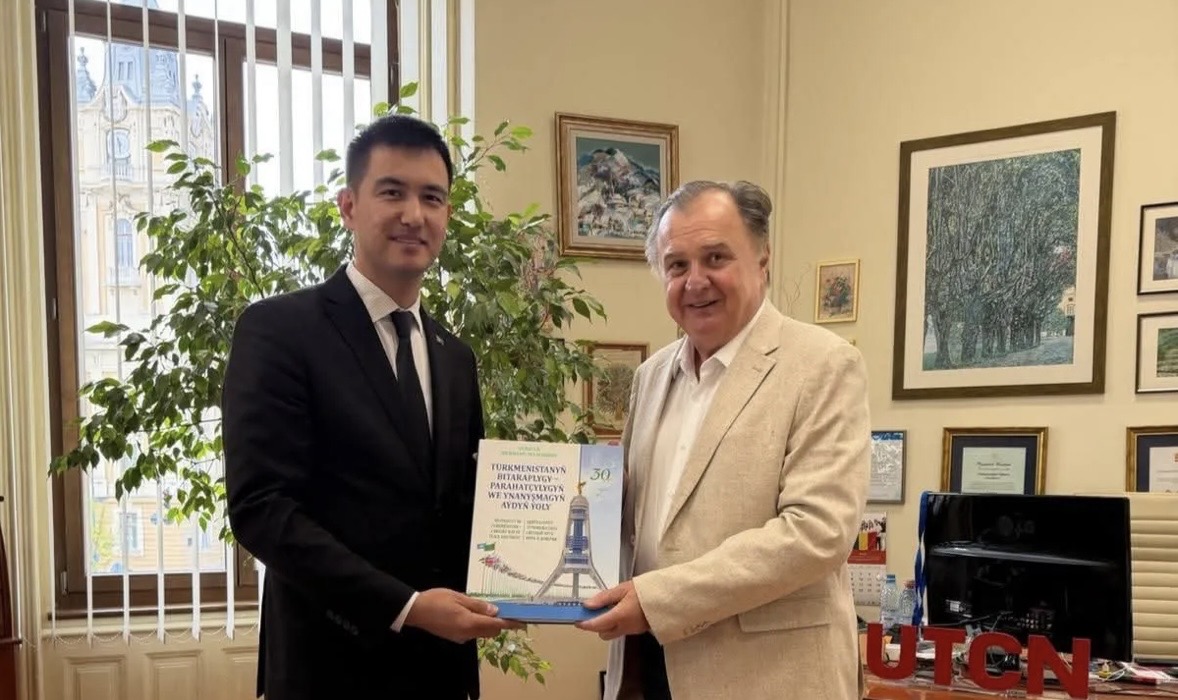
Turkmen Educators Enhance Professional Skills at the Technical University of Cluj-Napoca in Romania
23 Apr. 05:38Faculty members from the Institute of Telecommunications and Informatics of Turkmenistan are currently undergoing professional development training at the Technical University of Cluj-Napoca in Romania. As one of Romania's premier institutions for technical and engineering education, the university is hosting a comprehensive program featuring lectures, seminars, and hands-on laboratory sessions. The training is designed to integrate European educational standards into the academic framework of the Turkmen institute.
The training focuses on modern teaching methodologies, innovative approaches to curriculum development, and emerging global trends in information technology. Turkmen educators are exploring the latest advancements in digital systems while utilizing the university’s state-of-the-art research laboratories. This practical exposure to high-tech environments provides the participants with valuable insights into the management and implementation of complex technological infrastructures.
In addition to the academic curriculum, bilateral meetings are scheduled to discuss future initiatives aimed at expanding research and educational opportunities for both students and faculty. These discussions focus on establishing sustainable academic exchange programs and joint scientific projects. Such institutional synergy is vital for fostering a globalized learning environment and promoting intellectual growth within the telecommunications sector.
This professional exchange is a continuation of the strategic partnership established by the Cooperation Agreement signed in 2019. Since then, regular training sessions at the Romanian university have become a key component of the professional growth of Turkmen academics. This ongoing collaboration plays a crucial role in preparing highly skilled specialists capable of driving the digital transformation of Turkmenistan’s economy.
Also read

Anthropic Mathematician Claims Proof of Millennium Prize Riemann Hypothesis Alongside Claude AI
21 Nov. 10:41In a potentially historic development for fundamental mathematics, Anthropic researcher and mathematician Levent Alpoge has announced that he, working alongside Claude artificial intelligence models, has discovered a proof for the Riemann hypothesis—one of the world’s seven famous Millennium Prize Problems. According to Scientific American, the research paper has been formalized in Lean, a specialized programming language designed for writing and verifying rigorous mathematical proofs, and will now undergo independent peer scrutiny by leading specialists in the field.
Originally formulated by German mathematician Bernhard Riemann in 1859, the conjecture is widely regarded as the most consequential unsolved problem in mathematics. Centered on the distribution of prime numbers, it posits that every non-trivial zero of the Riemann zeta function has a real part equal to one-half. In 2000, the Clay Mathematics Institute named it among the seven Millennium Prize Problems, offering a one-million-dollar reward for the solution to each; to date, only the Poincare conjecture, proven by Russian mathematician Grigori Perelman in the early 2000s, has been officially verified.
Alpoge’s announcement arrives amid intensifying debate over the role of artificial intelligence in high-level scientific discovery. Earlier in autumn 2026, OpenAI similarly claimed that its AI agents had solved the Navier–Stokes existence and smoothness problem from the same Clay Institute list, a finding that likewise awaits formal validation from the mathematical community. Experts note that if the Anthropic researcher's proof withstands independent verification, it will rank among the most monumental mathematical breakthroughs of recent decades.
Blitz