
Playlist
Applications Open in Turkmenistan for the Prep4Success Program
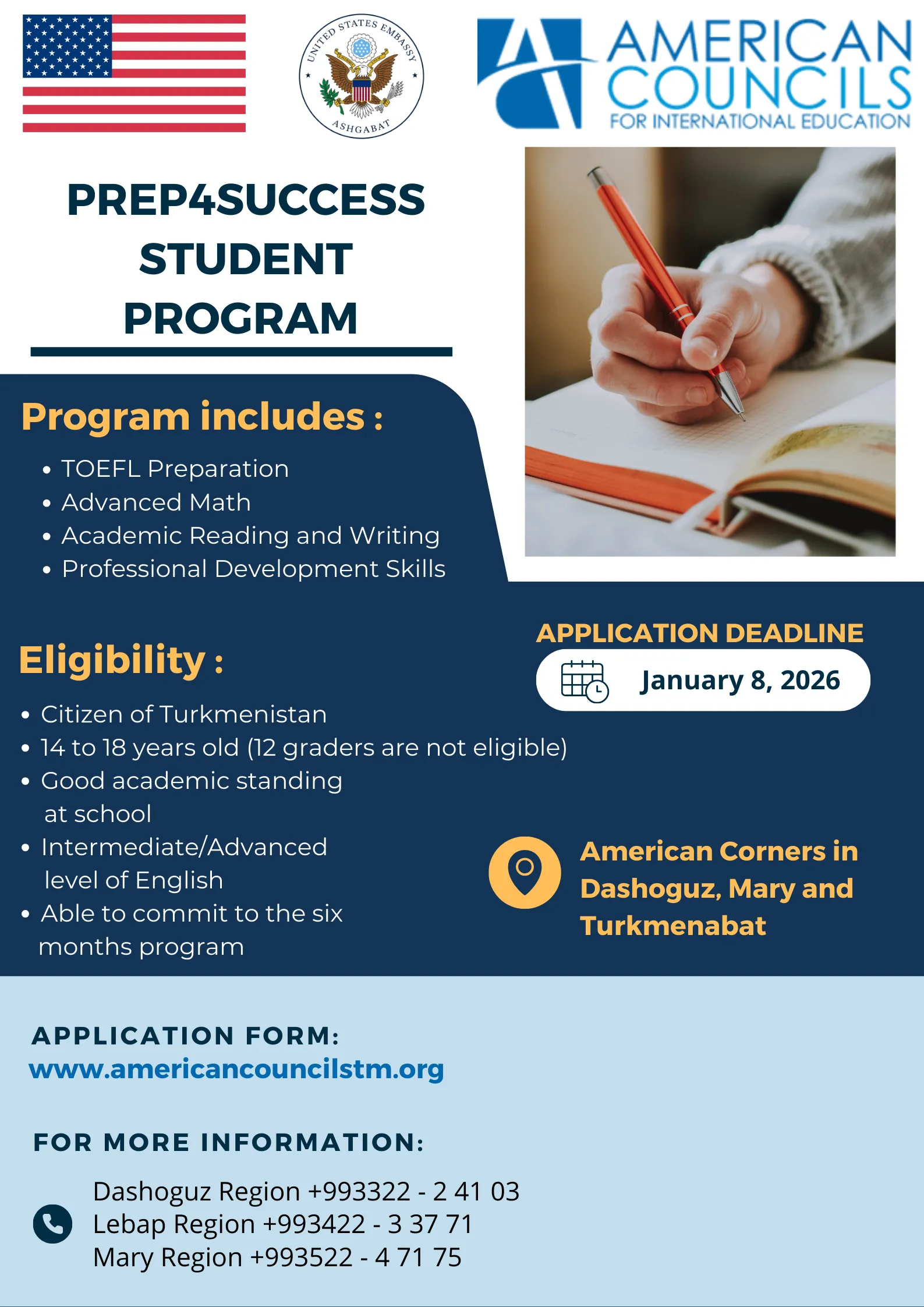
19 Dec. 07:28American Councils for International Education in Turkmenistan have launched the application process for the updated Prep4Success program, targeting students from the Dashoguz, Lebap, and Mary regions.
The program is open to Turkmen citizens aged 14 to 18. Students currently enrolled in the 12th grade are not eligible to apply for this program cycle.
The curriculum includes TOEFL preparation, academic reading and writing, advanced mathematics, and a range of career development and enrichment activities.
The six-month program will be held on Sundays at American Centers located in Dashoguz, Mary, and Turkmenabat.
Applications will be accepted until 5:00 PM on Thursday, January 8, 2026. Detailed information and the online application form are available on the American Councils website.
Also read

Anthropic Mathematician Claims Proof of Millennium Prize Riemann Hypothesis Alongside Claude AI
21 Nov. 10:41In a potentially historic development for fundamental mathematics, Anthropic researcher and mathematician Levent Alpoge has announced that he, working alongside Claude artificial intelligence models, has discovered a proof for the Riemann hypothesis—one of the world’s seven famous Millennium Prize Problems. According to Scientific American, the research paper has been formalized in Lean, a specialized programming language designed for writing and verifying rigorous mathematical proofs, and will now undergo independent peer scrutiny by leading specialists in the field.
Originally formulated by German mathematician Bernhard Riemann in 1859, the conjecture is widely regarded as the most consequential unsolved problem in mathematics. Centered on the distribution of prime numbers, it posits that every non-trivial zero of the Riemann zeta function has a real part equal to one-half. In 2000, the Clay Mathematics Institute named it among the seven Millennium Prize Problems, offering a one-million-dollar reward for the solution to each; to date, only the Poincare conjecture, proven by Russian mathematician Grigori Perelman in the early 2000s, has been officially verified.
Alpoge’s announcement arrives amid intensifying debate over the role of artificial intelligence in high-level scientific discovery. Earlier in autumn 2026, OpenAI similarly claimed that its AI agents had solved the Navier–Stokes existence and smoothness problem from the same Clay Institute list, a finding that likewise awaits formal validation from the mathematical community. Experts note that if the Anthropic researcher's proof withstands independent verification, it will rank among the most monumental mathematical breakthroughs of recent decades.
Also read
Blitz