
Playlist
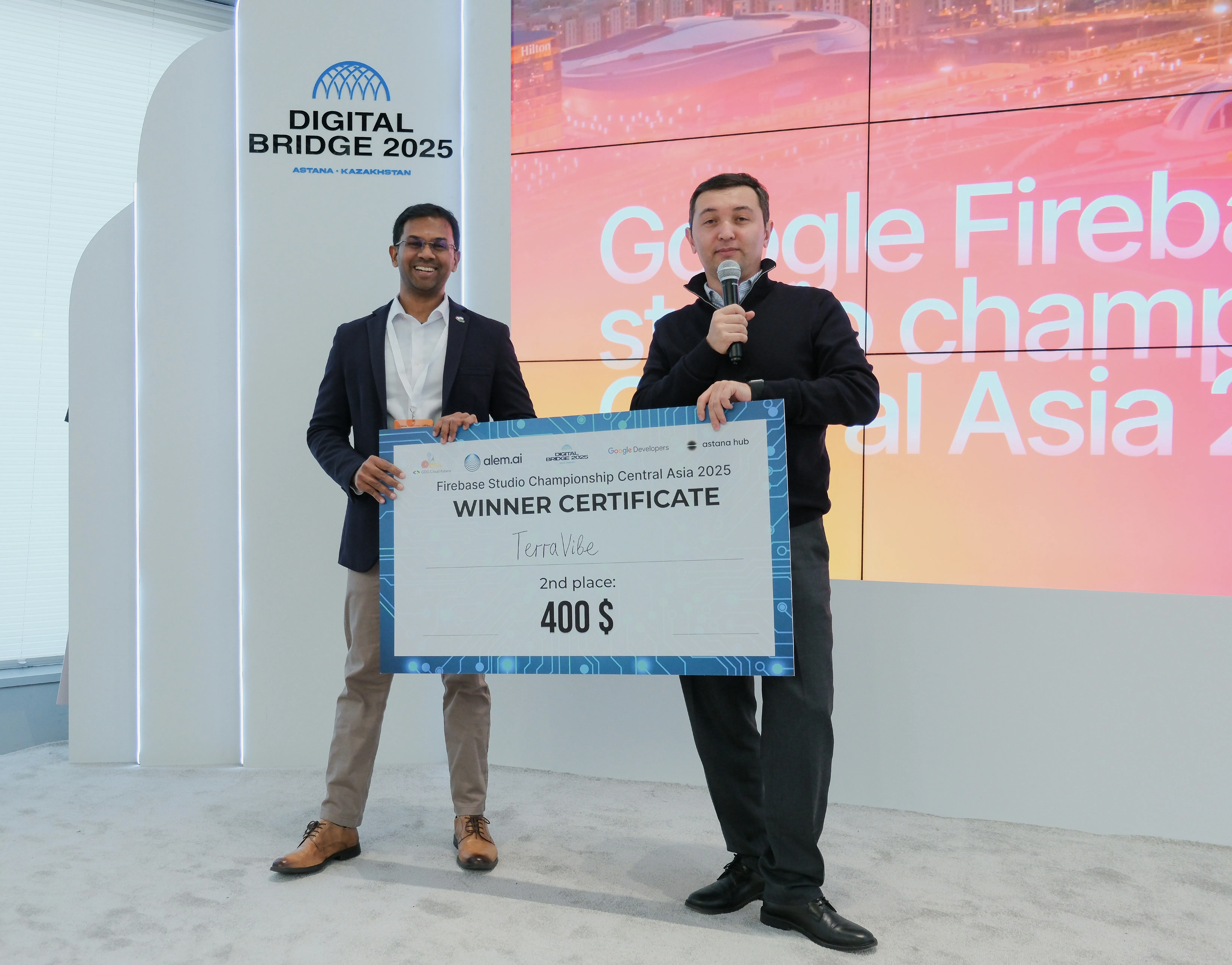
Turkmen schoolchildren won a prize in the Google competition.
16 Oct. 09:20Ashgabat schoolchildren Begench Annaorazov, Aykhan Bayramov, and Salykh Annanepesov took second place in the Firebase Studio Championship Central Asia 2025 competition.
All 12th-grade students from Specialized Secondary School No. 97.
The students presented a project called TerraVibe and placed among the top ten teams. In the finals, they took a respectable second place and were awarded special certificates of honor and cash prizes from Google.
To participate in the competition, the teams had to develop an innovative project using Firebase Studio and Gemini API technologies. Specifically, the task was to create a mobile app powered by artificial intelligence.
The TerraVibe app, developed by the participants from Turkmenistan, uses a camera to analyze the condition of a plant and, using AI, to identify damaged or defective areas from an image.
The students noted that they consulted with teachers from the computer department of the Kämil Bilim Erjeller educational center when developing the project.
Also read

Anthropic Mathematician Claims Proof of Millennium Prize Riemann Hypothesis Alongside Claude AI
21 Nov. 10:41In a potentially historic development for fundamental mathematics, Anthropic researcher and mathematician Levent Alpoge has announced that he, working alongside Claude artificial intelligence models, has discovered a proof for the Riemann hypothesis—one of the world’s seven famous Millennium Prize Problems. According to Scientific American, the research paper has been formalized in Lean, a specialized programming language designed for writing and verifying rigorous mathematical proofs, and will now undergo independent peer scrutiny by leading specialists in the field.
Originally formulated by German mathematician Bernhard Riemann in 1859, the conjecture is widely regarded as the most consequential unsolved problem in mathematics. Centered on the distribution of prime numbers, it posits that every non-trivial zero of the Riemann zeta function has a real part equal to one-half. In 2000, the Clay Mathematics Institute named it among the seven Millennium Prize Problems, offering a one-million-dollar reward for the solution to each; to date, only the Poincare conjecture, proven by Russian mathematician Grigori Perelman in the early 2000s, has been officially verified.
Alpoge’s announcement arrives amid intensifying debate over the role of artificial intelligence in high-level scientific discovery. Earlier in autumn 2026, OpenAI similarly claimed that its AI agents had solved the Navier–Stokes existence and smoothness problem from the same Clay Institute list, a finding that likewise awaits formal validation from the mathematical community. Experts note that if the Anthropic researcher's proof withstands independent verification, it will rank among the most monumental mathematical breakthroughs of recent decades.
Also read



Blitz