
Playlist
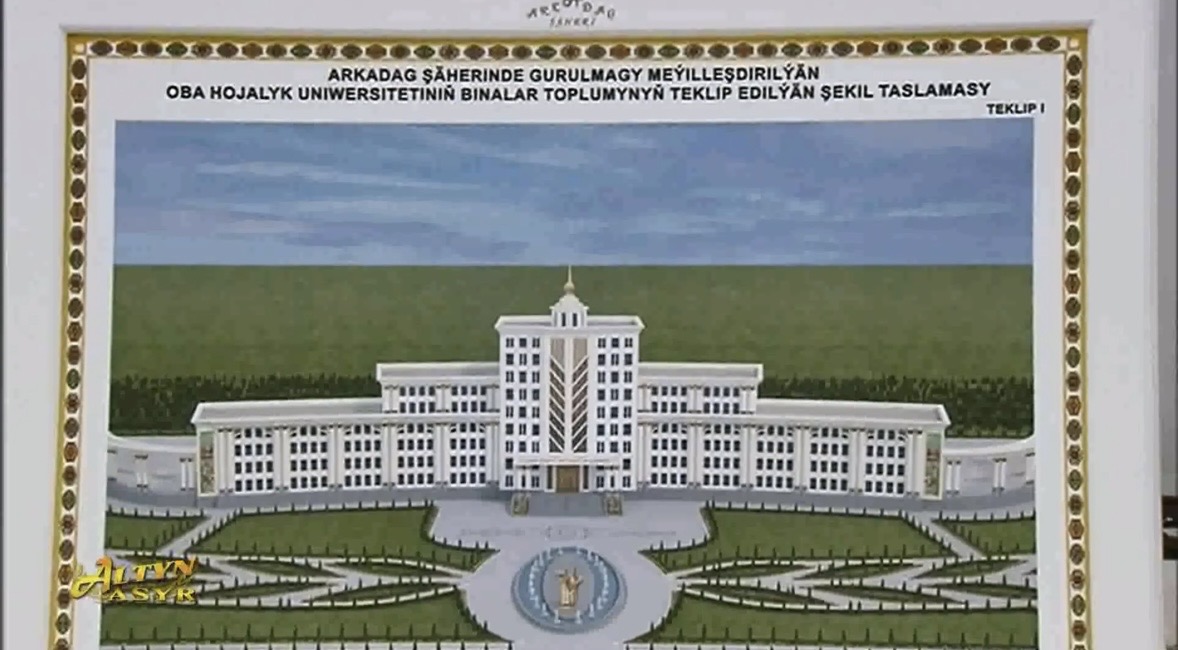
New Agricultural University Complex to be Constructed in Arkadag City
22 Apr. 03:57In a strategic move to further expand the urban and intellectual landscape of Arkadag City, the construction of a comprehensive building complex for the Agricultural University has been planned. This landmark project was announced by the National Leader of the Turkmen people during a recent operational meeting. The addition of a major higher education institution is expected to significantly enhance the city’s status as a premier center for science, technology, and social development.
Government authorities are currently conducting in-depth studies to finalize the logistical and architectural details of the university’s future campus. The project aims to integrate advanced academic infrastructure with practical research facilities, providing a platform for the next generation of agricultural experts. By establishing this institution within the borders of Arkadag City, the state seeks to foster a closer connection between modern urban planning and innovative agricultural sciences.
The university complex is envisioned as a catalyst for social growth, bringing thousands of students and faculty members into the city’s ecosystem. This influx of academic talent will bolster the cultural life of the region and support the development of high-tech farming techniques through academic research. The National Leader emphasized that the university will play a vital role in elevating the living standards and educational opportunities available to the residents of Arkadag and beyond.
Furthermore, the new Agricultural University complex will be designed to align with the "Smart City" standards that define Arkadag’s urban framework. This means incorporating eco-friendly building materials and digital management systems across the campus. The establishment of this educational hub reflects a forward-thinking approach to national development, ensuring that agricultural modernization remains a priority in the country’s socio-economic agenda.
Also read



Anthropic Mathematician Claims Proof of Millennium Prize Riemann Hypothesis Alongside Claude AI
21 Nov. 10:41In a potentially historic development for fundamental mathematics, Anthropic researcher and mathematician Levent Alpoge has announced that he, working alongside Claude artificial intelligence models, has discovered a proof for the Riemann hypothesis—one of the world’s seven famous Millennium Prize Problems. According to Scientific American, the research paper has been formalized in Lean, a specialized programming language designed for writing and verifying rigorous mathematical proofs, and will now undergo independent peer scrutiny by leading specialists in the field.
Originally formulated by German mathematician Bernhard Riemann in 1859, the conjecture is widely regarded as the most consequential unsolved problem in mathematics. Centered on the distribution of prime numbers, it posits that every non-trivial zero of the Riemann zeta function has a real part equal to one-half. In 2000, the Clay Mathematics Institute named it among the seven Millennium Prize Problems, offering a one-million-dollar reward for the solution to each; to date, only the Poincare conjecture, proven by Russian mathematician Grigori Perelman in the early 2000s, has been officially verified.
Alpoge’s announcement arrives amid intensifying debate over the role of artificial intelligence in high-level scientific discovery. Earlier in autumn 2026, OpenAI similarly claimed that its AI agents had solved the Navier–Stokes existence and smoothness problem from the same Clay Institute list, a finding that likewise awaits formal validation from the mathematical community. Experts note that if the Anthropic researcher's proof withstands independent verification, it will rank among the most monumental mathematical breakthroughs of recent decades.
Blitz