
Playlist
Turkmen Students Undertake Summer Industrial Internship in Romania
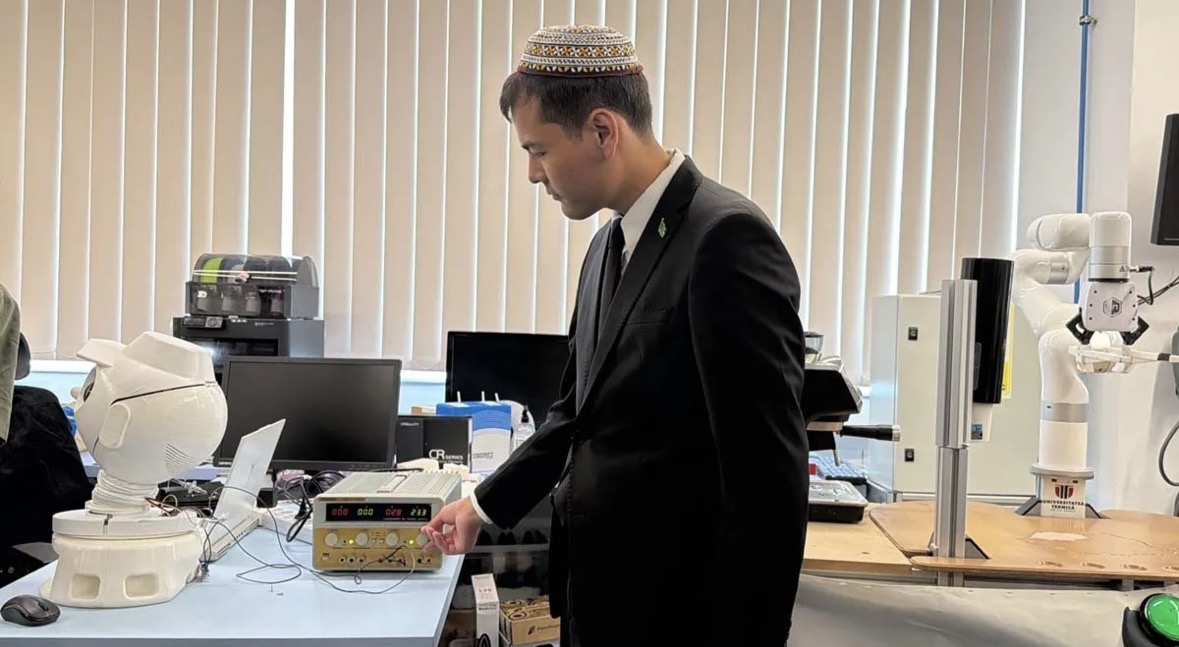
25 Jun. 03:10From June 21 to July 13, students from the Institute of Telecommunications and Informatics of Turkmenistan are participating in a summer industrial internship at the Technical University of Cluj-Napoka in Romania. As reported by the "Turkmenistan: Golden Age" news outlet, this exchange program is executed in strict compliance with the bilateral partnership agreement established between the two higher education institutions. The selected delegation comprises top-tier students chosen for their high academic standing, foreign language proficiency, and proprietary software development projects, accompanied by senior faculty members.
The Technical University of Cluj-Napoca, recognized for hosting one of the region's most sophisticated research infrastructures, has granted the Turkmen students access to dedicated laboratories equipped with cutting-edge server, network, and robotic technologies. The interns are actively engaged in studying intelligent data processing systems, comprehensive telecommunications network diagnostics, and software vulnerability testing. A premier highlight of this itinerary is the direct field placement and site access to operational facilities of global tech giants based in Romania, including Bosch, Emerson, and Tenaris. Alongside technical sessions, the Turkmen academic delegation is hosting structured presentations to brief the Romanian academic community on Turkmenistan's modern educational and economic progress.
Also read



Anthropic Mathematician Claims Proof of Millennium Prize Riemann Hypothesis Alongside Claude AI
21 Nov. 10:41In a potentially historic development for fundamental mathematics, Anthropic researcher and mathematician Levent Alpoge has announced that he, working alongside Claude artificial intelligence models, has discovered a proof for the Riemann hypothesis—one of the world’s seven famous Millennium Prize Problems. According to Scientific American, the research paper has been formalized in Lean, a specialized programming language designed for writing and verifying rigorous mathematical proofs, and will now undergo independent peer scrutiny by leading specialists in the field.
Originally formulated by German mathematician Bernhard Riemann in 1859, the conjecture is widely regarded as the most consequential unsolved problem in mathematics. Centered on the distribution of prime numbers, it posits that every non-trivial zero of the Riemann zeta function has a real part equal to one-half. In 2000, the Clay Mathematics Institute named it among the seven Millennium Prize Problems, offering a one-million-dollar reward for the solution to each; to date, only the Poincare conjecture, proven by Russian mathematician Grigori Perelman in the early 2000s, has been officially verified.
Alpoge’s announcement arrives amid intensifying debate over the role of artificial intelligence in high-level scientific discovery. Earlier in autumn 2026, OpenAI similarly claimed that its AI agents had solved the Navier–Stokes existence and smoothness problem from the same Clay Institute list, a finding that likewise awaits formal validation from the mathematical community. Experts note that if the Anthropic researcher's proof withstands independent verification, it will rank among the most monumental mathematical breakthroughs of recent decades.
Blitz