
Playlist
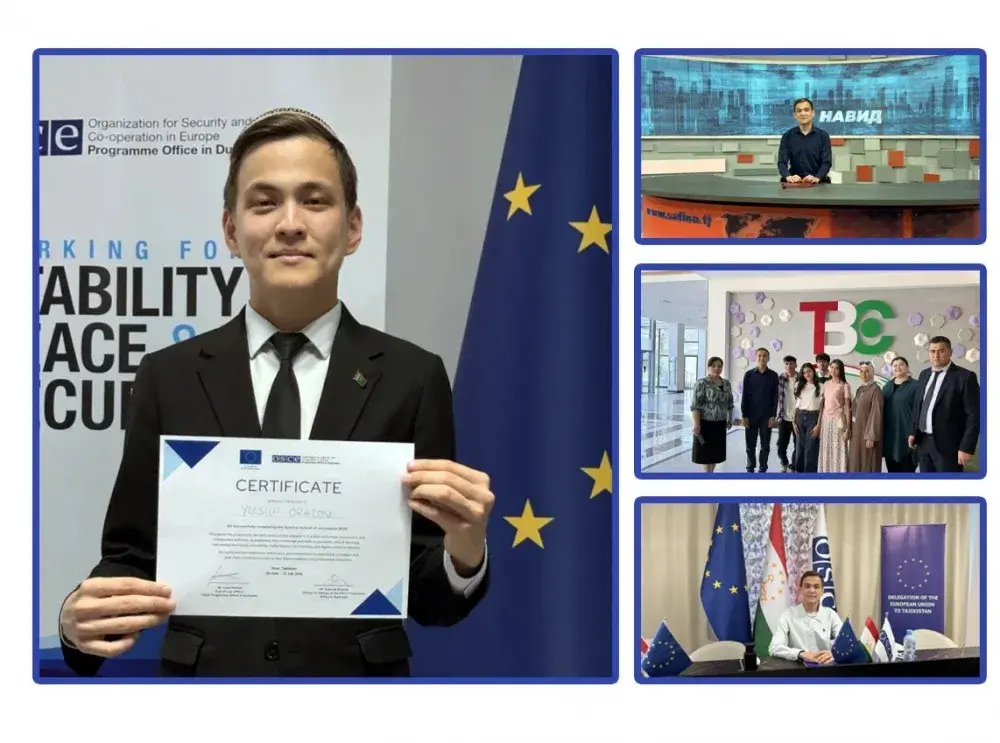
Turkmen Student Participates in OSCE Summer Journalism School in Dushanbe
14 Jul. 08:08Yusup Orazov, a first-year student of the International Journalism Faculty at the Institute of International Relations of the Ministry of Foreign Affairs of Turkmenistan, successfully participated in the Summer Journalism School hosted by the Organization for Security and Co-operation in Europe (OSCE) in Tajikistan. The international training program took place in Dushanbe from June 28 to July 12, organized by the OSCE Programme Office in Dushanbe with the financial and logistical support of the European Union Delegation to Tajikistan.
Designed for emerging media professionals and future journalists across Central Asia, the curriculum heavily emphasized modern mass media trends, professional ethical standards, media literacy advancement, and practical methodologies for countering disinformation and fake news. As part of the practical coursework, participants visited the "Safina" state television channel of Tajikistan to observe daily broadcasting and production workflows first-hand.
Upon completing the curriculum, Yusup Orazov was awarded an international certificate of success, highlighting the expanding opportunities for young Turkmen media professionals to acquire globally recognized skills and network with regional peers.
Also read

Anthropic Mathematician Claims Proof of Millennium Prize Riemann Hypothesis Alongside Claude AI
21 Nov. 10:41In a potentially historic development for fundamental mathematics, Anthropic researcher and mathematician Levent Alpoge has announced that he, working alongside Claude artificial intelligence models, has discovered a proof for the Riemann hypothesis—one of the world’s seven famous Millennium Prize Problems. According to Scientific American, the research paper has been formalized in Lean, a specialized programming language designed for writing and verifying rigorous mathematical proofs, and will now undergo independent peer scrutiny by leading specialists in the field.
Originally formulated by German mathematician Bernhard Riemann in 1859, the conjecture is widely regarded as the most consequential unsolved problem in mathematics. Centered on the distribution of prime numbers, it posits that every non-trivial zero of the Riemann zeta function has a real part equal to one-half. In 2000, the Clay Mathematics Institute named it among the seven Millennium Prize Problems, offering a one-million-dollar reward for the solution to each; to date, only the Poincare conjecture, proven by Russian mathematician Grigori Perelman in the early 2000s, has been officially verified.
Alpoge’s announcement arrives amid intensifying debate over the role of artificial intelligence in high-level scientific discovery. Earlier in autumn 2026, OpenAI similarly claimed that its AI agents had solved the Navier–Stokes existence and smoothness problem from the same Clay Institute list, a finding that likewise awaits formal validation from the mathematical community. Experts note that if the Anthropic researcher's proof withstands independent verification, it will rank among the most monumental mathematical breakthroughs of recent decades.
Blitz