
Playlist
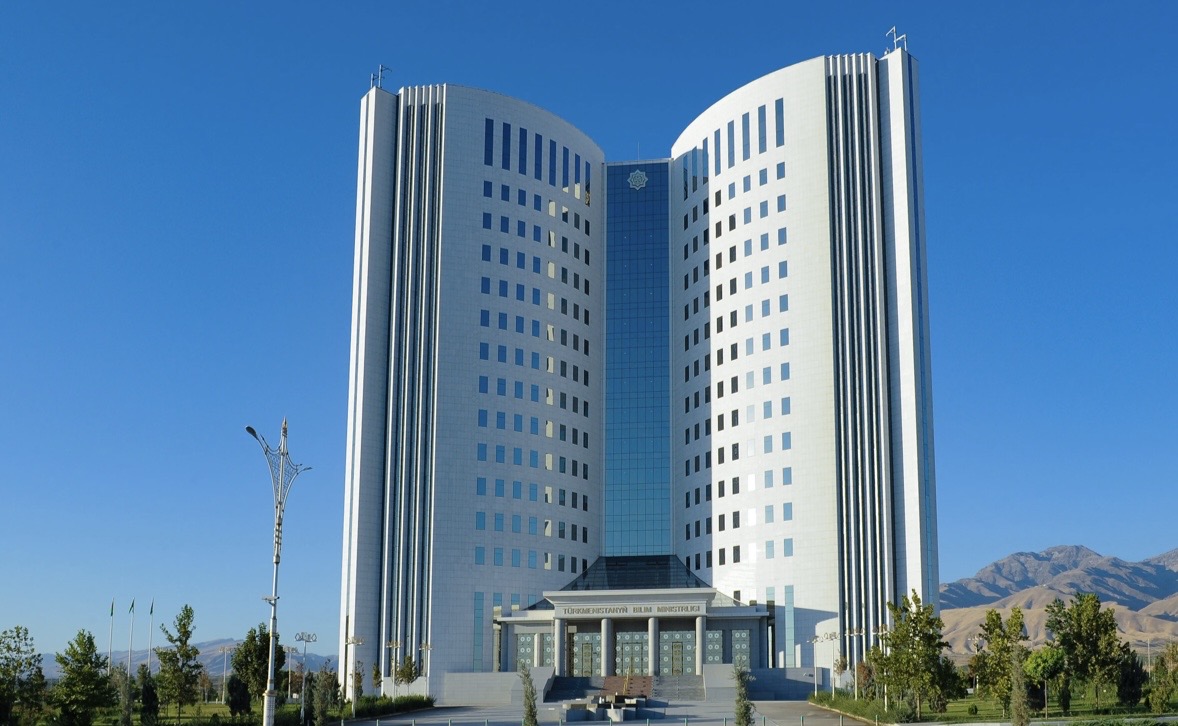
New Textbook "Russian Language for Professionals" Published for University Students in Turkmenistan
25 Mar. 05:35A new textbook titled "Russian Language for Professionals," authored by T. Babayeva, has been published for students of higher education institutions in Turkmenistan. The release of this manual aligns with the national strategy to enhance educational quality and equip future graduates with the necessary linguistic tools to excel in their specialized fields within a globalized environment.
According to the Ministry of Education of Turkmenistan, this new resource is specifically designed for students enrolled in non-linguistic degree programs. It is particularly recommended for those specializing in "International Economic Relations." The textbook is structured around a 136-hour curriculum, focusing on developing professional communication skills that are essential in today’s diverse workplace.
The textbook covers a broad range of practical skills, including professional business correspondence, document preparation, negotiation techniques, and the creation of effective presentations in Russian. By focusing on these functional areas, the manual ensures that students can confidently navigate professional interactions and represent their organizations with linguistic precision and cultural competence.
In addition to classroom instruction, the book includes various texts and assignments tailored for independent study. These resources are designed to help students master technical terminology and refine their analytical skills. The introduction of this modern textbook reflects Turkmenistan's ongoing efforts to provide high-level professional training and foster international dialogue through advanced language education.
Also read


Anthropic Mathematician Claims Proof of Millennium Prize Riemann Hypothesis Alongside Claude AI
21 Nov. 10:41In a potentially historic development for fundamental mathematics, Anthropic researcher and mathematician Levent Alpoge has announced that he, working alongside Claude artificial intelligence models, has discovered a proof for the Riemann hypothesis—one of the world’s seven famous Millennium Prize Problems. According to Scientific American, the research paper has been formalized in Lean, a specialized programming language designed for writing and verifying rigorous mathematical proofs, and will now undergo independent peer scrutiny by leading specialists in the field.
Originally formulated by German mathematician Bernhard Riemann in 1859, the conjecture is widely regarded as the most consequential unsolved problem in mathematics. Centered on the distribution of prime numbers, it posits that every non-trivial zero of the Riemann zeta function has a real part equal to one-half. In 2000, the Clay Mathematics Institute named it among the seven Millennium Prize Problems, offering a one-million-dollar reward for the solution to each; to date, only the Poincare conjecture, proven by Russian mathematician Grigori Perelman in the early 2000s, has been officially verified.
Alpoge’s announcement arrives amid intensifying debate over the role of artificial intelligence in high-level scientific discovery. Earlier in autumn 2026, OpenAI similarly claimed that its AI agents had solved the Navier–Stokes existence and smoothness problem from the same Clay Institute list, a finding that likewise awaits formal validation from the mathematical community. Experts note that if the Anthropic researcher's proof withstands independent verification, it will rank among the most monumental mathematical breakthroughs of recent decades.
Blitz