
Playlist
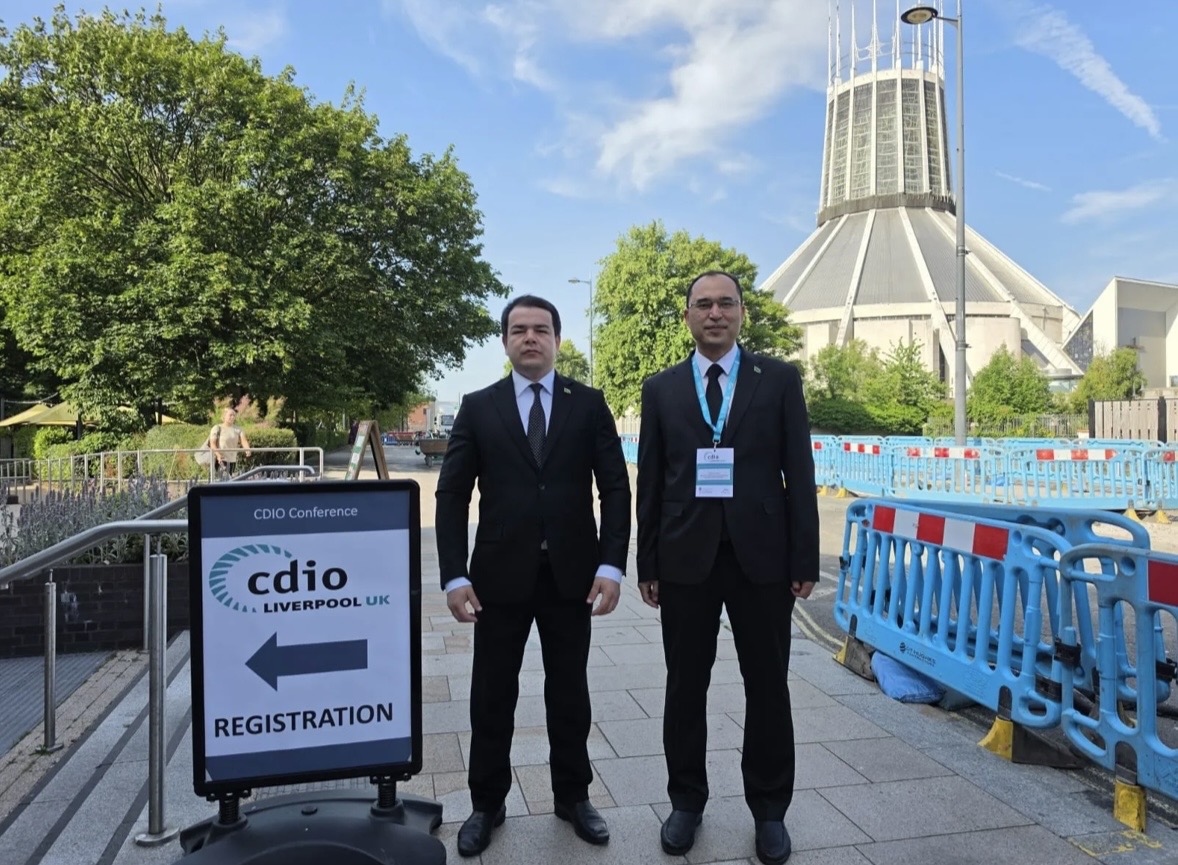
Turkmen Engineering University Delegates Attend CDIO 2026 International Conference in Liverpool
26 Jun. 11:56Representatives from the Oguz Han Engineering and Technology University of Turkmenistan participated in the 22nd CDio International Conference 2026, held from June 22 to 25 at the University of Liverpool, United Kingdom. According to the "Turkmenistan: Golden Age" news outlet, the state delegation included Yslam Orazov, Senior Lecturer at the Department of Cyber-Physical Systems, and Ahal Akgaev, Director of the university's Science and Technology Center. The CDIO (Conceive – Design – Implement – Operate) initiative is an advanced international educational framework designed to restructure university-level engineering training through proactive, project-based models. This year’s global summit gathered 157 delegates from 71 universities across 27 countries.
The primary theme of the conference focused on "Enhancing Student Professional Development: Innovations in Assessment and Feedback." Discussions centered on cultivating professional competencies within modern engineering education, implementing digital testing frameworks, and increasing classroom feedback efficiency. The Turkmen academic specialists presented key reports outlining their university's current scientific outputs, emphasizing research tracks in cyber-physical systems and advanced computing layouts. Additionally, the Turkmen delegation actively engaged in collaborative workshops and group sessions alongside other institutional members of the global CDIO academic network to exchange progressive pedagogical insights.
Also read




Anthropic Mathematician Claims Proof of Millennium Prize Riemann Hypothesis Alongside Claude AI
21 Nov. 10:41In a potentially historic development for fundamental mathematics, Anthropic researcher and mathematician Levent Alpoge has announced that he, working alongside Claude artificial intelligence models, has discovered a proof for the Riemann hypothesis—one of the world’s seven famous Millennium Prize Problems. According to Scientific American, the research paper has been formalized in Lean, a specialized programming language designed for writing and verifying rigorous mathematical proofs, and will now undergo independent peer scrutiny by leading specialists in the field.
Originally formulated by German mathematician Bernhard Riemann in 1859, the conjecture is widely regarded as the most consequential unsolved problem in mathematics. Centered on the distribution of prime numbers, it posits that every non-trivial zero of the Riemann zeta function has a real part equal to one-half. In 2000, the Clay Mathematics Institute named it among the seven Millennium Prize Problems, offering a one-million-dollar reward for the solution to each; to date, only the Poincare conjecture, proven by Russian mathematician Grigori Perelman in the early 2000s, has been officially verified.
Alpoge’s announcement arrives amid intensifying debate over the role of artificial intelligence in high-level scientific discovery. Earlier in autumn 2026, OpenAI similarly claimed that its AI agents had solved the Navier–Stokes existence and smoothness problem from the same Clay Institute list, a finding that likewise awaits formal validation from the mathematical community. Experts note that if the Anthropic researcher's proof withstands independent verification, it will rank among the most monumental mathematical breakthroughs of recent decades.
Blitz