
Playlist
Intelligence College in Europe Seeks to Enhance Educational Cooperation with Turkmenistan
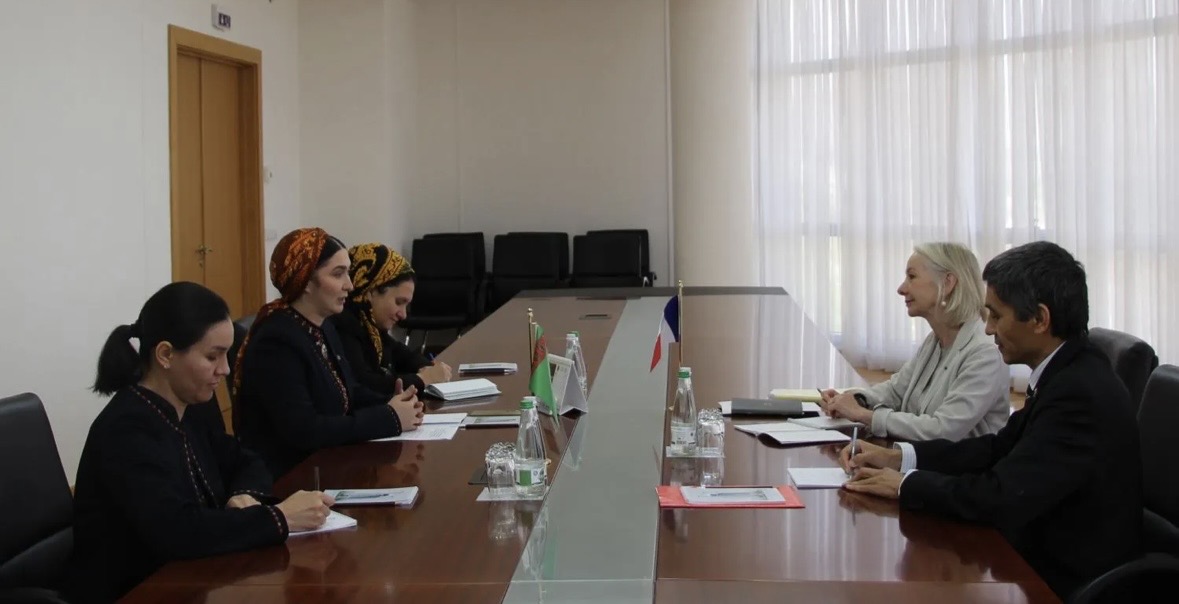
14 May. 09:17The Deputy Minister of Foreign Affairs of Turkmenistan, Mahri Bashimova, held a meeting with Yasmin Guedar, the Director of the Secretariat of the Intelligence College in Europe. During the talks, the sides evaluated the current state of dialogue between European and Central Asian countries, with a specific focus on Turkmenistan’s role. The meeting aimed to foster a stronger partnership in the fields of professional training and academic exchange between European institutions and Turkmen educational centers.
Ms. Guedar presented various projects designed to strengthen humanitarian ties and professional development within the region. The College expressed a strong interest in conducting training courses and specialized seminars for Turkmen students and officials from relevant departments. The proposed curriculum includes critical subjects such as preventive diplomacy, polemology (the study of conflict), and advanced political analysis, all of which are essential for navigating contemporary international relations.
The officials also exchanged views on key issues of the regional and international agenda. The discussion highlighted the significance of Turkmenistan's peaceful foreign policy and its commitment to the principles of permanent neutrality. The European side commended Turkmenistan’s dedication to values such as good-neighborliness and mutual respect, which serve as a solid foundation for building long-term, trust-based international partnerships.
As part of her visit to Ashgabat, Ms. Guedar participated in an international scientific-practical conference focused on neutrality and international law held at the International University for the Humanities and Development. Furthermore, she delivered a lecture for students majoring in international relations, providing them with insights into modern analytical methodologies. This engagement marks a significant step in integrating global educational standards into Turkmenistan’s academic framework, benefiting the next generation of diplomats.
Also read

Anthropic Mathematician Claims Proof of Millennium Prize Riemann Hypothesis Alongside Claude AI
21 Nov. 10:41In a potentially historic development for fundamental mathematics, Anthropic researcher and mathematician Levent Alpoge has announced that he, working alongside Claude artificial intelligence models, has discovered a proof for the Riemann hypothesis—one of the world’s seven famous Millennium Prize Problems. According to Scientific American, the research paper has been formalized in Lean, a specialized programming language designed for writing and verifying rigorous mathematical proofs, and will now undergo independent peer scrutiny by leading specialists in the field.
Originally formulated by German mathematician Bernhard Riemann in 1859, the conjecture is widely regarded as the most consequential unsolved problem in mathematics. Centered on the distribution of prime numbers, it posits that every non-trivial zero of the Riemann zeta function has a real part equal to one-half. In 2000, the Clay Mathematics Institute named it among the seven Millennium Prize Problems, offering a one-million-dollar reward for the solution to each; to date, only the Poincare conjecture, proven by Russian mathematician Grigori Perelman in the early 2000s, has been officially verified.
Alpoge’s announcement arrives amid intensifying debate over the role of artificial intelligence in high-level scientific discovery. Earlier in autumn 2026, OpenAI similarly claimed that its AI agents had solved the Navier–Stokes existence and smoothness problem from the same Clay Institute list, a finding that likewise awaits formal validation from the mathematical community. Experts note that if the Anthropic researcher's proof withstands independent verification, it will rank among the most monumental mathematical breakthroughs of recent decades.
Blitz