
Playlist
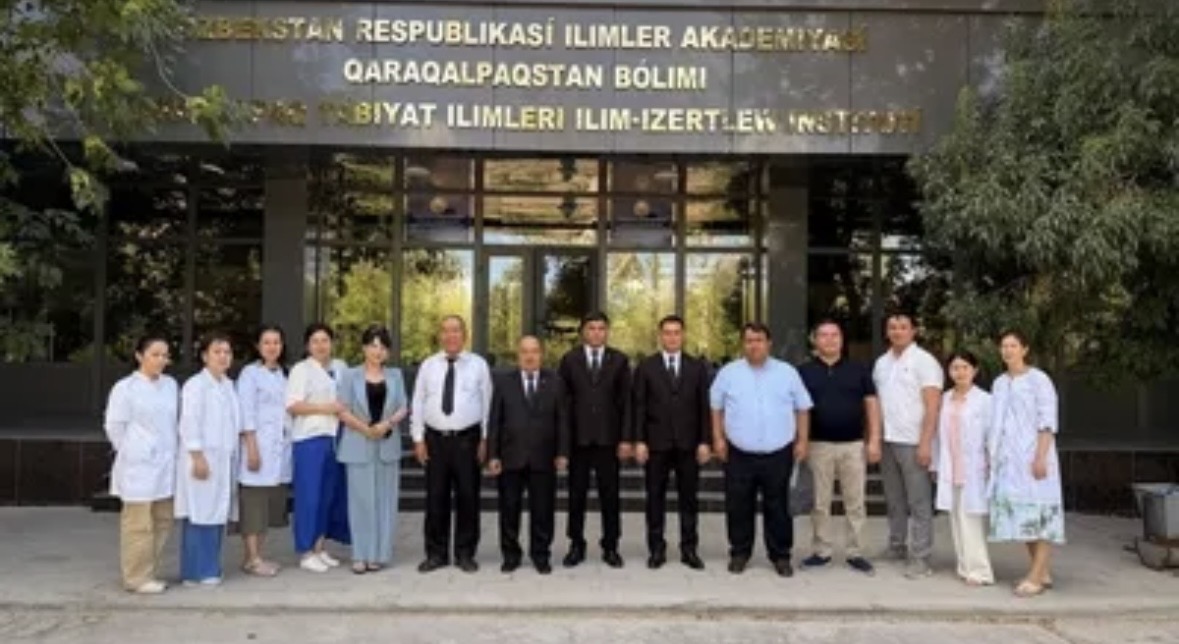
Turkmen Academic Delegation Conducts Environmental and Green Energy Study Tour in Uzbekistan
12 Jun. 14:52A specialized delegation from Turkmenistan is currently participating in an institutional knowledge-sharing mission across Tashkent and the Republic of Karakalpakstan. The initiative is executed under the auspices of the European Union-funded climate action program (2024–2029) and implemented via the German Agency for International Cooperation (GIZ). The primary objective of the mission is to analyze regional water management strategies, alternative energy deployment, and sustainable ecological frameworks within Central Asia.
The visiting assembly includes senior researchers from the Renewable Energy Sources Scientific and Production Center based at the State Energy Institute of Turkmenistan. Initial collaborative sessions were hosted in Nukus, where the Turkmen delegates engaged with counterparts from the Research Institute of Irrigation and Water Problems. The multilateral dialogue focused specifically on stabilizing sub-regional eco-systems, resource conservation, and cross-border environmental risk mitigation.
The technical itinerary features on-site evaluations of operational green infrastructure designed to enhance agricultural climate resilience. Field studies encompass solar-powered irrigation pumping arrays, biological filtration systems for drainage water purification, and specialized laboratory infrastructure for cultivating microalgae used in biofuel manufacturing. These assessments target the minimization of carbon footprints within localized agrarian frameworks.
The advanced phase of the tour includes scientific workshops in Tashkent and field inspections of high-intensity agricultural projects in the Sirdaryo Region. Technical training will focus on modern soil salinity rapid-assessment methods and the operational deployment of Agro-photovoltaic systems that merge solar power generation with commercial fruit cultivation. The insights gained are intended to inform ongoing sustainable development policies within Turkmenistan's domestic utility and agricultural sectors.
Also read




Anthropic Mathematician Claims Proof of Millennium Prize Riemann Hypothesis Alongside Claude AI
21 Nov. 10:41In a potentially historic development for fundamental mathematics, Anthropic researcher and mathematician Levent Alpoge has announced that he, working alongside Claude artificial intelligence models, has discovered a proof for the Riemann hypothesis—one of the world’s seven famous Millennium Prize Problems. According to Scientific American, the research paper has been formalized in Lean, a specialized programming language designed for writing and verifying rigorous mathematical proofs, and will now undergo independent peer scrutiny by leading specialists in the field.
Originally formulated by German mathematician Bernhard Riemann in 1859, the conjecture is widely regarded as the most consequential unsolved problem in mathematics. Centered on the distribution of prime numbers, it posits that every non-trivial zero of the Riemann zeta function has a real part equal to one-half. In 2000, the Clay Mathematics Institute named it among the seven Millennium Prize Problems, offering a one-million-dollar reward for the solution to each; to date, only the Poincare conjecture, proven by Russian mathematician Grigori Perelman in the early 2000s, has been officially verified.
Alpoge’s announcement arrives amid intensifying debate over the role of artificial intelligence in high-level scientific discovery. Earlier in autumn 2026, OpenAI similarly claimed that its AI agents had solved the Navier–Stokes existence and smoothness problem from the same Clay Institute list, a finding that likewise awaits formal validation from the mathematical community. Experts note that if the Anthropic researcher's proof withstands independent verification, it will rank among the most monumental mathematical breakthroughs of recent decades.
Blitz