
Playlist
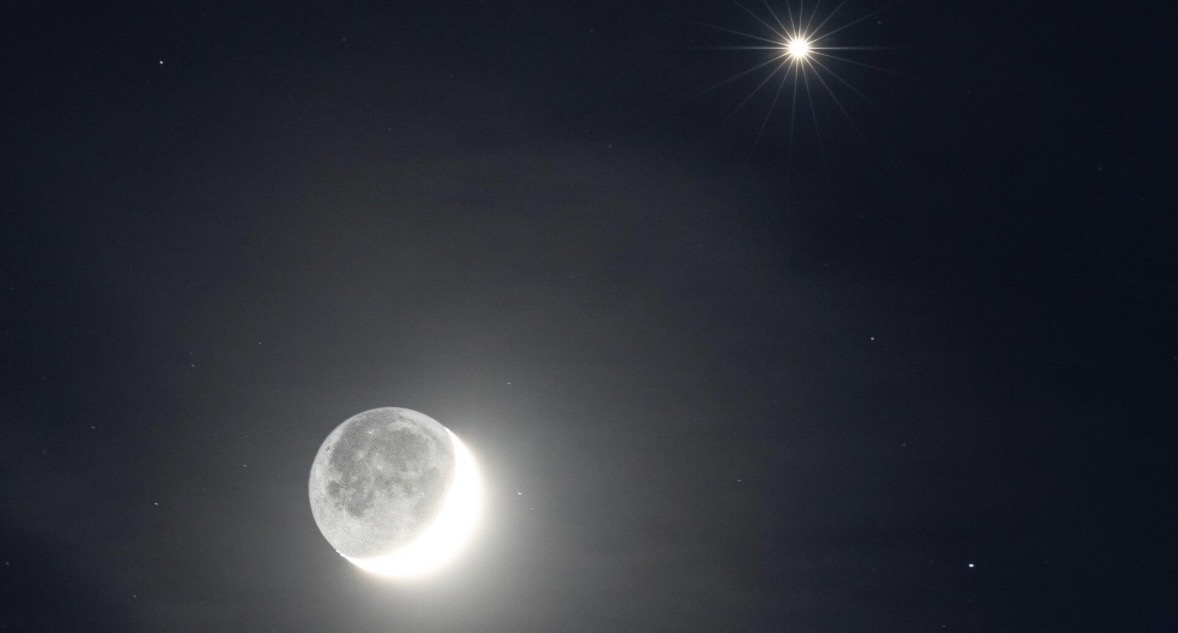
Stargazers are in for a celestial treat on May 18 as the Moon and Venus prepare for a stunning visual conjunction in the evening sky. Shortly after sunset, a slender waxing crescent Moon will appear alongside the brilliant radiance of Venus, creating one of the most picturesque astronomical scenes of the year. This phenomenon, easily visible from western horizons, offers a striking display of celestial mechanics in motion.
According to astronomical reports, the encounter will take place within the boundaries of the constellation Taurus. Venus, often referred to as the "Evening Star," will be exceptionally bright, making it identifiable without the aid of professional equipment. While the Moon and Venus will appear to be close companions, this is purely a line-of-sight effect; in reality, they remain separated by vast interplanetary distances, aligned only by their specific orbits relative to Earth.
Enhancing the spectacle, the gas giant Jupiter will also be visible, situated slightly above Venus to complete a remarkable trio of celestial bodies. This alignment creates a compelling composition for observers, who can witness three of the brightest objects in the solar system gathered in a small patch of the sky. While the event is visible to the naked eye, a pair of binoculars will offer a much clearer view of the lunar craters and the distinct glow of the planets.
The celestial display will evolve on the following evening, May 19, as the Moon continues its orbital journey. By the second night, the lunar crescent will have climbed higher, positioning itself almost directly between Venus and Jupiter. This shift provides a unique opportunity for residents to observe the rapid movement of the Moon and appreciate the dynamic nature of our planetary neighborhood.
Also read




On-the-Go Power: Japanese Engineers Develop Wireless In-Road Charging for Electric Vehicles
10 Oct. 08:10In a major leap for electric mobility, Honda R&D, alongside Taisei Corporation and Taisei Rotec, has unveiled an innovative dynamic wireless charging system that charges electric vehicles as they drive. By embedding compact energy-transmitting modules directly into the road surface, the system transfers power via a magnetic field to receivers mounted underneath moving vehicles. Designed to withstand heavy commercial transport up to 20 tons, real-world road testing is scheduled to begin in Japan in April 2027.
The technology eliminates the need for full road reconstruction, as modules can be integrated directly into milled asphalt layers. Aimed at boosting charging power up to 150 kW in future iterations, this infrastructure solution promise to significantly reduce grid pressure on traditional charging stations, particularly for logistics and commercial fleets.
Blitz