
Playlist
OSCE Forum in Ashgabat Equips Turkmen Youth with Climate Diplomacy Skills
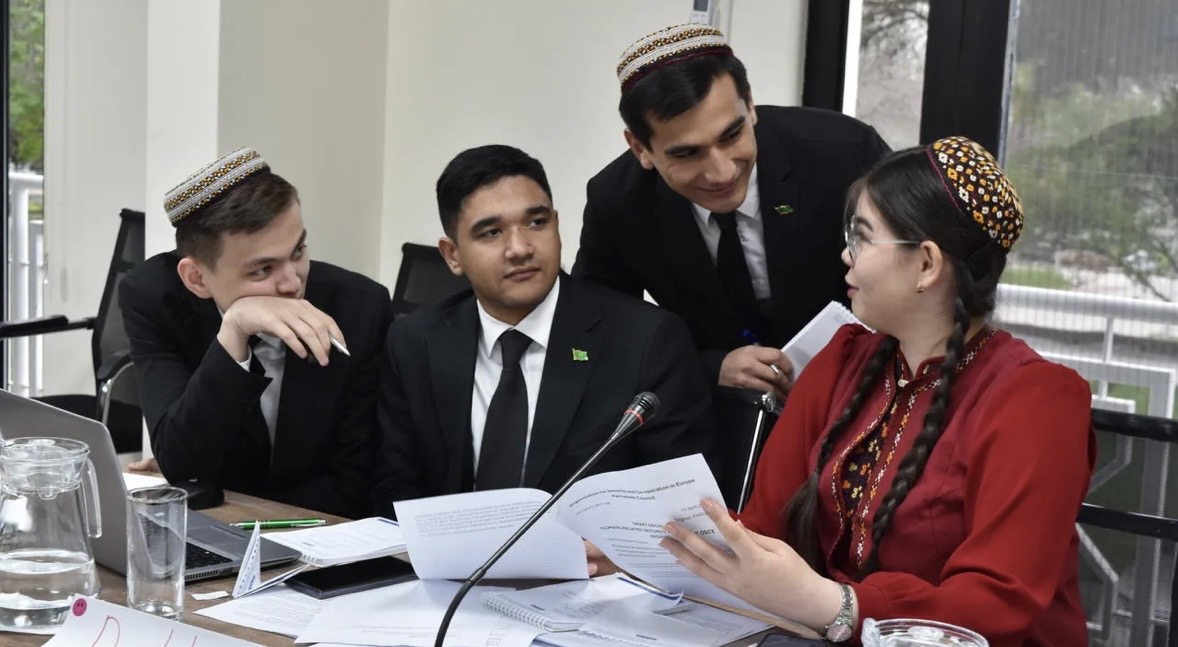
15 Apr. 13:27The OSCE Centre in Ashgabat recently concluded a two-day "Model OSCE" educational exercise, specifically designed to address the intersection of climate change and regional security. Nearly 25 students from Turkmenistan’s elite universities participated in the program, where they engaged in simulating consensus-based diplomacy. The initiative focused on preparing young specialists to navigate the complex geopolitical challenges emerging from environmental degradation.
The event gathered representatives from prestigious institutions, such as the Institute of International Relations of the Ministry of Foreign Affairs and the International University for the Humanities and Development. Participants examined the multidimensional impact of climate threats on economic resilience and human security. By focusing on practical scenarios, the forum allowed students to explore how ecological risks can influence political stability across the region.
The methodology combined virtual sessions led by international experts with interactive debates moderated by national specialists. Students applied OSCE conflict-prevention tools to resolve simulated disputes and strengthen interstate cooperation. This hands-on approach provided future diplomats with a deep understanding of how environmental factors are now integral to the global security architecture.
William Leaf, Head of the OSCE Centre in Ashgabat, highlighted the organization’s commitment to empowering the youth as primary drivers of regional progress. He noted that since climate change affects all dimensions of security, it is essential to cultivate a new generation of leaders capable of high-level negotiations and strategic consensus-building. The event marked a significant milestone in fostering sustainability and leadership within Turkmenistan’s academic community.
Also read


Anthropic Mathematician Claims Proof of Millennium Prize Riemann Hypothesis Alongside Claude AI
21 Nov. 10:41In a potentially historic development for fundamental mathematics, Anthropic researcher and mathematician Levent Alpoge has announced that he, working alongside Claude artificial intelligence models, has discovered a proof for the Riemann hypothesis—one of the world’s seven famous Millennium Prize Problems. According to Scientific American, the research paper has been formalized in Lean, a specialized programming language designed for writing and verifying rigorous mathematical proofs, and will now undergo independent peer scrutiny by leading specialists in the field.
Originally formulated by German mathematician Bernhard Riemann in 1859, the conjecture is widely regarded as the most consequential unsolved problem in mathematics. Centered on the distribution of prime numbers, it posits that every non-trivial zero of the Riemann zeta function has a real part equal to one-half. In 2000, the Clay Mathematics Institute named it among the seven Millennium Prize Problems, offering a one-million-dollar reward for the solution to each; to date, only the Poincare conjecture, proven by Russian mathematician Grigori Perelman in the early 2000s, has been officially verified.
Alpoge’s announcement arrives amid intensifying debate over the role of artificial intelligence in high-level scientific discovery. Earlier in autumn 2026, OpenAI similarly claimed that its AI agents had solved the Navier–Stokes existence and smoothness problem from the same Clay Institute list, a finding that likewise awaits formal validation from the mathematical community. Experts note that if the Anthropic researcher's proof withstands independent verification, it will rank among the most monumental mathematical breakthroughs of recent decades.
Blitz