
Playlist
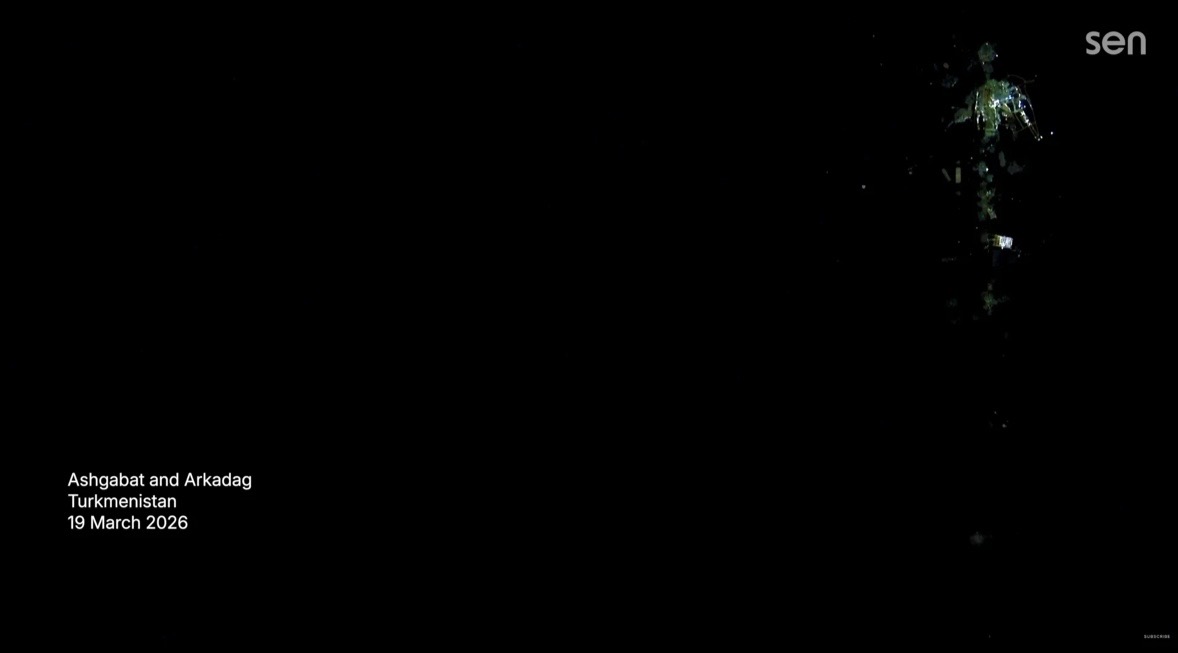
The American space-streaming company Sen has released stunning 4K imagery of Turkmenistan, showcasing the capital city of Ashgabat and the nation’s first smart city, Arkadag. Captured from the International Space Station (ISS) using the company’s proprietary ultra-high-definition cameras, the visuals provide a rare and detailed look at these urban centers from an orbital perspective. The footage highlights the distinct architectural characteristics and rapid development of the region.
The released frames offer a bird's-eye view of the white-marble skyline of Ashgabat and the advanced urban layout of Arkadag. These images illustrate how modern infrastructure and traditional design elements merge within the unique Central Asian landscape. From the vantage point of space, the scale of Turkmenistan’s urban planning projects becomes clearly visible, emphasizing the integration of technology and monumental architecture in its primary cities.
Sen is pioneering the world’s first 24-hour live 4K video stream from space, utilizing NASA’s data transmission infrastructure to relay signals back to Earth. The company’s mission is to democratize space exploration by providing a continuous and immersive view of our planet’s surface. This technological achievement allows for real-time observation of Earth’s dynamic environment and human achievements from a completely different angle than traditional satellite photography.
The inclusion of Ashgabat and Arkadag in these high-resolution broadcasts serves as a testament to the international visibility of Turkmenistan’s infrastructure milestones. Beyond their visual appeal, these orbital recordings offer valuable insights into urban growth patterns and regional geography, marking a new era in how the world perceives the development of modern cities through the lens of space technology.
Also read




On-the-Go Power: Japanese Engineers Develop Wireless In-Road Charging for Electric Vehicles
10 Oct. 08:10In a major leap for electric mobility, Honda R&D, alongside Taisei Corporation and Taisei Rotec, has unveiled an innovative dynamic wireless charging system that charges electric vehicles as they drive. By embedding compact energy-transmitting modules directly into the road surface, the system transfers power via a magnetic field to receivers mounted underneath moving vehicles. Designed to withstand heavy commercial transport up to 20 tons, real-world road testing is scheduled to begin in Japan in April 2027.
The technology eliminates the need for full road reconstruction, as modules can be integrated directly into milled asphalt layers. Aimed at boosting charging power up to 150 kW in future iterations, this infrastructure solution promise to significantly reduce grid pressure on traditional charging stations, particularly for logistics and commercial fleets.
Blitz