
Playlist
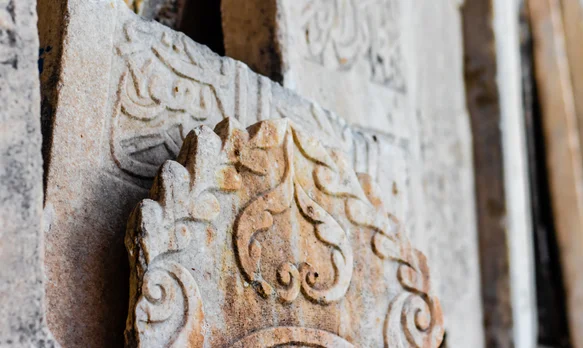
12,000-Year-Old Ritual Statue Unearthed at Ancient Göbekli Tepe Site in Turkey
23 Sep. 08:07Archaeologists have discovered a rare human statue estimated to be 12,000 years old at the prehistoric site of Göbekli Tepe, located in southeastern Turkey.
Turkish Minister of Culture and Tourism, Mehmet Nuri Ersoy, announced the find, highlighting its potential to reveal deeper insights into the spiritual life and ceremonial practices of Neolithic societies. The statue was found embedded horizontally into the wall of an ancient structure — likely as part of a ritual offering.
The artifact was uncovered during restoration work between structures labeled B and D. The statue's head and torso are intact, but its feet are missing. Experts suggest this could be the result of intentional modification or natural degradation over millennia, according to Anadolu Agency.
Göbekli Tepe predates Stonehenge by 6,000 years and is 7,000 years older than the Egyptian pyramids. Researchers estimate it was constructed between 9600 and 8200 BCE.
Since 2018, the site has been listed as a UNESCO World Heritage Site. It features circular enclosures with massive T-shaped pillars standing up to 6 meters tall and weighing up to 10 tons. These megaliths are adorned with intricate carvings of animals and abstract symbols. Recent findings suggest that early human communities may have possessed advanced astronomical and architectural knowledge.
Also read




Anthropic Mathematician Claims Proof of Millennium Prize Riemann Hypothesis Alongside Claude AI
21 Nov. 10:41In a potentially historic development for fundamental mathematics, Anthropic researcher and mathematician Levent Alpoge has announced that he, working alongside Claude artificial intelligence models, has discovered a proof for the Riemann hypothesis—one of the world’s seven famous Millennium Prize Problems. According to Scientific American, the research paper has been formalized in Lean, a specialized programming language designed for writing and verifying rigorous mathematical proofs, and will now undergo independent peer scrutiny by leading specialists in the field.
Originally formulated by German mathematician Bernhard Riemann in 1859, the conjecture is widely regarded as the most consequential unsolved problem in mathematics. Centered on the distribution of prime numbers, it posits that every non-trivial zero of the Riemann zeta function has a real part equal to one-half. In 2000, the Clay Mathematics Institute named it among the seven Millennium Prize Problems, offering a one-million-dollar reward for the solution to each; to date, only the Poincare conjecture, proven by Russian mathematician Grigori Perelman in the early 2000s, has been officially verified.
Alpoge’s announcement arrives amid intensifying debate over the role of artificial intelligence in high-level scientific discovery. Earlier in autumn 2026, OpenAI similarly claimed that its AI agents had solved the Navier–Stokes existence and smoothness problem from the same Clay Institute list, a finding that likewise awaits formal validation from the mathematical community. Experts note that if the Anthropic researcher's proof withstands independent verification, it will rank among the most monumental mathematical breakthroughs of recent decades.
Also read



Blitz