
Playlist
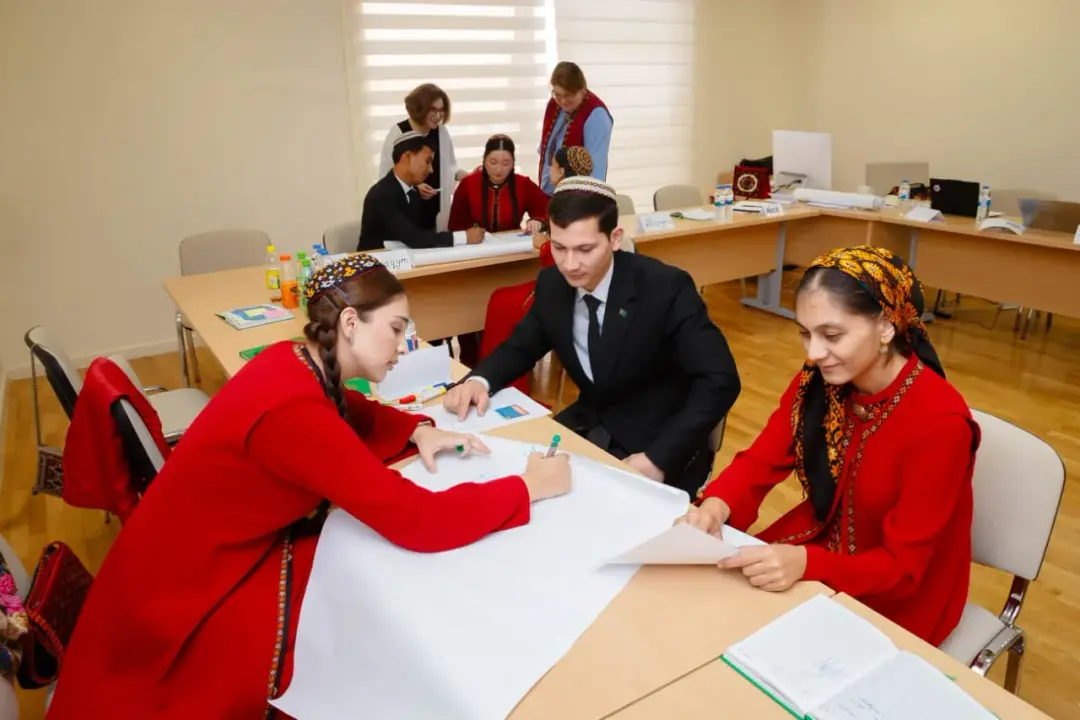
Turkmenistan Enhances Social Work Bachelor’s Program in Partnership with UNICEF
20 Oct. 17:08Turkmenistan is comprehensively revising its Bachelor’s degree curriculum in Social Work to align higher education with national workforce needs, international standards, and ongoing social service reforms. Supported by technical assistance from UNICEF, the degree program was initially introduced in 2023 at Magtymguly Turkmen State University in Ashgabat and the Seyitnazar Seydi Turkmen State Pedagogical Institute in Turkmenabat. Since its launch, 125 students have enrolled, with the inaugural cohort of 35 students set to graduate during the 2026–2027 academic year. To support this transition, UNICEF international expert Dr. Salome Namitcheishvili conducted academic consultations and specialized lectures across both institutions.
The curriculum enhancement emphasizes practical training as a primary pillar of professional development. Faculty members from both higher education institutions discussed expanding partnerships with local social service providers, establishing structured field practicums, and conducting practical skills workshops. The UNICEF expert introduced an innovative evaluation tool—the Practical Training Portfolio—to systematically assess students' emerging field competencies. Additionally, field visits to social service institutions in Turkmenabat allowed faculty and students to integrate theoretical knowledge with real-world professional practice.
During the joint working sessions, course modules were developed for fourth-year students covering specialized topics such as child protection, family support services, and community-level social work practice. Graduating students received targeted guidance on thesis preparation, internship completion, and final examinations, while first-year students were introduced to foundational principles of social work. UNICEF reaffirmed its commitment to supporting national partners in cultivating a highly qualified cadre of social work professionals capable of delivering quality services to children and families across Turkmenistan.
Also read


Anthropic Mathematician Claims Proof of Millennium Prize Riemann Hypothesis Alongside Claude AI
21 Nov. 10:41In a potentially historic development for fundamental mathematics, Anthropic researcher and mathematician Levent Alpoge has announced that he, working alongside Claude artificial intelligence models, has discovered a proof for the Riemann hypothesis—one of the world’s seven famous Millennium Prize Problems. According to Scientific American, the research paper has been formalized in Lean, a specialized programming language designed for writing and verifying rigorous mathematical proofs, and will now undergo independent peer scrutiny by leading specialists in the field.
Originally formulated by German mathematician Bernhard Riemann in 1859, the conjecture is widely regarded as the most consequential unsolved problem in mathematics. Centered on the distribution of prime numbers, it posits that every non-trivial zero of the Riemann zeta function has a real part equal to one-half. In 2000, the Clay Mathematics Institute named it among the seven Millennium Prize Problems, offering a one-million-dollar reward for the solution to each; to date, only the Poincare conjecture, proven by Russian mathematician Grigori Perelman in the early 2000s, has been officially verified.
Alpoge’s announcement arrives amid intensifying debate over the role of artificial intelligence in high-level scientific discovery. Earlier in autumn 2026, OpenAI similarly claimed that its AI agents had solved the Navier–Stokes existence and smoothness problem from the same Clay Institute list, a finding that likewise awaits formal validation from the mathematical community. Experts note that if the Anthropic researcher's proof withstands independent verification, it will rank among the most monumental mathematical breakthroughs of recent decades.
Blitz