
Playlist

Turkmenistan Develops Educational Programs on AI and Blockchain Technologies
26 Aug. 07:18Several higher education institutions in Turkmenistan are creating specialized curricula focused on artificial intelligence, information technologies, and blockchain. This was reported by the newspaper "Turkmenistan."
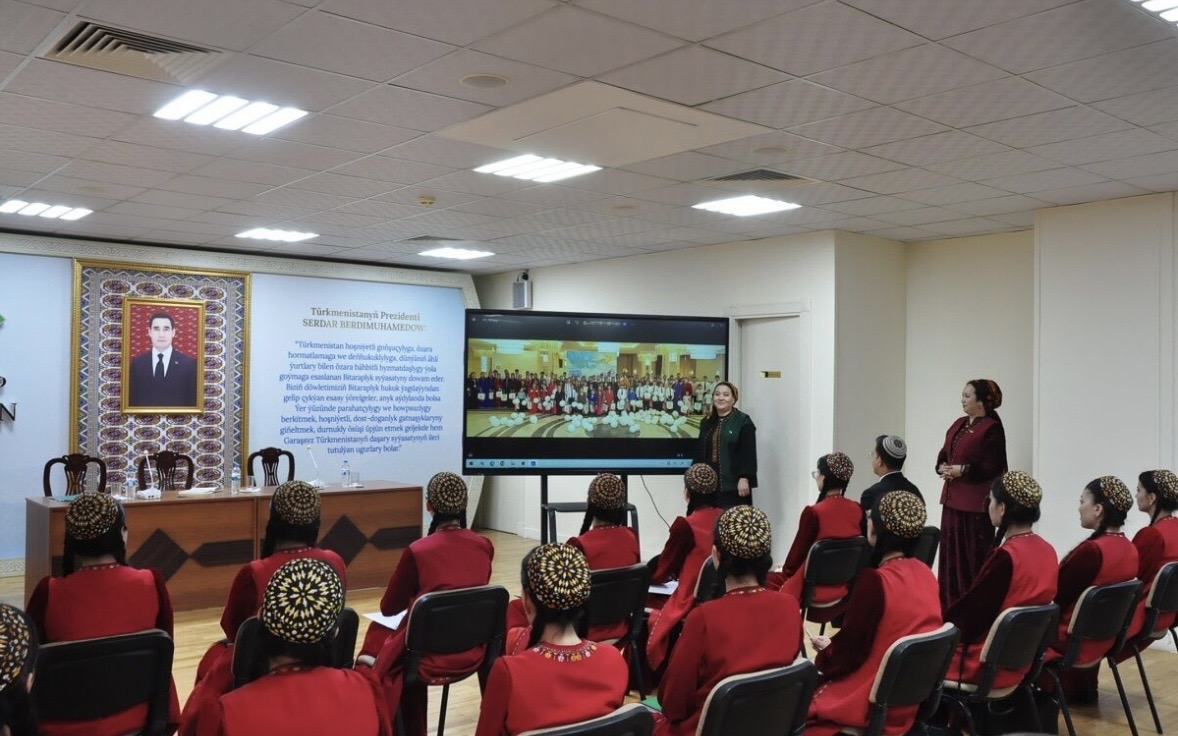
The information was shared on August 23 during a meeting of education workers held at the conference hall of the Magtymguly Turkmen State University, which reviewed the results of the 2024-2025 academic year and discussed plans for 2025-2026.
The report was presented by Maksat Churiev, PhD in Technical Sciences and acting head of the Cybersecurity Department at the International Oil and Gas University named after Yagshygeldi Kakaev. He spoke about the use of AI in the education system and positive outcomes achieved.
According to Churiev, the development of these specialized programs follows directives from the National Leader of the Turkmen People, Gurbanguly Berdimuhamedow, aimed at training youth in AI, IT, and blockchain technologies.
It is emphasized that these new educational programs are important for enhancing the skills of young people and preparing specialists to meet the demands of the modern market economy.
Also read

Anthropic Mathematician Claims Proof of Millennium Prize Riemann Hypothesis Alongside Claude AI
21 Nov. 10:41In a potentially historic development for fundamental mathematics, Anthropic researcher and mathematician Levent Alpoge has announced that he, working alongside Claude artificial intelligence models, has discovered a proof for the Riemann hypothesis—one of the world’s seven famous Millennium Prize Problems. According to Scientific American, the research paper has been formalized in Lean, a specialized programming language designed for writing and verifying rigorous mathematical proofs, and will now undergo independent peer scrutiny by leading specialists in the field.
Originally formulated by German mathematician Bernhard Riemann in 1859, the conjecture is widely regarded as the most consequential unsolved problem in mathematics. Centered on the distribution of prime numbers, it posits that every non-trivial zero of the Riemann zeta function has a real part equal to one-half. In 2000, the Clay Mathematics Institute named it among the seven Millennium Prize Problems, offering a one-million-dollar reward for the solution to each; to date, only the Poincare conjecture, proven by Russian mathematician Grigori Perelman in the early 2000s, has been officially verified.
Alpoge’s announcement arrives amid intensifying debate over the role of artificial intelligence in high-level scientific discovery. Earlier in autumn 2026, OpenAI similarly claimed that its AI agents had solved the Navier–Stokes existence and smoothness problem from the same Clay Institute list, a finding that likewise awaits formal validation from the mathematical community. Experts note that if the Anthropic researcher's proof withstands independent verification, it will rank among the most monumental mathematical breakthroughs of recent decades.
Blitz