
Playlist
Eco-Quest Held at Turkmenistan’s Institute of International Relations
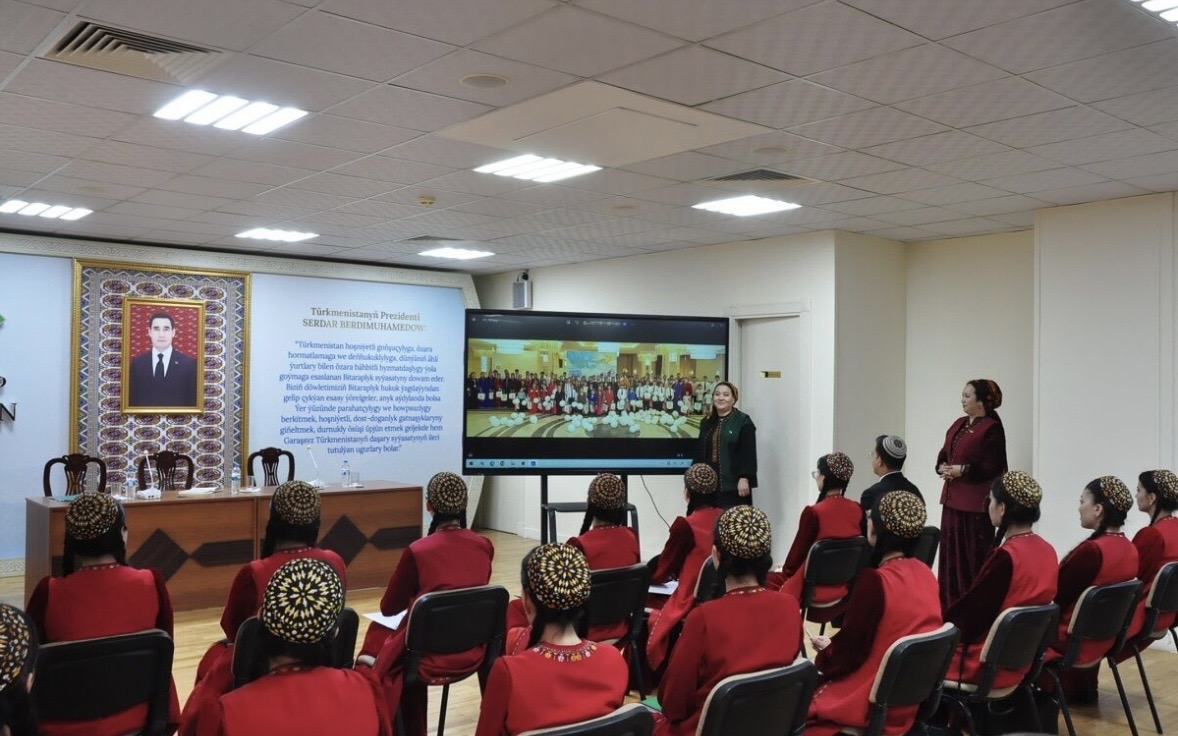
08 May. 14:53The UNESCO "Culture of Peace" club, in collaboration with the "Young Naturalist" public organization, organized an educational eco-quest titled "Ecological Wellbeing — The Beauty of the Earth" at the Institute of International Relations of the Ministry of Foreign Affairs of Turkmenistan. The primary objective of the initiative was to enhance environmental awareness among students and promote a sense of responsibility toward the preservation of the country’s natural heritage. The event integrated theoretical discussions with practical environmental activities.
At the beginning of the campaign, experts from the "Young Naturalist" organization conducted a seminar dedicated to World Environment Day and the strategic role of environmental diplomacy. The session focused on Turkmenistan’s cooperation with UNESCO and the nation's efforts to safeguard its unique ecosystems. Students were informed about the intersection of diplomacy and environmental policy, emphasizing how sustainable development remains a cornerstone of the country's foreign and domestic agendas.
The presentations covered a wide range of topics, including Turkmenistan’s participation in international environmental conventions, the development of a "green" economy, and measures taken to combat desertification. Speakers highlighted that fostering an ecological culture among the youth is essential for ensuring biodiversity conservation and long-term environmental sustainability. The seminar provided a platform for students to discuss contemporary challenges and the technological solutions being implemented at the state level.
The event concluded with a practical session focused on the beautification of the institute's grounds. Students actively participated in landscaping and maintaining the green zones, reflecting their commitment to environmental stewardship. Participants who showed exceptional initiative were recognized with special gifts from the "Young Naturalist" public organization. Such activities are instrumental in encouraging the youth to adopt sustainable lifestyles and take proactive roles in protecting the planet.
Also read



Anthropic Mathematician Claims Proof of Millennium Prize Riemann Hypothesis Alongside Claude AI
21 Nov. 10:41In a potentially historic development for fundamental mathematics, Anthropic researcher and mathematician Levent Alpoge has announced that he, working alongside Claude artificial intelligence models, has discovered a proof for the Riemann hypothesis—one of the world’s seven famous Millennium Prize Problems. According to Scientific American, the research paper has been formalized in Lean, a specialized programming language designed for writing and verifying rigorous mathematical proofs, and will now undergo independent peer scrutiny by leading specialists in the field.
Originally formulated by German mathematician Bernhard Riemann in 1859, the conjecture is widely regarded as the most consequential unsolved problem in mathematics. Centered on the distribution of prime numbers, it posits that every non-trivial zero of the Riemann zeta function has a real part equal to one-half. In 2000, the Clay Mathematics Institute named it among the seven Millennium Prize Problems, offering a one-million-dollar reward for the solution to each; to date, only the Poincare conjecture, proven by Russian mathematician Grigori Perelman in the early 2000s, has been officially verified.
Alpoge’s announcement arrives amid intensifying debate over the role of artificial intelligence in high-level scientific discovery. Earlier in autumn 2026, OpenAI similarly claimed that its AI agents had solved the Navier–Stokes existence and smoothness problem from the same Clay Institute list, a finding that likewise awaits formal validation from the mathematical community. Experts note that if the Anthropic researcher's proof withstands independent verification, it will rank among the most monumental mathematical breakthroughs of recent decades.
Blitz