
Playlist
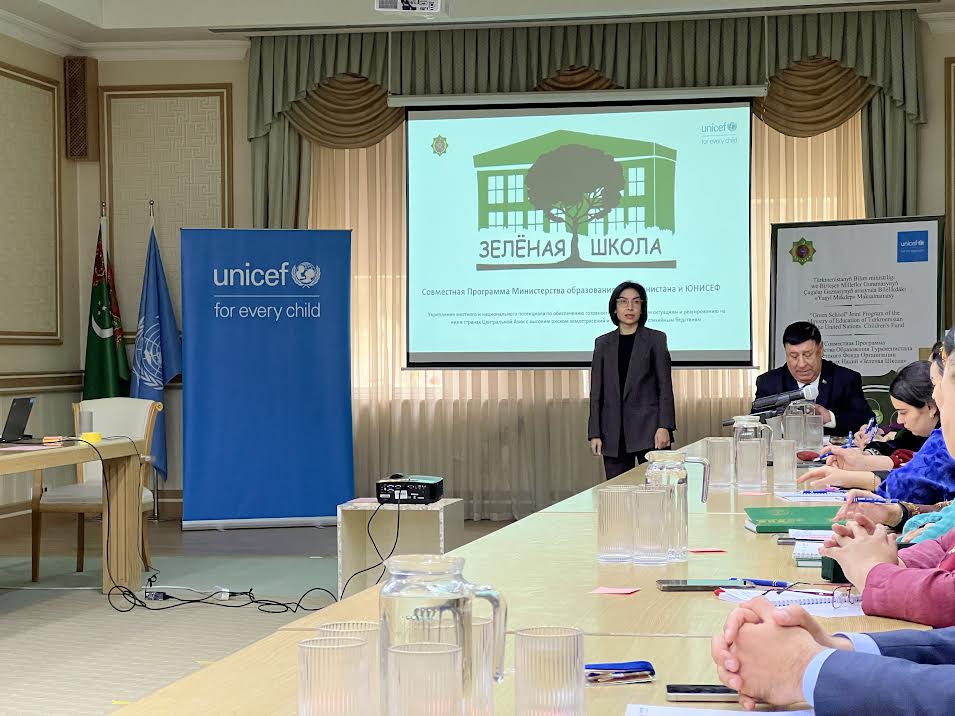
On October 21, 2025, the Ministry of Education of Turkmenistan and the National Institute of Education, with the support of UNICEF, began implementing the joint “Green School” program. After completing the first phase of dedicated seminars, an official launch ceremony was held in Ashgabat. In the initial phase, 20 pilot schools from across the country will participate in the program. The main goal of the project is to integrate ecological education and sustainable development principles into everyday school life, as well as to cultivate a culture of responsible and caring attitudes towards nature among students and teachers.
Within the program, school administrations and teachers will participate in practical training to develop ecological action plans and create environmental groups at schools. Participants will also receive guidance on environmental assessments, organizing informational and educational events, and drafting ecological codes that promote sustainable approaches in schools and local communities.
Maayke Biker, Acting Deputy Representative of UNICEF in Turkmenistan, noted: “The ‘Green School’ program helps children understand that their actions can improve the world. By encouraging schools to take practical steps like waste reduction, energy saving, and environmental awareness, we support nurturing a generation that values sustainable development and cares about its future.”
The “Green School” program is part of Turkmenistan’s efforts to integrate air and environmental protection issues into the national education system. This initiative supports fulfilling the country’s National Climate Change Strategy, Nationally Determined Contributions (NDCs), and Sustainable Development Goals (SDGs), while inspiring children to take collective action for a clean and sustainable future.
Also read



Ecological Shift: Golden Jackals Pro Projected to Inhabit 75% of the European Continent
Today in 06:53Once restricted mainly to the Balkans and the Black Sea coastal regions, golden jackals are rapidly expanding their footprint across Europe. According to a landmark study by an international research team published in Nature Ecology & Evolution, these adaptable predators could eventually inhabit up to 75% of the European continent—nearly a sixfold expansion from their historical range. Scientists arrived at these conclusions after monitoring nearly 9,000 sampling sites across multiple European nations.
Recent sightings and acoustic tracking confirm that jackals have established populations in the Czech Republic, the Baltic region, and even Scandinavia. The species thrives in areas with mild winters, mixed agricultural landscapes, and proximity to water sources. Regional climate warming has transformed previously uninhabitable northern areas into suitable habitats, while farming landscapes offer abundant food sources and coverage.
Biologists attribute this unprecedented expansion primarily to the historical decline of wolf populations, which naturally suppress jackal numbers and limit their movement. Smaller than wolves but slightly larger than foxes, jackals feed on small rodents, carrion, plants, and fruits. Their high ecological adaptability allows them to settle efficiently into newly colonized territories without human interference.
However, their entry into Western and Southern Europe, including countries like France and Spain, poses potential ecological consequences. Environmentalists warn that the arrival of jackals could disrupt local ecosystems and threaten endangered ground-nesting steppe birds and smaller wildlife across the Iberian Peninsula.
Also read




Blitz