
Playlist
Turkmen Students Take Gold at Global Innovation Challenge in Malaysia
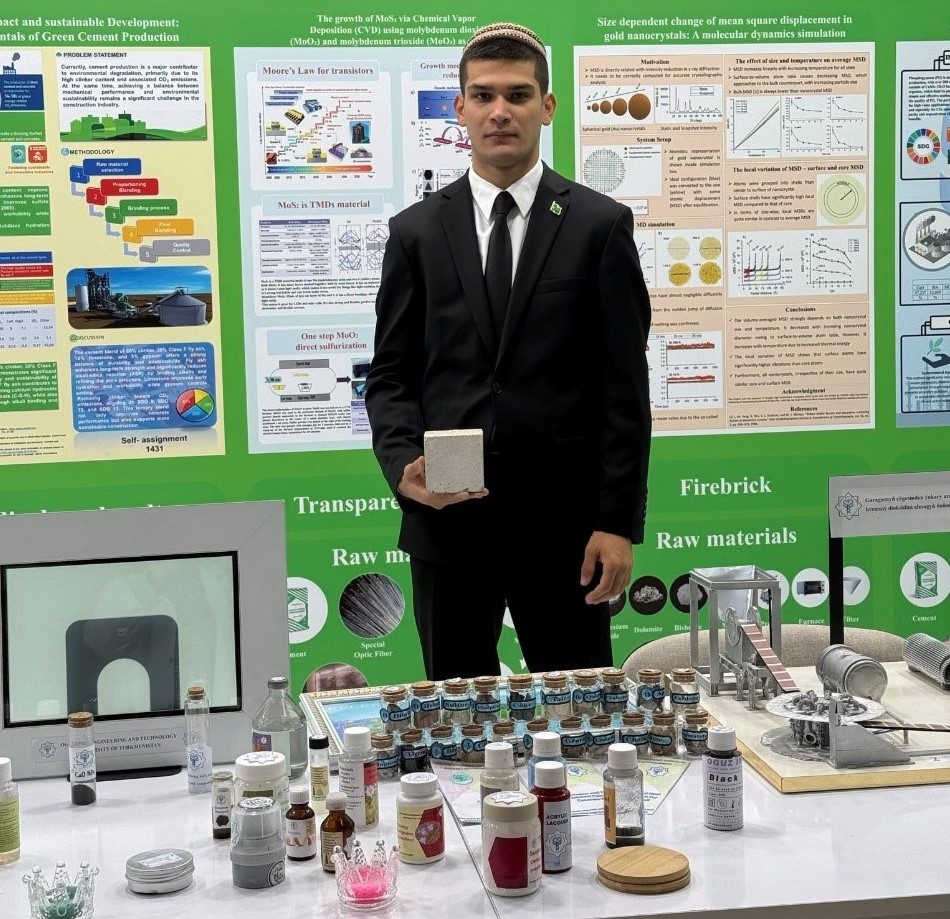
25 Sep. 12:55Brilliant minds from Oguz Khan Engineering and Technology University of Turkmenistan have returned home victorious after competing at the prestigious World Sustainable Development Goal Challenge (WSDG 2025) in Malaysia. Their groundbreaking projects in sustainability earned them top honors, including gold medals and major awards.
Among the winners was 4th-year student Suleymanmuhammet Shamuhammedov from the Chemical Technology Faculty. His research on producing eco-friendly “green cement” to reduce environmental impact and energy consumption earned him not only a gold medal but also the competition’s highest recognition — the WSDG Innovation Grand Award. International experts praised the originality and environmental value of his work.
Another gold medal went to the team project by Aymyrat Khalnazarov and Jemal Sharipova, both 3rd-year students. Their innovative approach transforms phosphogypsum — a harmful byproduct of fertilizer production — into clean, usable gypsum for construction. The project also received a special award for the Best Innovation in Sustainable Development.
Their achievements were guided by senior lecturer and team mentor, Dr. Atamyrat Altiyev, from the Department of Applied Chemistry.
The competition, hosted by Malaysia’s Multimedia University in partnership with the national youth science organization, featured over 2,100 student projects from 15 countries, including India, Romania, Brazil, Kazakhstan, and Egypt.
Such remarkable achievements reflect the growing role of Turkmenistan in global scientific development and highlight the country’s strong foundation in education and research.
Also read


Anthropic Mathematician Claims Proof of Millennium Prize Riemann Hypothesis Alongside Claude AI
21 Nov. 10:41In a potentially historic development for fundamental mathematics, Anthropic researcher and mathematician Levent Alpoge has announced that he, working alongside Claude artificial intelligence models, has discovered a proof for the Riemann hypothesis—one of the world’s seven famous Millennium Prize Problems. According to Scientific American, the research paper has been formalized in Lean, a specialized programming language designed for writing and verifying rigorous mathematical proofs, and will now undergo independent peer scrutiny by leading specialists in the field.
Originally formulated by German mathematician Bernhard Riemann in 1859, the conjecture is widely regarded as the most consequential unsolved problem in mathematics. Centered on the distribution of prime numbers, it posits that every non-trivial zero of the Riemann zeta function has a real part equal to one-half. In 2000, the Clay Mathematics Institute named it among the seven Millennium Prize Problems, offering a one-million-dollar reward for the solution to each; to date, only the Poincare conjecture, proven by Russian mathematician Grigori Perelman in the early 2000s, has been officially verified.
Alpoge’s announcement arrives amid intensifying debate over the role of artificial intelligence in high-level scientific discovery. Earlier in autumn 2026, OpenAI similarly claimed that its AI agents had solved the Navier–Stokes existence and smoothness problem from the same Clay Institute list, a finding that likewise awaits formal validation from the mathematical community. Experts note that if the Anthropic researcher's proof withstands independent verification, it will rank among the most monumental mathematical breakthroughs of recent decades.
Also read



Blitz