
Playlist
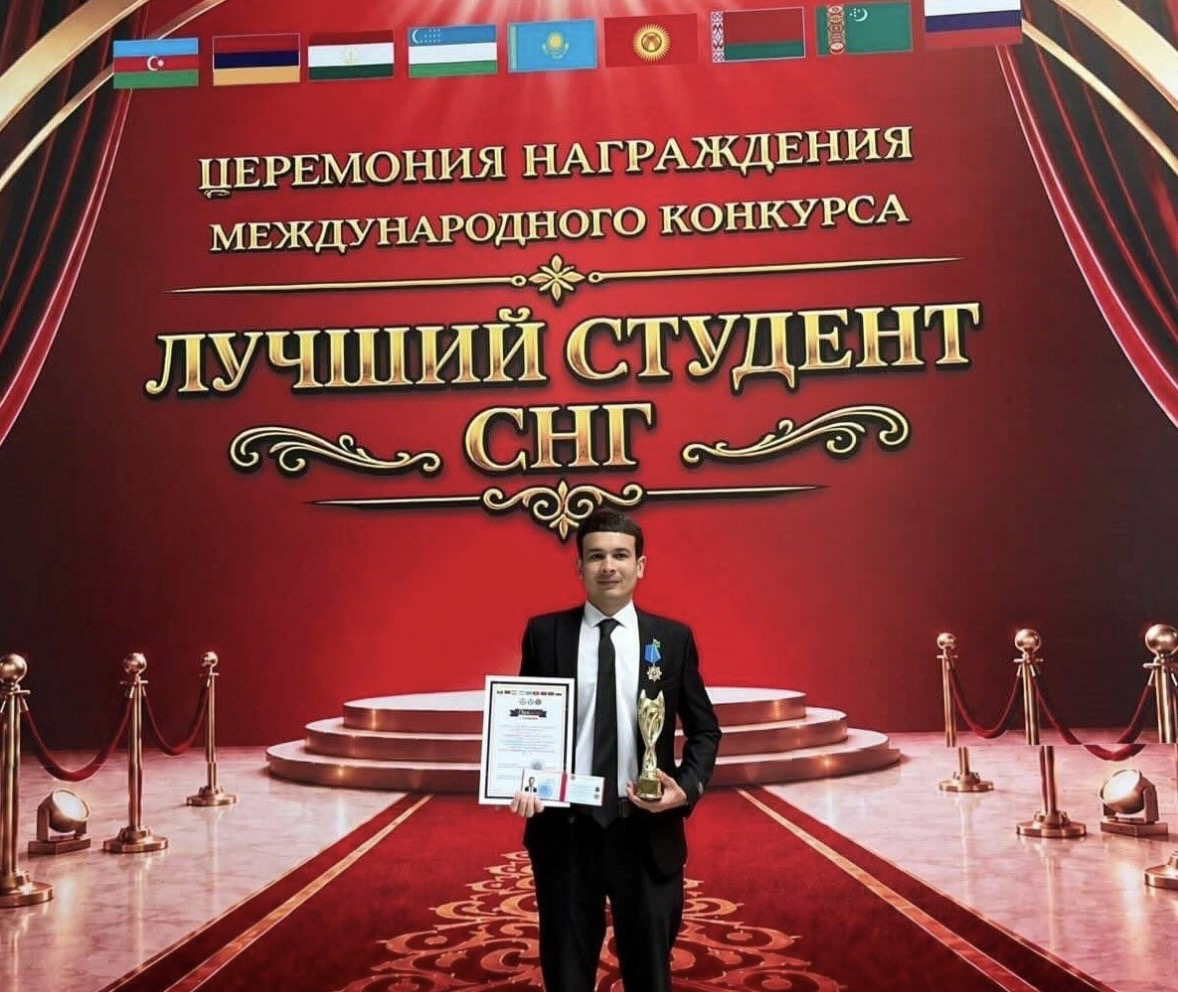
Turkmen Student Named Best Student of the CIS at International Competition in Kazakhstan
30 May. 12:54The youth of Turkmenistan pursuing higher education in premier foreign academic institutions continue to secure outstanding milestones within global structural educational frameworks. The academic and societal contributions of Turkmen students are systematically validated during high-profile international forums and multi-disciplinary events. This sustainable performance reflects the strategic state priorities of Ashgabat directed toward cultivating top-tier intellectual resources and empowering youth in international layouts.
At a major transnational youth forum held in Astana, a fourth-year Turkmen student from the L.N. Gumilyov Eurasian National University clinched the honorary title of Best Student of the CIS. The youth delegate was decorated with an institutional medal, a cup, and a first-degree certificate by leading innovative and educational organizations. The international tournament evaluates applicants based on their consistent academic excellence, scientific research output, athletic achievements, and proactive leadership in youth policy.
The awardee has established a strong track record of leadership and cultural advocacy within his respective university ecosystem in recent years. During a seasonal youth festival, he previously secured top honors as the best international student, showcasing exceptional integration into the academic community. Furthermore, serving as the head coordinator for Turkmen student groups in the capital since 2022, he has successfully managed numerous initiatives aimed at presenting national heritage at university functions.
These notable personal and organizational achievements were formally recognized by the Embassy of Turkmenistan to the Republic of Kazakhstan through an official letter of appreciation. The student's victory emphasizes the high competitive capacity and civic responsibility inherent in the state's contemporary student delegation abroad. Educational analysts suggest that such prominent student representations are vital for driving inter-university exchange networks and fostering long-term humanitarian partnerships.
Also read



Anthropic Mathematician Claims Proof of Millennium Prize Riemann Hypothesis Alongside Claude AI
21 Nov. 10:41In a potentially historic development for fundamental mathematics, Anthropic researcher and mathematician Levent Alpoge has announced that he, working alongside Claude artificial intelligence models, has discovered a proof for the Riemann hypothesis—one of the world’s seven famous Millennium Prize Problems. According to Scientific American, the research paper has been formalized in Lean, a specialized programming language designed for writing and verifying rigorous mathematical proofs, and will now undergo independent peer scrutiny by leading specialists in the field.
Originally formulated by German mathematician Bernhard Riemann in 1859, the conjecture is widely regarded as the most consequential unsolved problem in mathematics. Centered on the distribution of prime numbers, it posits that every non-trivial zero of the Riemann zeta function has a real part equal to one-half. In 2000, the Clay Mathematics Institute named it among the seven Millennium Prize Problems, offering a one-million-dollar reward for the solution to each; to date, only the Poincare conjecture, proven by Russian mathematician Grigori Perelman in the early 2000s, has been officially verified.
Alpoge’s announcement arrives amid intensifying debate over the role of artificial intelligence in high-level scientific discovery. Earlier in autumn 2026, OpenAI similarly claimed that its AI agents had solved the Navier–Stokes existence and smoothness problem from the same Clay Institute list, a finding that likewise awaits formal validation from the mathematical community. Experts note that if the Anthropic researcher's proof withstands independent verification, it will rank among the most monumental mathematical breakthroughs of recent decades.
Blitz