
Playlist
Turkmenistan and Italy Strengthen Ties in Higher Education and Digital Innovation
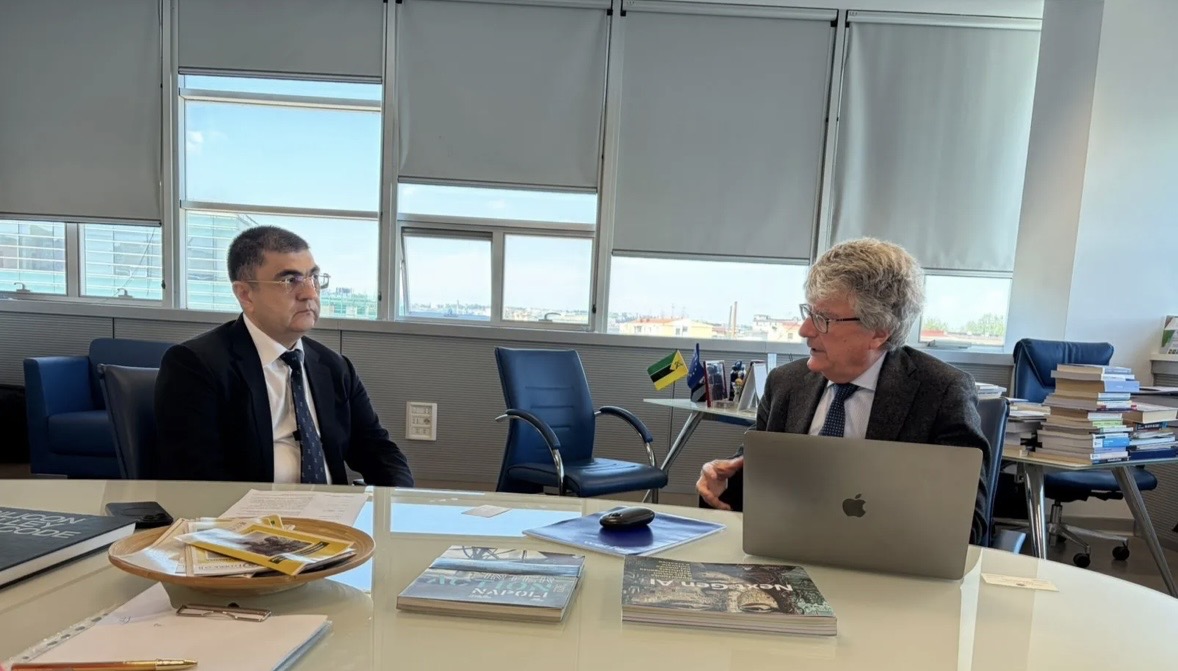
28 Apr. 09:57The Ambassador of Turkmenistan to Italy, Toyly Komekov, recently conducted a high-level diplomatic visit to Naples to foster academic and technological cooperation. A primary highlight of the visit was a meeting with Professor Matteo Lorito, the Rector of the University of Naples Federico II, one of the world's most prestigious educational institutions. The discussions focused on establishing a robust framework for partnership between Turkmen universities and Italian academic centers, emphasizing scientific research and institutional growth.
The dialogue identified key priority areas for future collaboration, including advanced agriculture, environmental protection, and sustainable development. Both parties emphasized the importance of refining the legal and contractual base to facilitate student and faculty exchanges. This partnership aims to bridge the gap between academic theory and practical application, providing Turkmen scholars with access to world-class laboratory facilities and innovative research methodologies.
During his trip, Ambassador Komekov also met with Dr. Giorgio Ventre, the Scientific Director of the renowned Apple Developer Academy at the university. Their conversation centered on specialized training in software development and digital transformation. This interaction highlighted the potential for Turkmen IT professionals to engage in professional development programs that align with the digital economy strategies currently being implemented in Turkmenistan.
The visit concluded with a consensus to organize reciprocal visits for scientific and educational delegations from both nations in the near future. These upcoming exchanges will serve to finalize specific joint initiatives and formalize the cooperation between respective institutions. This strategic engagement underscores Turkmenistan's commitment to internationalizing its higher education system and leveraging global expertise to drive domestic technological progress.
Also read


Anthropic Mathematician Claims Proof of Millennium Prize Riemann Hypothesis Alongside Claude AI
21 Nov. 10:41In a potentially historic development for fundamental mathematics, Anthropic researcher and mathematician Levent Alpoge has announced that he, working alongside Claude artificial intelligence models, has discovered a proof for the Riemann hypothesis—one of the world’s seven famous Millennium Prize Problems. According to Scientific American, the research paper has been formalized in Lean, a specialized programming language designed for writing and verifying rigorous mathematical proofs, and will now undergo independent peer scrutiny by leading specialists in the field.
Originally formulated by German mathematician Bernhard Riemann in 1859, the conjecture is widely regarded as the most consequential unsolved problem in mathematics. Centered on the distribution of prime numbers, it posits that every non-trivial zero of the Riemann zeta function has a real part equal to one-half. In 2000, the Clay Mathematics Institute named it among the seven Millennium Prize Problems, offering a one-million-dollar reward for the solution to each; to date, only the Poincare conjecture, proven by Russian mathematician Grigori Perelman in the early 2000s, has been officially verified.
Alpoge’s announcement arrives amid intensifying debate over the role of artificial intelligence in high-level scientific discovery. Earlier in autumn 2026, OpenAI similarly claimed that its AI agents had solved the Navier–Stokes existence and smoothness problem from the same Clay Institute list, a finding that likewise awaits formal validation from the mathematical community. Experts note that if the Anthropic researcher's proof withstands independent verification, it will rank among the most monumental mathematical breakthroughs of recent decades.
Blitz