
Playlist
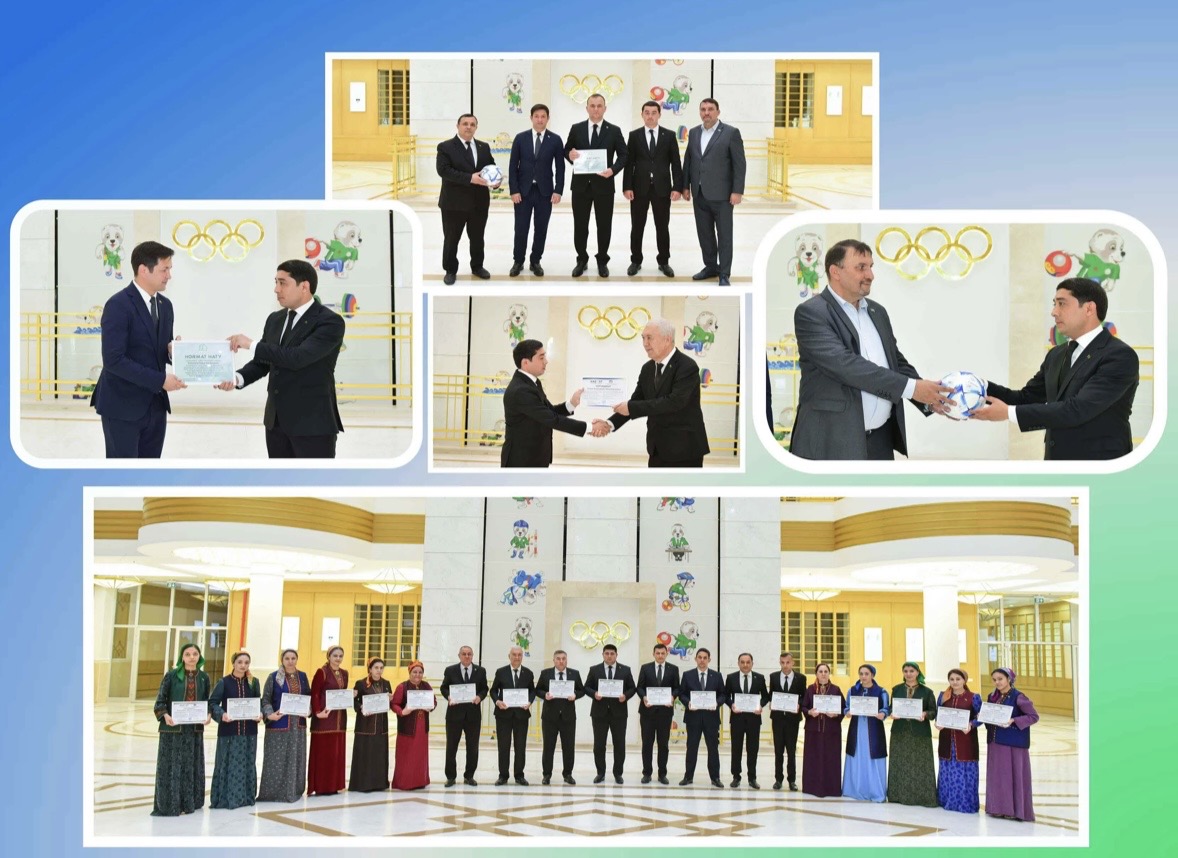
Turkmen State Institute of Physical Culture and Sports Awards Certificates to International Training Program Graduates
28 May. 10:37The Faculty of Olympic Sports at the Turkmen State Institute of Physical Culture and Sports hosted an official certificate presentation ceremony. The academic event honored faculty members and undergraduate students who successfully completed advanced, international-level professional development curricula. The ceremony underscored the higher education institution's ongoing commitment to integrating contemporary global athletic standards into the national educational framework.
The specialized digital educational program, which spanned from late February to May 2026, was systematically coordinated by the International Association of Universities of Physical Culture and Sports in alliance with the Kazakh Academy of Sports and Tourism. Participants successfully engaged in a rigorous 72-hour course titled "Modern High-Performance Sports: Challenges and Future Prospects," conducted by prominent academician and Doctor of Pedagogical Sciences, Professor Vladimir Platonov.
The cross-border academic initiative unified more than 270 professional educators, athletic trainers, and sports scientists representing Central Asian nations, Kazakhstan, and the Russian Federation on a single virtual platform. The overarching structural dynamic of the project was directed toward optimizing high-level athlete training frameworks and expanding regional scientific cooperation. A delegation of 22 experienced instructors from the Turkmen sports institute participated, effectively broadening their professional capacities.
Concurrently, during the same multi-month period, a specialized domestic program focused on young sports officials was executed in partnership with local athletic bodies. Orchestrated under the auspices of the National Student Sports Federation within the framework of the Turkmenistan Students League, this initiative was co-developed by the Football Federation of Turkmenistan and the host institute to identify and train young match referees. Individuals who met all qualification benchmarks within this specialized track were also awarded professional certificates during the ceremonies.
Also read


Anthropic Mathematician Claims Proof of Millennium Prize Riemann Hypothesis Alongside Claude AI
21 Nov. 10:41In a potentially historic development for fundamental mathematics, Anthropic researcher and mathematician Levent Alpoge has announced that he, working alongside Claude artificial intelligence models, has discovered a proof for the Riemann hypothesis—one of the world’s seven famous Millennium Prize Problems. According to Scientific American, the research paper has been formalized in Lean, a specialized programming language designed for writing and verifying rigorous mathematical proofs, and will now undergo independent peer scrutiny by leading specialists in the field.
Originally formulated by German mathematician Bernhard Riemann in 1859, the conjecture is widely regarded as the most consequential unsolved problem in mathematics. Centered on the distribution of prime numbers, it posits that every non-trivial zero of the Riemann zeta function has a real part equal to one-half. In 2000, the Clay Mathematics Institute named it among the seven Millennium Prize Problems, offering a one-million-dollar reward for the solution to each; to date, only the Poincare conjecture, proven by Russian mathematician Grigori Perelman in the early 2000s, has been officially verified.
Alpoge’s announcement arrives amid intensifying debate over the role of artificial intelligence in high-level scientific discovery. Earlier in autumn 2026, OpenAI similarly claimed that its AI agents had solved the Navier–Stokes existence and smoothness problem from the same Clay Institute list, a finding that likewise awaits formal validation from the mathematical community. Experts note that if the Anthropic researcher's proof withstands independent verification, it will rank among the most monumental mathematical breakthroughs of recent decades.
Blitz