
Playlist
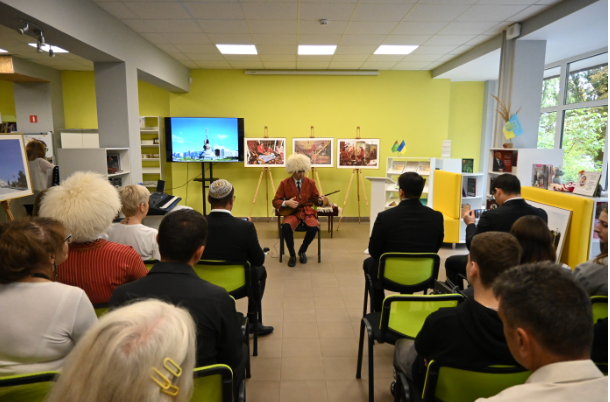
In celebration of Turkmenistan’s upcoming Independence Day, a cultural program has begun in Kyiv. One of the key events was an art gathering titled “Sounds of the Dutar”, hosted at the Magtymguly Library.
The event highlighted Turkmen musical heritage, focusing on traditional instruments and the ancient art of bakhshi. Attendees included teachers and students from music schools, representatives of the Sviatoshyn District administration and library network, as well as Turkmen youth living in Ukraine.
The library director, also the event’s host, shared the history of the institution and its attached Magtymguly museum. A diplomat from the Embassy of Turkmenistan spoke about the origins and development of the national composer school, the cultural role of instruments like dutar and gidjak, and the importance of preserving these traditions.
He emphasized that dutar craftsmanship, its musical performance, and the art of bakhshi were inscribed on UNESCO’s Representative List of the Intangible Cultural Heritage of Humanity — a global recognition of Turkmen culture.
Citations from President Serdar Berdimuhamedov and National Leader Gurbanguly Berdimuhamedov were featured, underlining the dutar as a symbol of independence, neutrality, peace, and the soul of the Turkmen people.
A musical highlight of the evening was a performance by Serdar Derekov, a dutarist from the Turkmen diaspora in Ukraine. Ukrainian students also presented musical numbers including a piano duet, a guitar trio, and bandura performances.
Guests toured the Magtymguly museum, where items of traditional Turkmen craftsmanship and instruments — gifted by Turkmenistan’s Ministry of Culture during the poet’s 300th anniversary — were on display.
The event, held near both Turkmenistan's Independence Day and the International Day of Music, fostered cultural appreciation and strengthened ties between nations through the power of music.

Ecological Shift: Golden Jackals Pro Projected to Inhabit 75% of the European Continent
Today in 06:53Once restricted mainly to the Balkans and the Black Sea coastal regions, golden jackals are rapidly expanding their footprint across Europe. According to a landmark study by an international research team published in Nature Ecology & Evolution, these adaptable predators could eventually inhabit up to 75% of the European continent—nearly a sixfold expansion from their historical range. Scientists arrived at these conclusions after monitoring nearly 9,000 sampling sites across multiple European nations.
Recent sightings and acoustic tracking confirm that jackals have established populations in the Czech Republic, the Baltic region, and even Scandinavia. The species thrives in areas with mild winters, mixed agricultural landscapes, and proximity to water sources. Regional climate warming has transformed previously uninhabitable northern areas into suitable habitats, while farming landscapes offer abundant food sources and coverage.
Biologists attribute this unprecedented expansion primarily to the historical decline of wolf populations, which naturally suppress jackal numbers and limit their movement. Smaller than wolves but slightly larger than foxes, jackals feed on small rodents, carrion, plants, and fruits. Their high ecological adaptability allows them to settle efficiently into newly colonized territories without human interference.
However, their entry into Western and Southern Europe, including countries like France and Spain, poses potential ecological consequences. Environmentalists warn that the arrival of jackals could disrupt local ecosystems and threaten endangered ground-nesting steppe birds and smaller wildlife across the Iberian Peninsula.
Also read




Blitz