
Playlist
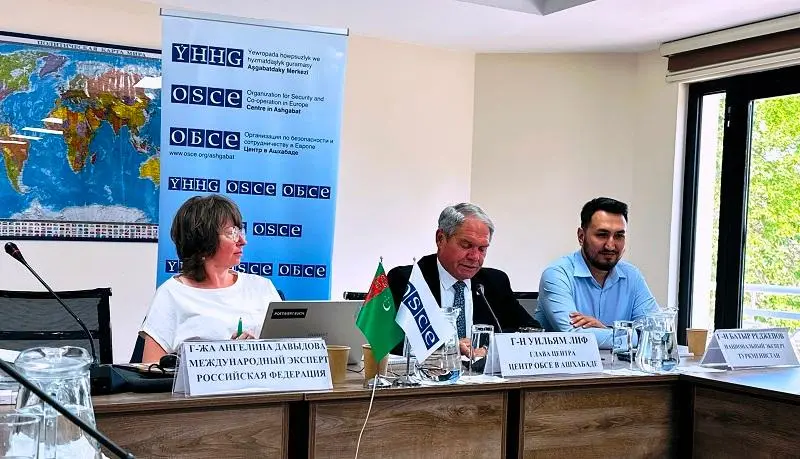
OSCE Centre in Ashgabat Conducts Practical Workshop on Environmental Journalism
17 Sep. 18:09A two-day training seminar focused on improving environmental coverage in mass media was hosted by the OSCE Centre in Ashgabat. The event gathered reporters from Turkmen print publications, news websites, national television, the press service of Turkmen Expo, and non-governmental organizations, alongside a correspondent from tmcars news. International expert Angelina Davydova (Russia, Germany) briefed participants on the contemporary climate agenda and verification techniques for news sources.
The seminar placed strong emphasis on integrating artificial intelligence into media workflows and enhancing digital literacy. Programmer Batyr Rejepov (Turkmenistan) demonstrated practical neural network applications for journalists, while Kazakh expert Marat Sadykov presented online research strategies. Working in groups, participants developed investigative topics targeting regional environmental issues across Turkmenistan and Central Asia.
Attendees highlighted that climate and environmental topics are integral to sustainable development alongside economic and social progress. William Leaf, Head of the OSCE Centre in Ashgabat, stressed the critical responsibility journalists hold in delivering fact-checked, reliable environmental news to the public.
The initiative aligns with the OSCE Centre's ongoing efforts to support climate action and enhance media standards across the region. The pivotal role of environmental journalists continues to be recognized in key international declarations and guidelines.
In 2026, UNESCO's International Programme for the Development of Communication alongside the Office of the OSCE Representative on Freedom of the Media released a joint practical guide titled "Covering the Environment: A Practical Guide for Journalists." The publication serves as a comprehensive resource for data-driven reporting, fact-checking, and leveraging AI tools in environmental journalism.
Also read


Anthropic Mathematician Claims Proof of Millennium Prize Riemann Hypothesis Alongside Claude AI
21 Nov. 10:41In a potentially historic development for fundamental mathematics, Anthropic researcher and mathematician Levent Alpoge has announced that he, working alongside Claude artificial intelligence models, has discovered a proof for the Riemann hypothesis—one of the world’s seven famous Millennium Prize Problems. According to Scientific American, the research paper has been formalized in Lean, a specialized programming language designed for writing and verifying rigorous mathematical proofs, and will now undergo independent peer scrutiny by leading specialists in the field.
Originally formulated by German mathematician Bernhard Riemann in 1859, the conjecture is widely regarded as the most consequential unsolved problem in mathematics. Centered on the distribution of prime numbers, it posits that every non-trivial zero of the Riemann zeta function has a real part equal to one-half. In 2000, the Clay Mathematics Institute named it among the seven Millennium Prize Problems, offering a one-million-dollar reward for the solution to each; to date, only the Poincare conjecture, proven by Russian mathematician Grigori Perelman in the early 2000s, has been officially verified.
Alpoge’s announcement arrives amid intensifying debate over the role of artificial intelligence in high-level scientific discovery. Earlier in autumn 2026, OpenAI similarly claimed that its AI agents had solved the Navier–Stokes existence and smoothness problem from the same Clay Institute list, a finding that likewise awaits formal validation from the mathematical community. Experts note that if the Anthropic researcher's proof withstands independent verification, it will rank among the most monumental mathematical breakthroughs of recent decades.
Blitz