
Playlist
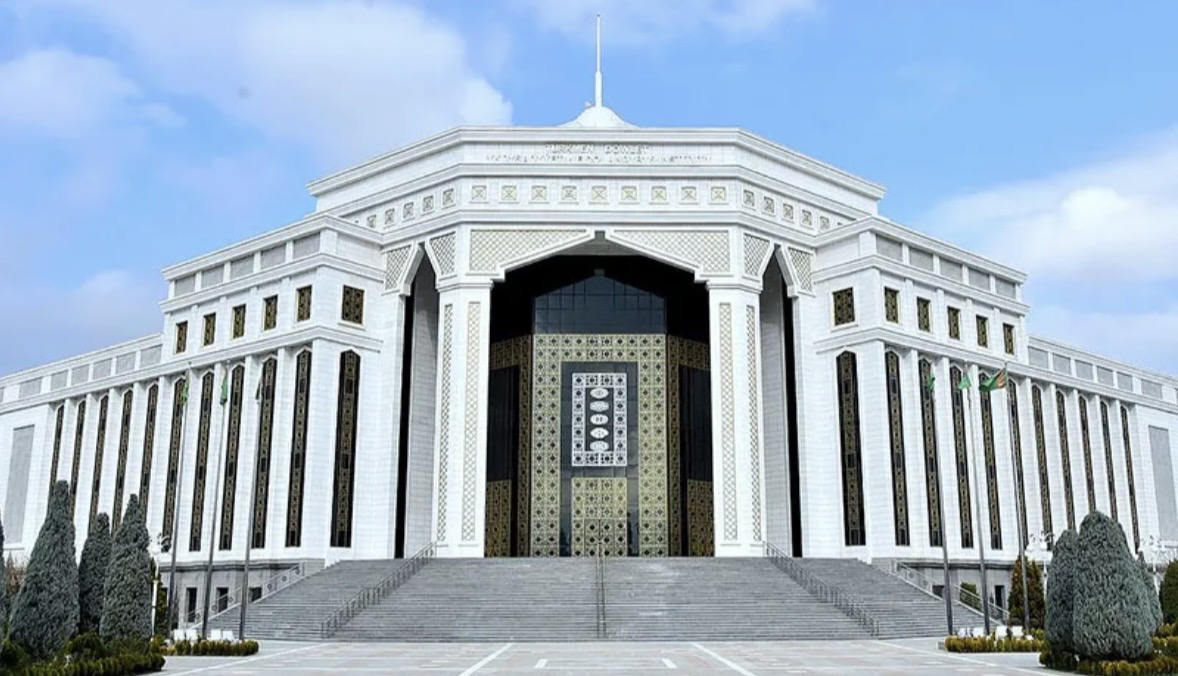
New Rector Appointed to the Turkmen State Institute of Economics and Management
03 Apr. 17:08President Serdar Berdimuhamedov has approved several high-level leadership changes within Turkmenistan’s higher education system during a recent Cabinet meeting. The restructuring involves the appointment of new heads for the nation’s premier economic and financial academic institutions. These strategic rotations are designed to enhance the administrative efficiency and educational standards of the country’s specialized universities.
According to the official decree, Aknabat Orazmyradovna Atabayeva has been relieved of her duties as the Rector of the Turkmen State Institute of Economics and Management. The dismissal follows her transition to a new professional role, concluding her tenure at the head of the institution. Her leadership during her term was marked by efforts to align the university's curriculum with national economic goals.
To fill the vacancy, Bayram Malikberdiyevich Tangryberdiyev has been appointed as the new Rector of the Turkmen State Institute of Economics and Management. Prior to this new assignment, Mr. Tangryberdiyev served as the Rector of the Turkmen State Finance Institute. His extensive background in academic administration and financial science is expected to bring a fresh perspective to the management and strategic development of the institute.
Consequently, Mr. Tangryberdiyev was officially transferred from his previous post at the Finance Institute to assume his new leadership responsibilities. These appointments underscore the government's commitment to dynamic personnel management within the education sector. The transition aims to ensure that Turkmenistan’s future economists and managers receive a high-quality education led by experienced and capable administrators.
Also read

Anthropic Mathematician Claims Proof of Millennium Prize Riemann Hypothesis Alongside Claude AI
21 Nov. 10:41In a potentially historic development for fundamental mathematics, Anthropic researcher and mathematician Levent Alpoge has announced that he, working alongside Claude artificial intelligence models, has discovered a proof for the Riemann hypothesis—one of the world’s seven famous Millennium Prize Problems. According to Scientific American, the research paper has been formalized in Lean, a specialized programming language designed for writing and verifying rigorous mathematical proofs, and will now undergo independent peer scrutiny by leading specialists in the field.
Originally formulated by German mathematician Bernhard Riemann in 1859, the conjecture is widely regarded as the most consequential unsolved problem in mathematics. Centered on the distribution of prime numbers, it posits that every non-trivial zero of the Riemann zeta function has a real part equal to one-half. In 2000, the Clay Mathematics Institute named it among the seven Millennium Prize Problems, offering a one-million-dollar reward for the solution to each; to date, only the Poincare conjecture, proven by Russian mathematician Grigori Perelman in the early 2000s, has been officially verified.
Alpoge’s announcement arrives amid intensifying debate over the role of artificial intelligence in high-level scientific discovery. Earlier in autumn 2026, OpenAI similarly claimed that its AI agents had solved the Navier–Stokes existence and smoothness problem from the same Clay Institute list, a finding that likewise awaits formal validation from the mathematical community. Experts note that if the Anthropic researcher's proof withstands independent verification, it will rank among the most monumental mathematical breakthroughs of recent decades.
Blitz