
Playlist
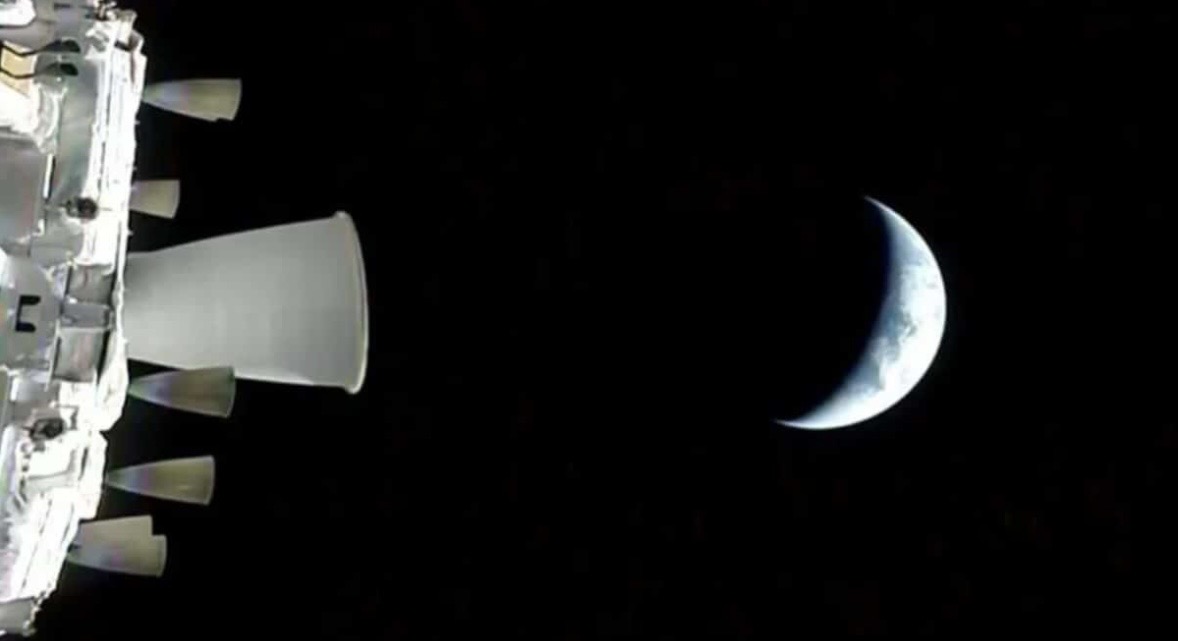
NASA Unveils Striking Image of Earth as a Crescent from Orion Spacecraft
05 Apr. 07:16As part of the historic Artemis II lunar mission, NASA's Orion spacecraft has captured a breathtaking view of Earth from deep space. The image depicts our home planet as a slender silver crescent, a perspective that evokes the familiar appearance of the Moon. This marks the first time since the final Apollo mission in 1972 that humans have witnessed Earth from such a vast distance, signaling a new chapter in deep-space exploration.
Following its successful launch from Kennedy Space Center on April 1, 2026, the spacecraft is currently on its outbound trajectory toward the Moon. On April 3, the four-member crew received clearance to proceed with essential system checks and manual flight demonstrations. These maneuvers are designed to verify the spacecraft's handling qualities and life-support performance before it enters the lunar sphere of influence for its close flyby.
The scientific objectives of the mission are focused on enhancing our understanding of lunar formation and the broader history of the solar system. By observing the lunar surface—including its craters, ancient lava flows, and jagged mountain ranges—the crew aims to gather high-resolution data that was previously unattainable. These insights are critical for mapping out future landing sites and establishing a long-term human presence on the Moon's surface.
Artemis II represents the first crewed flight beyond low Earth orbit in over half a century. The mission follows a free-return trajectory, carrying the crew around the Moon and using lunar gravity to propel the spacecraft back toward Earth. The collection of images released by NASA, including views of Earth's night side and its atmospheric limb, underscores the technological progress of the Orion spacecraft and the international significance of the Artemis program.
Also read




On-the-Go Power: Japanese Engineers Develop Wireless In-Road Charging for Electric Vehicles
10 Oct. 08:10In a major leap for electric mobility, Honda R&D, alongside Taisei Corporation and Taisei Rotec, has unveiled an innovative dynamic wireless charging system that charges electric vehicles as they drive. By embedding compact energy-transmitting modules directly into the road surface, the system transfers power via a magnetic field to receivers mounted underneath moving vehicles. Designed to withstand heavy commercial transport up to 20 tons, real-world road testing is scheduled to begin in Japan in April 2027.
The technology eliminates the need for full road reconstruction, as modules can be integrated directly into milled asphalt layers. Aimed at boosting charging power up to 150 kW in future iterations, this infrastructure solution promise to significantly reduce grid pressure on traditional charging stations, particularly for logistics and commercial fleets.
Blitz