
Playlist

Interview with Dunia Sadykova, Specialist in Educational and Awareness Work at the “Ýaş Tebigatçy” sosial organization
03 Oct. 12:18— Tell us about your role and why educational work is so important for “Ýaş Tebigatçy.”
— I work in wagyz-nesihat, which includes educational and awareness programs we conduct for schoolchildren, students, and the wider public. Our goal is not only to provide knowledge about ecology but also to develop everyday habits: careful use of water, proper waste management, and biodiversity preservation. Practical lessons, workshops, and creative competitions help turn knowledge into personal experience.
— What formats of educational work do you use most often?
— We apply different approaches: interactive lectures, workshops on waste recycling and “trash-art,” ecological camps, and project-based competitions. The most effective formats are those where children and youth act themselves — planting trees, creating information boards, or making videos. Such experiences stay with them for a long time.
— Which recent projects do you consider most significant?
— Among the most important were the youth eco-camp organized together with international partners, where young activists learned about climate and sustainable development, as well as creative contests and short films on environmental themes. We also discussed building a volunteer network and conducted several workshops that expanded the reach of our educational activities.
— How do you measure the success of such programs?
— We look at the number of participants, the number of seminars and events held, and tangible results — for example, the number of trees planted or school initiatives launched. Feedback is also crucial: if participants start adopting eco-friendly habits in their daily lives, it means the program was successful.
— What challenges do you face most often?
— The main challenge is to engage people and make ecology part of their everyday life. Sometimes resources are limited, so we actively build partnerships with organizations and the media. Another key task is training volunteers and trainers since one well-prepared leader can pass knowledge on to dozens of schoolchildren.
— What message would you like to give young people who want to join environmental initiatives?
— Start small: plant a tree, organize a clean-up at your school or in your neighborhood, or make a short video about your favorite natural place. The important thing is to do it consistently and together with like-minded people. We are always open to cooperation and happy to welcome new participants.
— We sincerely thank you for the time and for the vital educational work for future generations.
— Thank you!

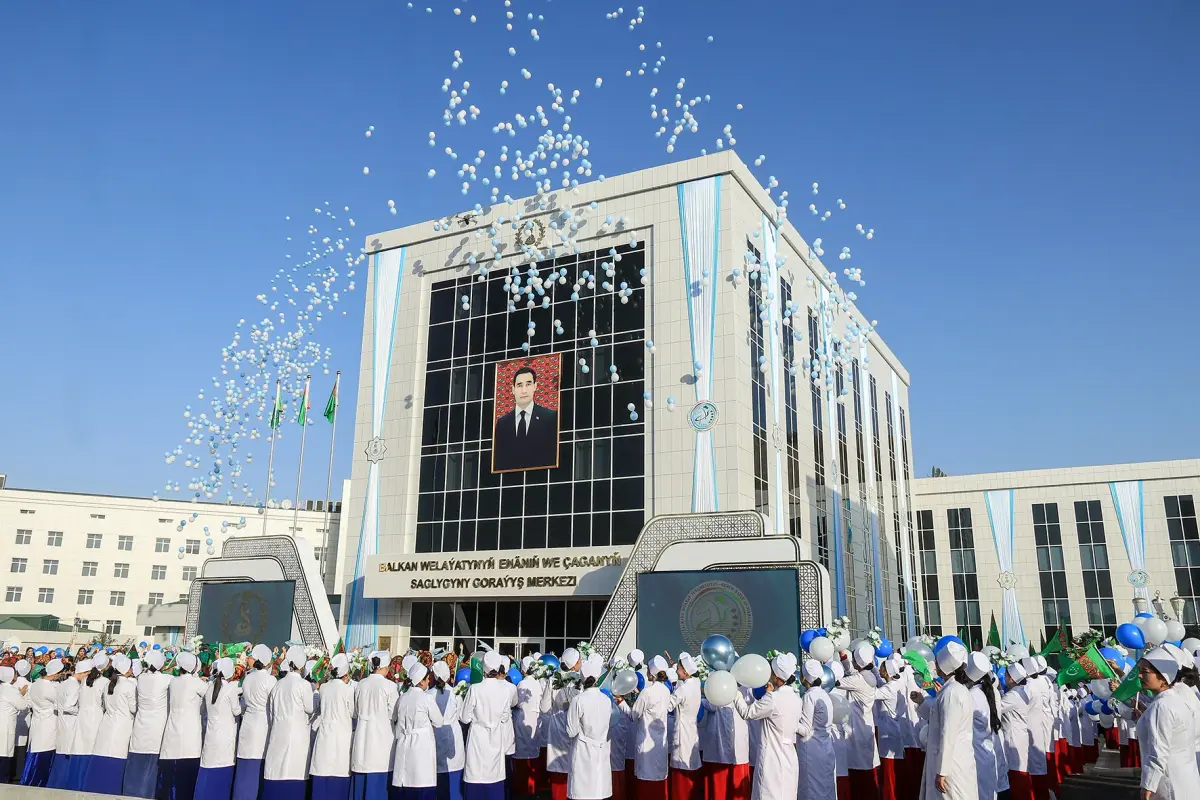
Modern Maternal and Child Healthcare Center Opens Its Doors in Balkanabat
Today in 08:38In celebration of the National Healthcare and Pharmaceutical Industry Workers' Day, a state-of-the-art Maternal and Child Healthcare Center was officially inaugurated in the city of Balkanabat. The landmark event gathered regional and municipal officials, members of the Halk Maslahaty and Parliament, healthcare professionals, and community leaders. The opening ceremony featured festive cultural performances, musical numbers, and traditional Kushtdepdi dances.
The newly constructed medical complex consists of four- and five-story buildings designed to accommodate up to 305 patients. The center houses comprehensive maternity and postnatal wards, a gynecology division, pediatric units, and diagnostic consultation departments. The facility is equipped with advanced medical technology, including MRI, CT scanners, digital mammography, and fluorography units.
Notably, the center features the region's first 10-bed neonatal intensive care unit, fully outfitted with "Medicor" incubators from Hungary and high-precision German monitoring systems. These technologies allow medical staff to continuously monitor vital stats, body temperature, oxygen saturation, and respiratory functions of newborns.
During the ceremony, outstanding builders from the "Shadiyan Gurlushyk" enterprise were honored with gifts on behalf of the President of Turkmenistan, who also donated a new fleet of vehicles to support the medical center's operations.
Also read

Blitz