
Playlist
International Scientific Conference in Ashgabat Highlights Global Sports Cooperation
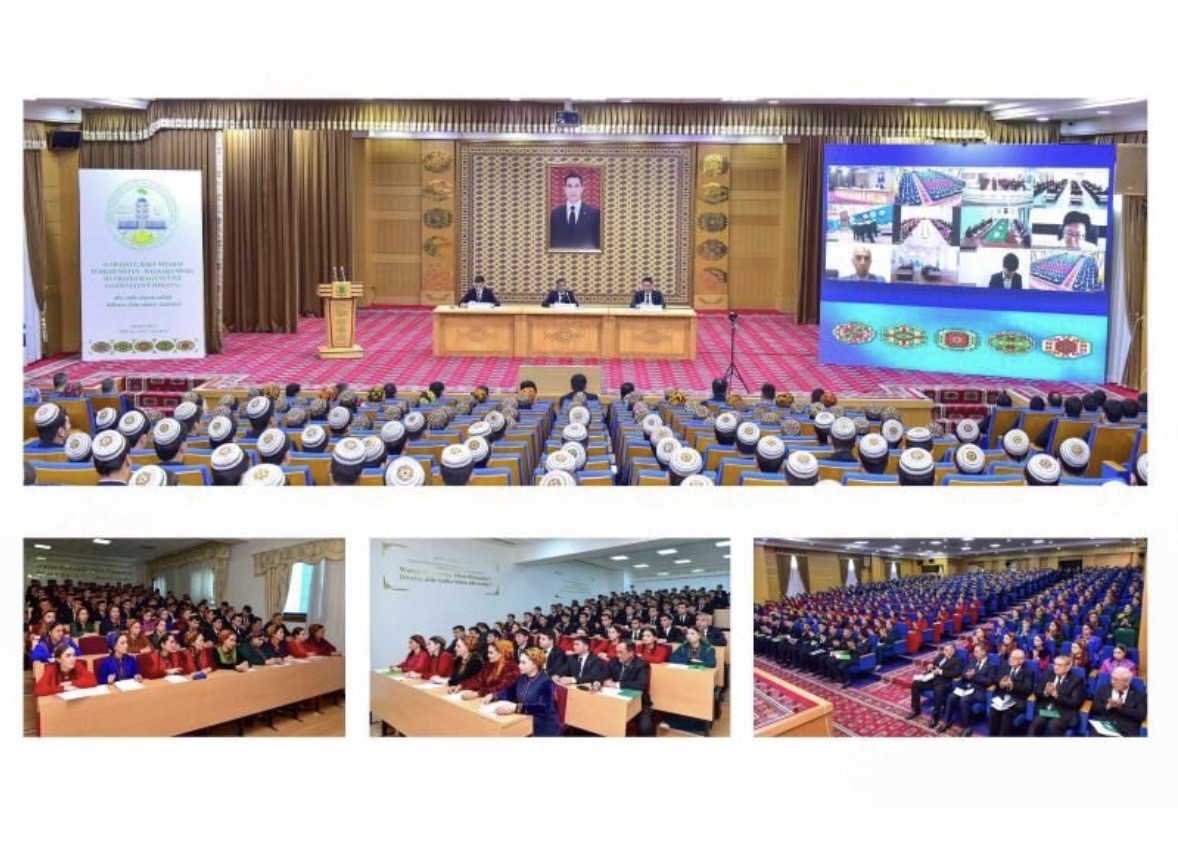
05 Apr. 14:05The Turkmen State Institute of Physical Culture and Sports hosted an international scientific-practical conference to mark World Health Day. The event, held via a digital platform, focused on strengthening international ties in the field of sports and promoting a culture of wellness. A dedicated exhibition showcased the nation's significant progress in the sporting arena, alongside cutting-edge research from the university's specialized scientific centers.
Representatives from prestigious institutions in the UK, USA, China, Russia, Turkey, and across Central Asia participated in the discussions. The forum served as a vital exchange for ideas on sports diplomacy, high-performance athlete training, and the strategic importance of physical culture in fostering social stability. Experts emphasized that scientific advancements in sports play a crucial role in building global peace and mutual understanding.
Scholars from renowned academic centers, including the University of Cambridge, presented insights into the correlation between physical exercise and academic achievement. Their research highlights how physical activity enhances cognitive performance, particularly in STEM subjects. Additionally, the sessions covered practical aspects of sports facility management and modern methodologies for promoting mass participation in team sports like football.
The conference concluded with a focus on the integration of artificial intelligence and digital technologies into sports pedagogy. To bring these concepts to life, the event featured "phygital" sports competitions among students, blending traditional physical performance with digital environments in football, basketball, and chess. This modern format underscores the transition toward innovative methods of engaging the youth in physical culture through technological synergy.
Also read


Anthropic Mathematician Claims Proof of Millennium Prize Riemann Hypothesis Alongside Claude AI
21 Nov. 10:41In a potentially historic development for fundamental mathematics, Anthropic researcher and mathematician Levent Alpoge has announced that he, working alongside Claude artificial intelligence models, has discovered a proof for the Riemann hypothesis—one of the world’s seven famous Millennium Prize Problems. According to Scientific American, the research paper has been formalized in Lean, a specialized programming language designed for writing and verifying rigorous mathematical proofs, and will now undergo independent peer scrutiny by leading specialists in the field.
Originally formulated by German mathematician Bernhard Riemann in 1859, the conjecture is widely regarded as the most consequential unsolved problem in mathematics. Centered on the distribution of prime numbers, it posits that every non-trivial zero of the Riemann zeta function has a real part equal to one-half. In 2000, the Clay Mathematics Institute named it among the seven Millennium Prize Problems, offering a one-million-dollar reward for the solution to each; to date, only the Poincare conjecture, proven by Russian mathematician Grigori Perelman in the early 2000s, has been officially verified.
Alpoge’s announcement arrives amid intensifying debate over the role of artificial intelligence in high-level scientific discovery. Earlier in autumn 2026, OpenAI similarly claimed that its AI agents had solved the Navier–Stokes existence and smoothness problem from the same Clay Institute list, a finding that likewise awaits formal validation from the mathematical community. Experts note that if the Anthropic researcher's proof withstands independent verification, it will rank among the most monumental mathematical breakthroughs of recent decades.
Blitz