
Playlist
India Encourages Turkmen Students to Explore Higher Education Opportunities
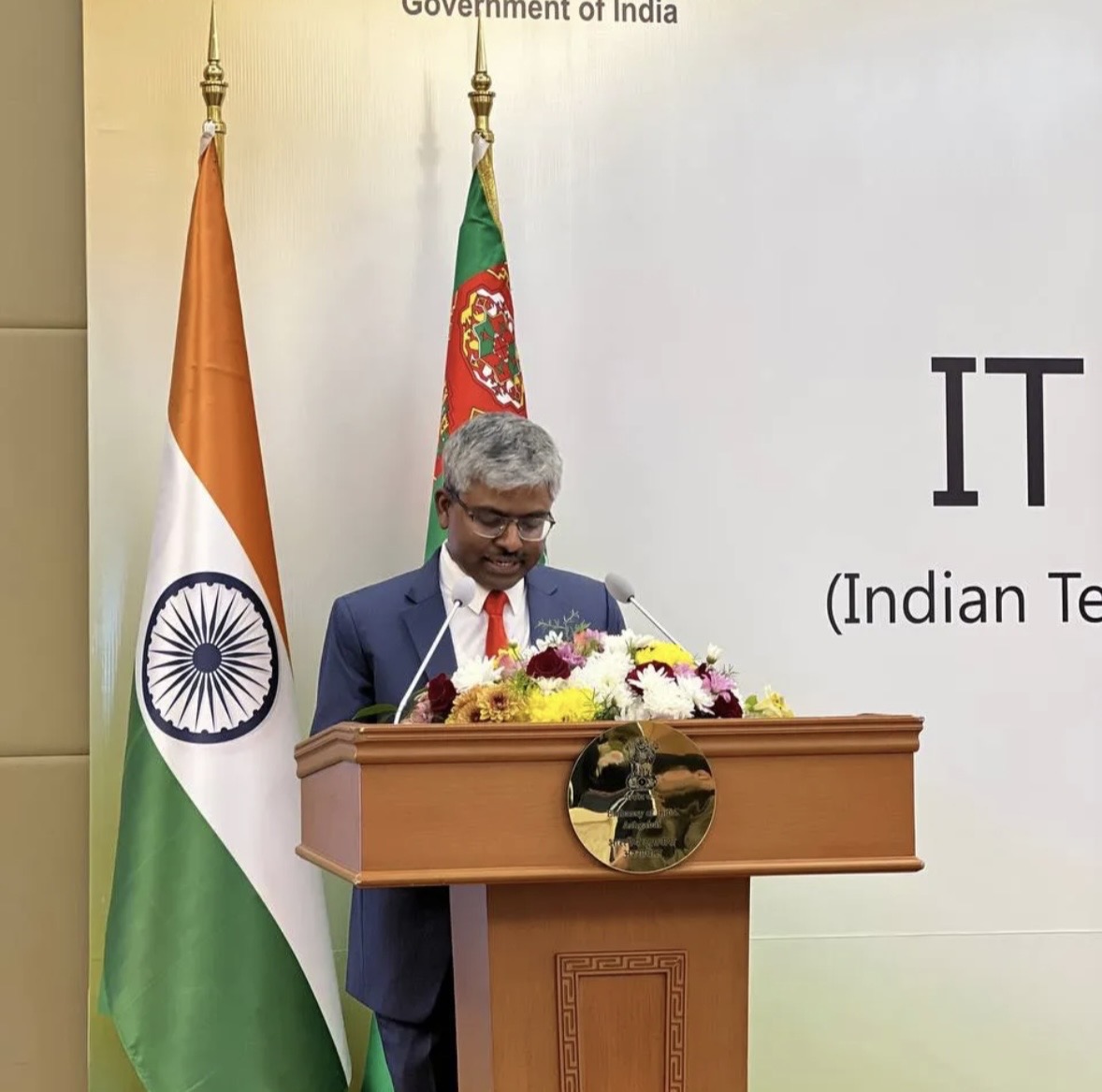
24 Mar. 11:09On March 24, 2026, the Embassy of India in Ashgabat hosted a formal event at the Yyldyz Hotel to commemorate ITEC Day. The gathering brought together alumni of the Indian Technical and Economic Cooperation (ITEC) program and the Indian Council for Cultural Relations (ICCR) scholarships, alongside members of the diplomatic and academic communities. The celebration focused on highlighting the long-standing educational partnership between the two nations and promoting modern academic pathways for local students.
The Ambassador of India to Turkmenistan, Bandaru Wilsonbabu, opened the proceedings by detailing the evolution of the ITEC program since its inception in 1964. He emphasized that the initiative remains a cornerstone of India's foreign policy aimed at capacity building in partner countries. To date, over 225,000 professionals from 160 countries have benefited from this training. Turkmenistan holds a prominent place in this framework, with more than 500 civilian professionals and approximately 100 military personnel having completed advanced courses at India’s premier institutions.
Ambassador Wilsonbabu also pointed to the growing trend of Turkmen students choosing India for their higher education. In addition to the 200 scholars who have utilized ICCR grants, nearly 100 students from Turkmenistan enroll in Indian universities on a self-financed basis annually. The Ambassador highlighted that India provides high-quality, internationally recognized education at an affordable cost, urging young Turkmens to take active advantage of these diverse learning opportunities in various technical and humanitarian fields.
The event featured heartfelt testimonials from alumni who discussed how their educational experiences in India have positively impacted their professional careers in Turkmenistan. These insights provided prospective candidates with a realistic view of the academic environment and living standards in India. The evening concluded with a vibrant cultural showcase, including traditional Indian music, dance performances, and a yoga demonstration, reinforcing the deep cultural bonds that complement the educational ties between the two countries.
Also read


Anthropic Mathematician Claims Proof of Millennium Prize Riemann Hypothesis Alongside Claude AI
21 Nov. 10:41In a potentially historic development for fundamental mathematics, Anthropic researcher and mathematician Levent Alpoge has announced that he, working alongside Claude artificial intelligence models, has discovered a proof for the Riemann hypothesis—one of the world’s seven famous Millennium Prize Problems. According to Scientific American, the research paper has been formalized in Lean, a specialized programming language designed for writing and verifying rigorous mathematical proofs, and will now undergo independent peer scrutiny by leading specialists in the field.
Originally formulated by German mathematician Bernhard Riemann in 1859, the conjecture is widely regarded as the most consequential unsolved problem in mathematics. Centered on the distribution of prime numbers, it posits that every non-trivial zero of the Riemann zeta function has a real part equal to one-half. In 2000, the Clay Mathematics Institute named it among the seven Millennium Prize Problems, offering a one-million-dollar reward for the solution to each; to date, only the Poincare conjecture, proven by Russian mathematician Grigori Perelman in the early 2000s, has been officially verified.
Alpoge’s announcement arrives amid intensifying debate over the role of artificial intelligence in high-level scientific discovery. Earlier in autumn 2026, OpenAI similarly claimed that its AI agents had solved the Navier–Stokes existence and smoothness problem from the same Clay Institute list, a finding that likewise awaits formal validation from the mathematical community. Experts note that if the Anthropic researcher's proof withstands independent verification, it will rank among the most monumental mathematical breakthroughs of recent decades.
Blitz