
Playlist
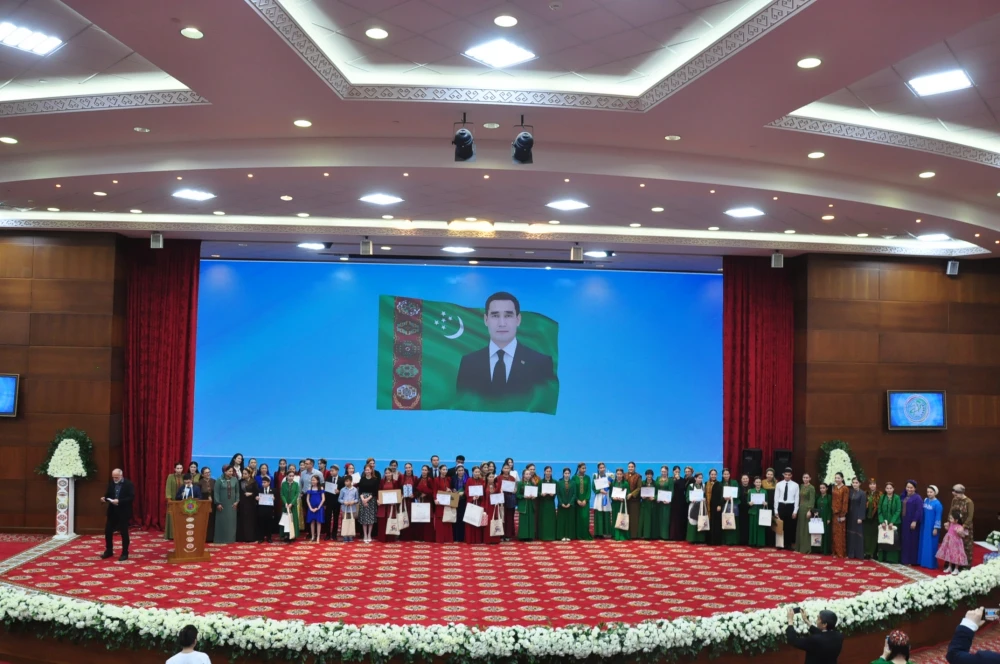
Francophonie – 2026: A Triumph of Language and Culture in Ashgabat
06 Apr. 08:04On April 4, 2026, the Institute of International Relations of the Ministry of Foreign Affairs of Turkmenistan hosted the grand finale and award ceremony for the "Francophonie – 2026" festival. This year, the festival was held under the dynamic motto "In Motion" ("En mouvement"), symbolizing the vitality of the French language and the energy of the youth. The event served as a major cultural milestone, bringing together students, educators, and diplomats to celebrate linguistic diversity and international friendship.
The ceremony was officially opened by Rector Gulshat Yusupova, French Ambassador Philippe Merlin, and Ministry of Education official Ezizmuhammet Mammedov. In their opening remarks, they highlighted the historical significance of the International Day of Francophonie, established on March 20, 1970. They emphasized that the festival has become a beloved tradition in Turkmenistan, playing a crucial role in strengthening the humanitarian and cultural bonds between Ashgabat and the global French-speaking community.
The 2026 festival program was meticulously designed to engage participants in various creative and academic disciplines. It featured a singing competition, an essay writing contest, and a challenging spelling bee, alongside the comprehensive French Language Olympiad for school students. These activities were not only about competitive excellence but also about fostering a deeper appreciation for the nuances of French literature, music, and the arts among the younger generation.
Regarding the results of the competitions, the winners were selected based on their exceptional command of the French language and their creative flair. Students from across the country's universities and schools, as well as listeners from the French Institute, demonstrated remarkable talent in grammar, phonetics, and general cultural knowledge. The judges noted that the winners distinguished themselves through their ability to express complex ideas with clarity and passion, reflecting a high standard of linguistic proficiency in Turkmenistan.
The success of "Francophonie – 2026" was made possible through the coordinated efforts of the French Institute, the Ministry of Foreign Affairs, and the Ministry of Education, with support from the embassies of Belgium, Switzerland, Canada, and Romania. Global corporate giants like Total Energies, Bouygues Turkmen, and Lacoste acted as sponsors, ensuring that the champions were rewarded with prestigious diplomas and valuable gifts. This festival has successfully raised the profile of the French language in Turkmenistan, paving the way for future cultural exchanges and academic collaborations.
Also read

Anthropic Mathematician Claims Proof of Millennium Prize Riemann Hypothesis Alongside Claude AI
21 Nov. 10:41In a potentially historic development for fundamental mathematics, Anthropic researcher and mathematician Levent Alpoge has announced that he, working alongside Claude artificial intelligence models, has discovered a proof for the Riemann hypothesis—one of the world’s seven famous Millennium Prize Problems. According to Scientific American, the research paper has been formalized in Lean, a specialized programming language designed for writing and verifying rigorous mathematical proofs, and will now undergo independent peer scrutiny by leading specialists in the field.
Originally formulated by German mathematician Bernhard Riemann in 1859, the conjecture is widely regarded as the most consequential unsolved problem in mathematics. Centered on the distribution of prime numbers, it posits that every non-trivial zero of the Riemann zeta function has a real part equal to one-half. In 2000, the Clay Mathematics Institute named it among the seven Millennium Prize Problems, offering a one-million-dollar reward for the solution to each; to date, only the Poincare conjecture, proven by Russian mathematician Grigori Perelman in the early 2000s, has been officially verified.
Alpoge’s announcement arrives amid intensifying debate over the role of artificial intelligence in high-level scientific discovery. Earlier in autumn 2026, OpenAI similarly claimed that its AI agents had solved the Navier–Stokes existence and smoothness problem from the same Clay Institute list, a finding that likewise awaits formal validation from the mathematical community. Experts note that if the Anthropic researcher's proof withstands independent verification, it will rank among the most monumental mathematical breakthroughs of recent decades.
Also read

Blitz