
Playlist
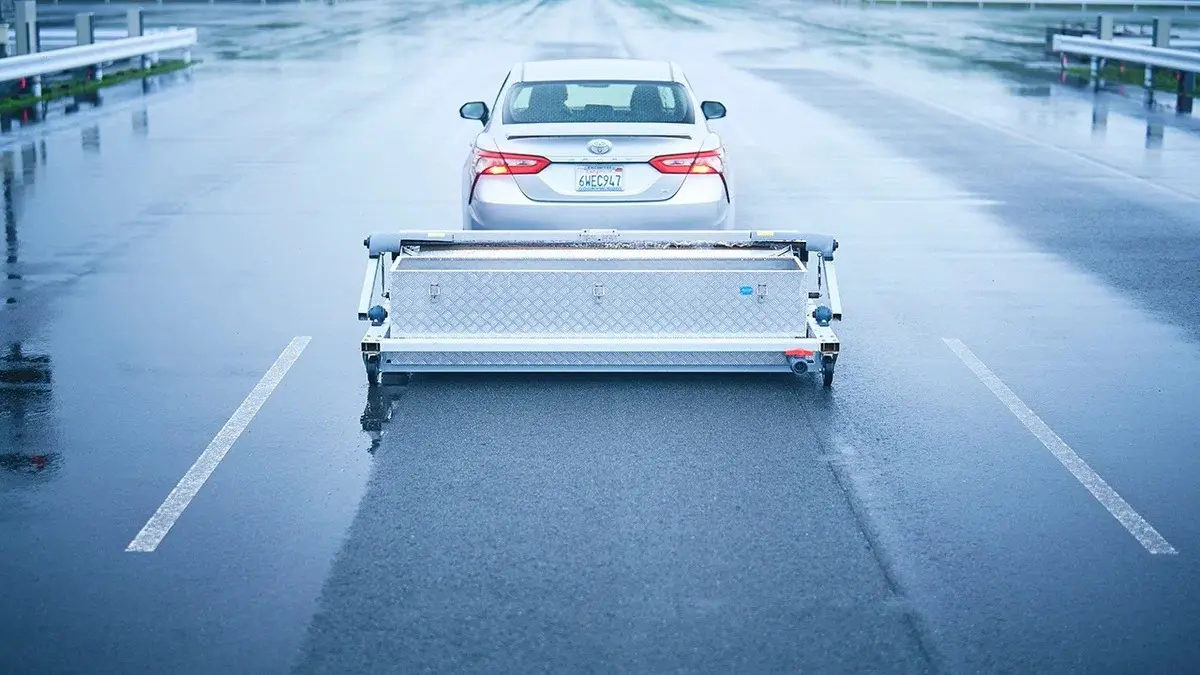
Clever Engineering: Toyota Designs Giant Sponge Roller to Expedite Test Track Drying
03 Aug. 07:03Engineers at the Toyota Higashi-Fuji Technical Center in Susono City have developed a specialized apparatus designed to rapidly remove standing water from proving grounds. The mechanism substantially reduces operational downtime for vehicle testing following rain events.
The development was prompted by requirement specifications for evaluating automatic emergency braking systems, which demand completely dry road surfaces. Because the testing facility is shared across multiple company divisions, weather-related delays routinely forced staff to work overtime and on weekends.
In designing the system, engineers drew inspiration from moisture-mitigation techniques used on baseball fields. Although alternatives such as heat cannons, pavement heaters, industrial vacuums, and squeegees were evaluated, the team ultimately selected a more cost-effective and straightforward mechanical approach.
The apparatus consists of a two-meter sponge roller capable of drying a 3,5-meter-wide swath in a single two-way pass. Moisture is collected in a modified 320-liter aluminum housing, with the roller constructed from repurposed protective packaging waste. To minimize surface abrasion, the system automatically elevates the sponge assembly whenever the towing vehicle executes turns.
Following implementation, track drying times were reduced from four hours to two hours in winter, and down to 1–1,5 hours during summer conditions. Toyota estimates that the tool saves approximately 91 working hours annually, with current utilization averaging once or twice per month.
Also read



On-the-Go Power: Japanese Engineers Develop Wireless In-Road Charging for Electric Vehicles
10 Oct. 08:10In a major leap for electric mobility, Honda R&D, alongside Taisei Corporation and Taisei Rotec, has unveiled an innovative dynamic wireless charging system that charges electric vehicles as they drive. By embedding compact energy-transmitting modules directly into the road surface, the system transfers power via a magnetic field to receivers mounted underneath moving vehicles. Designed to withstand heavy commercial transport up to 20 tons, real-world road testing is scheduled to begin in Japan in April 2027.
The technology eliminates the need for full road reconstruction, as modules can be integrated directly into milled asphalt layers. Aimed at boosting charging power up to 150 kW in future iterations, this infrastructure solution promise to significantly reduce grid pressure on traditional charging stations, particularly for logistics and commercial fleets.
Blitz