
Playlist
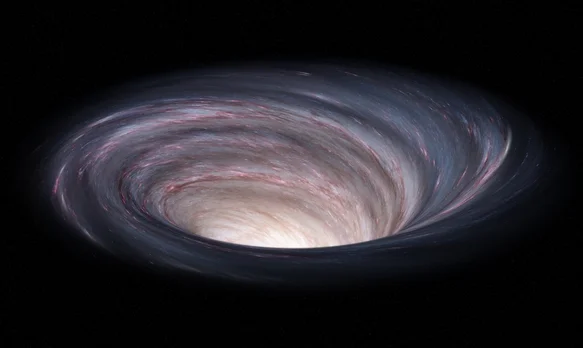
Scientists have identified a black hole, designated RACS J0320-35, with a mass approximately one billion times that of the Sun, located about 12.8 million light-years from Earth. What makes this object extraordinary is its growth rate, which defies theoretical expectations.
According to observations from the Chandra X-ray Observatory, the black hole is accreting matter at 2.4 times the theoretical maximum speed. Its growth is fueled by large amounts of surrounding gas, dust, and stellar debris.
Researchers estimate it gains 300 to 3,000 solar masses annually. Among black holes observed during the first billion years after the Big Bang, this one emits the highest levels of X-rays.
Astronomers are viewing the object as it appeared just 920 million years after the universe’s formation. The origin of its enormous size remains unclear, but scientists suggest it could have formed through the direct collapse of a dense, massive gas cloud.
Also read




Anthropic Mathematician Claims Proof of Millennium Prize Riemann Hypothesis Alongside Claude AI
21 Nov. 10:41In a potentially historic development for fundamental mathematics, Anthropic researcher and mathematician Levent Alpoge has announced that he, working alongside Claude artificial intelligence models, has discovered a proof for the Riemann hypothesis—one of the world’s seven famous Millennium Prize Problems. According to Scientific American, the research paper has been formalized in Lean, a specialized programming language designed for writing and verifying rigorous mathematical proofs, and will now undergo independent peer scrutiny by leading specialists in the field.
Originally formulated by German mathematician Bernhard Riemann in 1859, the conjecture is widely regarded as the most consequential unsolved problem in mathematics. Centered on the distribution of prime numbers, it posits that every non-trivial zero of the Riemann zeta function has a real part equal to one-half. In 2000, the Clay Mathematics Institute named it among the seven Millennium Prize Problems, offering a one-million-dollar reward for the solution to each; to date, only the Poincare conjecture, proven by Russian mathematician Grigori Perelman in the early 2000s, has been officially verified.
Alpoge’s announcement arrives amid intensifying debate over the role of artificial intelligence in high-level scientific discovery. Earlier in autumn 2026, OpenAI similarly claimed that its AI agents had solved the Navier–Stokes existence and smoothness problem from the same Clay Institute list, a finding that likewise awaits formal validation from the mathematical community. Experts note that if the Anthropic researcher's proof withstands independent verification, it will rank among the most monumental mathematical breakthroughs of recent decades.
Also read




Blitz