
Playlist
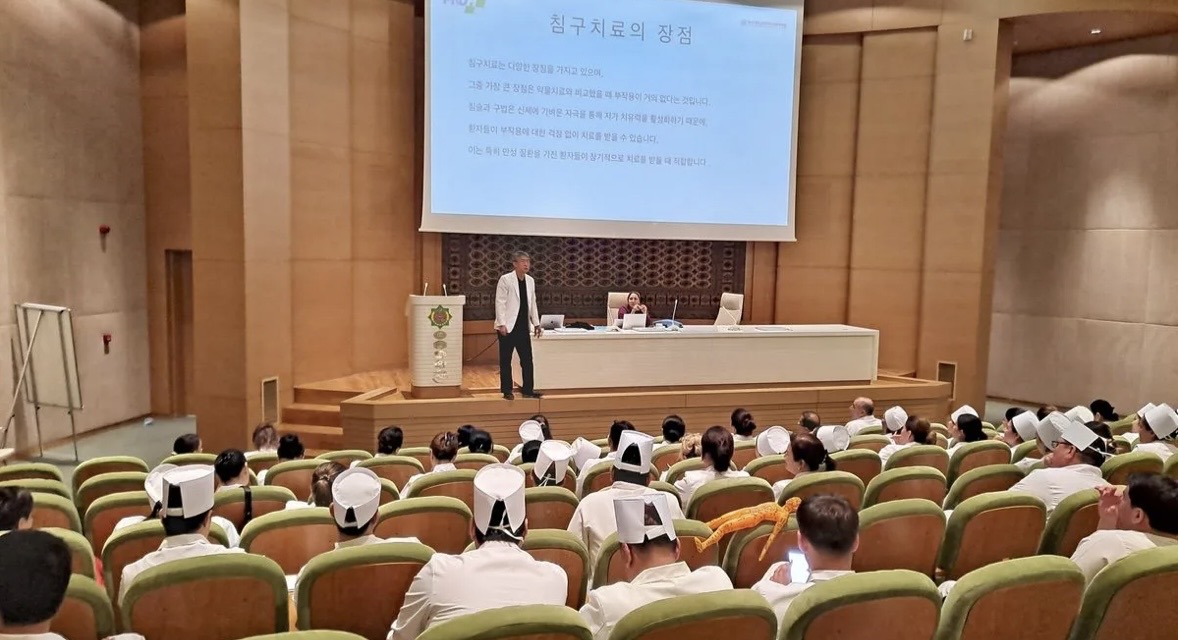
Ashgabat hosts advanced training courses on traditional Korean medicine
05 May. 13:49A significant educational initiative aimed at enhancing the expertise of healthcare professionals in traditional Korean medicine has concluded in Ashgabat. From April 28 to May 2, 2026, prominent professors from the School of Korean Medicine at Pusan National University (PNU) conducted specialized training sessions at the International Training and Research Center. This program represents a key milestone in the ongoing academic exchange between Turkmenistan and the Republic of Korea.
The curriculum was meticulously designed to cater to different levels of expertise. It featured a foundational track for specialists introduced to Eastern medicine for the first time, and an advanced track for physicians who participated in the initial phase of the program in 2025. This dual-track approach ensured that participants received targeted instruction, ranging from basic concepts to complex therapeutic interventions, thereby maximizing the educational impact.
Acupuncture served as the focal point of the practical training sessions. Participants studied the theory of energy meridians and gained hands-on experience in needle insertion techniques under the direct supervision of Korean experts. Furthermore, the program explored pharmacological synergies, focusing on the potential of combining Turkmenistan's diverse medicinal flora with the advanced drug formulation methods utilized at Pusan University.
During their stay, the visiting professors toured the Scientific and Clinical Center for Maternal and Child Health and the International Burn Center. These visits facilitated high-level consultations on incorporating Korean medical practices into patient rehabilitation and the broader national healthcare framework. The successful completion of these courses marks the continuation of a strategic partnership in medical education that began in 2025, fostering innovation in Turkmenistan's healthcare sector.
Also read

Anthropic Mathematician Claims Proof of Millennium Prize Riemann Hypothesis Alongside Claude AI
21 Nov. 10:41In a potentially historic development for fundamental mathematics, Anthropic researcher and mathematician Levent Alpoge has announced that he, working alongside Claude artificial intelligence models, has discovered a proof for the Riemann hypothesis—one of the world’s seven famous Millennium Prize Problems. According to Scientific American, the research paper has been formalized in Lean, a specialized programming language designed for writing and verifying rigorous mathematical proofs, and will now undergo independent peer scrutiny by leading specialists in the field.
Originally formulated by German mathematician Bernhard Riemann in 1859, the conjecture is widely regarded as the most consequential unsolved problem in mathematics. Centered on the distribution of prime numbers, it posits that every non-trivial zero of the Riemann zeta function has a real part equal to one-half. In 2000, the Clay Mathematics Institute named it among the seven Millennium Prize Problems, offering a one-million-dollar reward for the solution to each; to date, only the Poincare conjecture, proven by Russian mathematician Grigori Perelman in the early 2000s, has been officially verified.
Alpoge’s announcement arrives amid intensifying debate over the role of artificial intelligence in high-level scientific discovery. Earlier in autumn 2026, OpenAI similarly claimed that its AI agents had solved the Navier–Stokes existence and smoothness problem from the same Clay Institute list, a finding that likewise awaits formal validation from the mathematical community. Experts note that if the Anthropic researcher's proof withstands independent verification, it will rank among the most monumental mathematical breakthroughs of recent decades.
Blitz