
Playlist
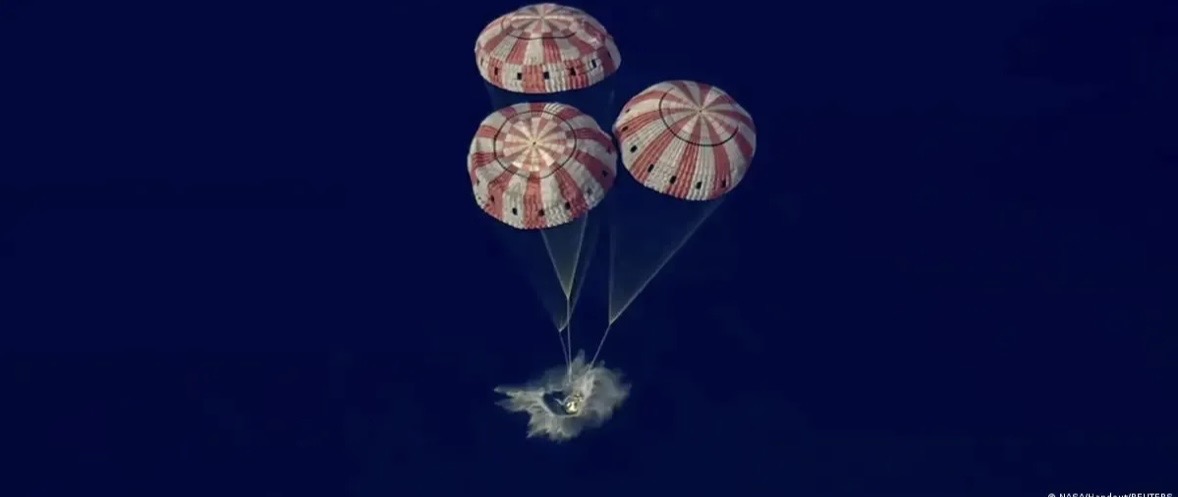
The Orion spacecraft successfully splashed down in the Pacific Ocean on April 11, marking the successful conclusion of the Artemis 2 mission. Landing near the coast of San Diego, the vessel returned its four-person crew safely to Earth after a high-stakes journey around the Moon. This milestone represents a critical validation of NASA’s deep-space exploration systems and sets the stage for future manned lunar landings.
The international crew, consisting of NASA astronauts Reid Wiseman, Victor Glover, and Christina Koch, alongside Canadian Space Agency astronaut Jeremy Hansen, spent ten days in transit. During the mission, which launched from the U.S. East Coast on April 1, the team conducted vital assessments of the spacecraft’s maneuvering capabilities and observed the lunar environment. Their return marks the first time in over fifty years that a crewed vehicle has returned from the vicinity of the Moon.
A significant highlight of the expedition was the establishment of a new distance record for human spaceflight. At its furthest point, Orion traveled 407,000 kilometers from Earth, surpassing the long-standing record held by the Apollo 13 mission since 1970. This achievement underscores the advanced propulsion and navigation technologies that characterize the modern era of space exploration, extending the reach of human presence further into the cosmos.
Throughout the mission, the crew also conducted rigorous testing of next-generation survival gear, including advanced spacesuits designed with autonomous life-support systems. These suits are engineered to provide up to six days of emergency oxygen, a crucial safety feature for future long-duration missions. The global interest in the splashdown, viewed by millions across digital platforms, reflects the renewed public enthusiasm for the next chapter of human discovery in space.
Also read



On-the-Go Power: Japanese Engineers Develop Wireless In-Road Charging for Electric Vehicles
10 Oct. 08:10In a major leap for electric mobility, Honda R&D, alongside Taisei Corporation and Taisei Rotec, has unveiled an innovative dynamic wireless charging system that charges electric vehicles as they drive. By embedding compact energy-transmitting modules directly into the road surface, the system transfers power via a magnetic field to receivers mounted underneath moving vehicles. Designed to withstand heavy commercial transport up to 20 tons, real-world road testing is scheduled to begin in Japan in April 2027.
The technology eliminates the need for full road reconstruction, as modules can be integrated directly into milled asphalt layers. Aimed at boosting charging power up to 150 kW in future iterations, this infrastructure solution promise to significantly reduce grid pressure on traditional charging stations, particularly for logistics and commercial fleets.
Blitz