
Playlist
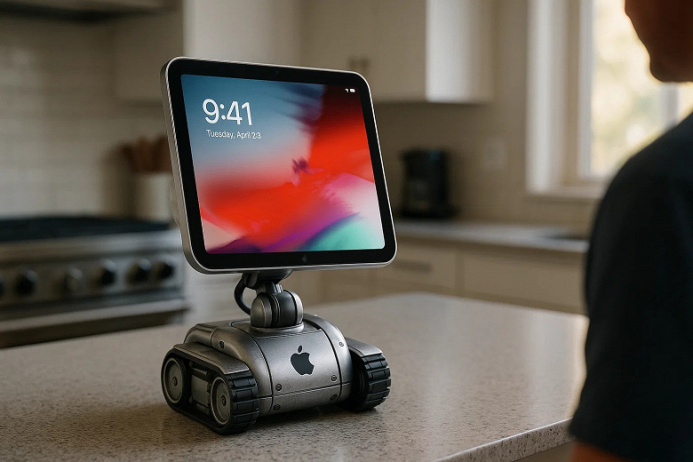
Apple Reenters the AI Race with a Companion Robot, Smart Displays, and Next-Gen Security Systems
18 Aug. 06:01Apple is making a major push back into the artificial intelligence space, not just through software but also with a new wave of hardware products. The company is reportedly developing a lineup of AI-driven devices, including a companion robot, smart home displays, and advanced security cameras.
At the center of this initiative is a desktop robot codenamed J595. It will feature a 7-inch display mounted on a motorized neck, allowing it to follow users with its gaze and reposition its screen dynamically. The robot will use an enhanced version of Siri, powered by large language models, and will be capable of maintaining conversations with multiple people at once.
Apple is also working on a simpler smart display (J490), which lacks mechanical parts but supports voice control and smart home features. Both devices will run on a new operating system called Charismatic, which will support multimedia widgets and facial recognition features.
In the smart home security space, Apple is developing AI-powered cameras with infrared sensors that can not only record video but also automate tasks — like turning off lights when no one is in the room. A smart doorbell prototype is also in development, equipped with facial recognition to unlock doors for trusted individuals.
Through these new products, Apple aims to strengthen its innovation leadership and compete directly with Amazon, Google, and Samsung in the smart home and personal robotics markets — while expanding its ecosystem into entirely new territories.
Also read

On-the-Go Power: Japanese Engineers Develop Wireless In-Road Charging for Electric Vehicles
10 Oct. 08:10In a major leap for electric mobility, Honda R&D, alongside Taisei Corporation and Taisei Rotec, has unveiled an innovative dynamic wireless charging system that charges electric vehicles as they drive. By embedding compact energy-transmitting modules directly into the road surface, the system transfers power via a magnetic field to receivers mounted underneath moving vehicles. Designed to withstand heavy commercial transport up to 20 tons, real-world road testing is scheduled to begin in Japan in April 2027.
The technology eliminates the need for full road reconstruction, as modules can be integrated directly into milled asphalt layers. Aimed at boosting charging power up to 150 kW in future iterations, this infrastructure solution promise to significantly reduce grid pressure on traditional charging stations, particularly for logistics and commercial fleets.
Blitz