
Playlist

Uzbekistan proposed declaring 2027 the Year of Environmental Protection in the Turkic world
20 May. 12:52President of Uzbekistan Shavkat Mirziyoyev has proposed designating 2027 as the "Year of Environmental Protection" within the framework of the Organization of Turkic States (OTS). This strategic initiative was presented during an informal summit of the member states' leaders held in Turkistan. The primary objective of the proposal is to unify the efforts of Turkic-speaking nations in addressing escalating climate challenges and ecological concerns.
The Head of State emphasized the critical necessity of establishing a unified climate risk monitoring system based on satellite data. He noted that contemporary environmental threats require member nations to transition toward closely coordinated collective actions. Integrating artificial intelligence technologies was highlighted as a priority for the sustainable management of transboundary water resources and combating soil degradation across the region.
In support of the environmental agenda, Uzbekistan has allocated 50 specialized educational grants for youth from OTS member countries. Starting from the 2026–2027 academic year, students will be enrolled at the Central Asian University of Environmental and Climate Change Studies in Tashkent. This initiative aims to cultivate professional expertise and foster a dedicated community of specialists focused on regional sustainable development.
Alongside environmental issues, the President urged the acceleration of digital transformation in regional logistics processes. Specifically, he proposed the implementation of a simplified customs corridor mechanism and the complete digitalization of data exchange. These measures are expected to enhance the transparency of cargo transportation and optimize supply chain management between the member states of the organization.
Also read

World’s Largest Unmanned Cargo Aircraft Completes Maiden Flight in China
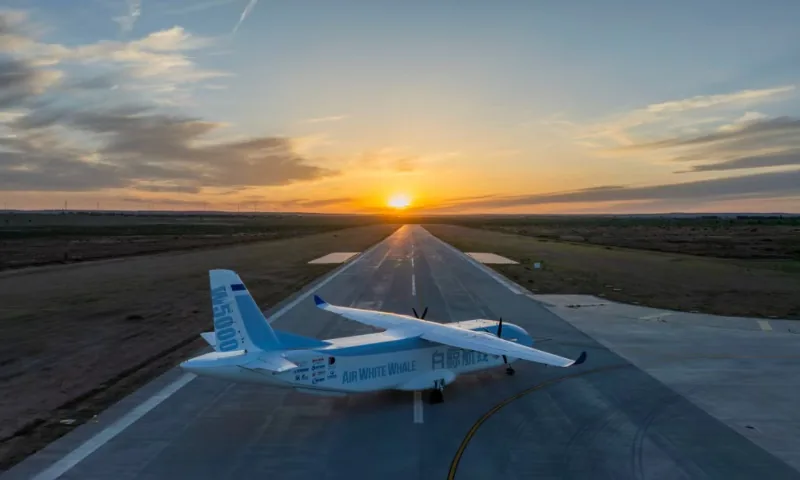
17 Nov. 16:55The Chinese-developed W5000, billed by its creators at Air White Whale as the world’s largest unmanned cargo plane, has successfully completed its maiden test flight in Inner Mongolia. Boasting a 65-cubic-meter cargo hold, the aircraft is engineered to carry payloads of up to five tons across distances reaching 2,600 kilometers.
During the trial, the aircraft lifted off after a roughly 600-meter runway roll, climbed to an altitude of 2,000 meters, and remained airborne for about 30 minutes before making a smooth landing. Operating entirely without onboard pilots, the W5000 relies on autonomous flight controls monitored by ground-based specialists, who verified the seamless integration of its propulsion, avionics, and data-link systems.
Powered by a domestically produced turboprop engine, the airframe consists of nearly 65% carbon-fiber composite materials. This lightweight structural design reduces overall empty weight while maximizing the share of takeoff mass dedicated to freight.
Developers envision deploying the W5000 for regional logistics, temperature-controlled deliveries, and emergency relief operations. Because the design eliminates cockpit equipment and flight crew expenses while cutting fuel burn, the manufacturer estimates per-ton-kilometer shipping costs will be over 60% lower than those of comparable manned cargo aircraft.
Blitz