
Playlist

US Energy Secretary Chris Wright announced that global oil prices are likely to hit their highest levels within the next few weeks. Speaking at the Semafor Economic Forum in Washington, Wright indicated that the upward pressure on energy costs is closely linked to the stability of maritime operations through the Strait of Hormuz, a critical transit point for international energy supplies.
The Secretary’s recent assessment marks a shift from his previous forecasts, which had anticipated a quicker decline in oil valuations. According to Wright, as long as shipping volumes through this strategic corridor remain disrupted, the market will continue to see elevated prices. He emphasized that the peak of this pricing cycle is expected to manifest in the very near future.
Market analysts are closely watching the situation in the Strait of Hormuz, as any delay in restoring full-scale navigation directly impacts global supply chains. The Energy Secretary's comments underscore the vulnerability of the energy market to geopolitical and logistical bottlenecks, which are currently driving volatility and pushing costs to record highs.
Meanwhile, the economic implications of rising fuel costs are also being analyzed within a political framework. President Donald Trump has suggested that high oil and gasoline prices might persist through the upcoming midterm elections in November. This highlights the dual challenge of managing energy stability while addressing its impact on the broader economic and political landscape.
Also read



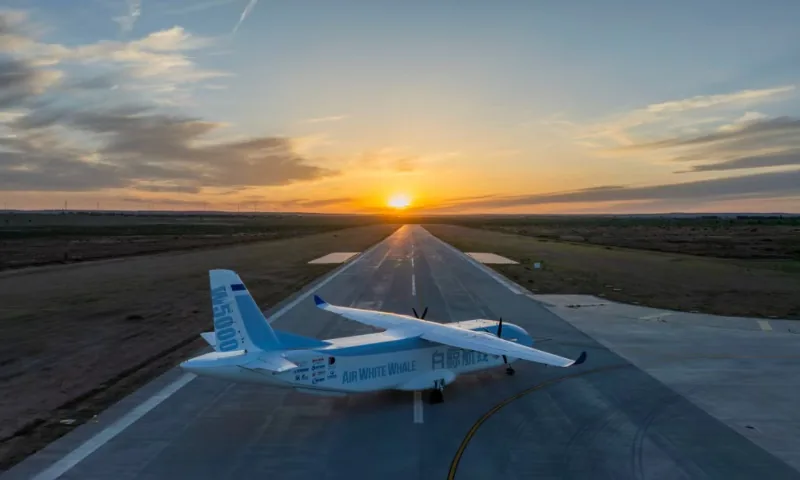
World’s Largest Unmanned Cargo Aircraft Completes Maiden Flight in China
17 Nov. 16:55The Chinese-developed W5000, billed by its creators at Air White Whale as the world’s largest unmanned cargo plane, has successfully completed its maiden test flight in Inner Mongolia. Boasting a 65-cubic-meter cargo hold, the aircraft is engineered to carry payloads of up to five tons across distances reaching 2,600 kilometers.
During the trial, the aircraft lifted off after a roughly 600-meter runway roll, climbed to an altitude of 2,000 meters, and remained airborne for about 30 minutes before making a smooth landing. Operating entirely without onboard pilots, the W5000 relies on autonomous flight controls monitored by ground-based specialists, who verified the seamless integration of its propulsion, avionics, and data-link systems.
Powered by a domestically produced turboprop engine, the airframe consists of nearly 65% carbon-fiber composite materials. This lightweight structural design reduces overall empty weight while maximizing the share of takeoff mass dedicated to freight.
Developers envision deploying the W5000 for regional logistics, temperature-controlled deliveries, and emergency relief operations. Because the design eliminates cockpit equipment and flight crew expenses while cutting fuel burn, the manufacturer estimates per-ton-kilometer shipping costs will be over 60% lower than those of comparable manned cargo aircraft.
Blitz