
Playlist
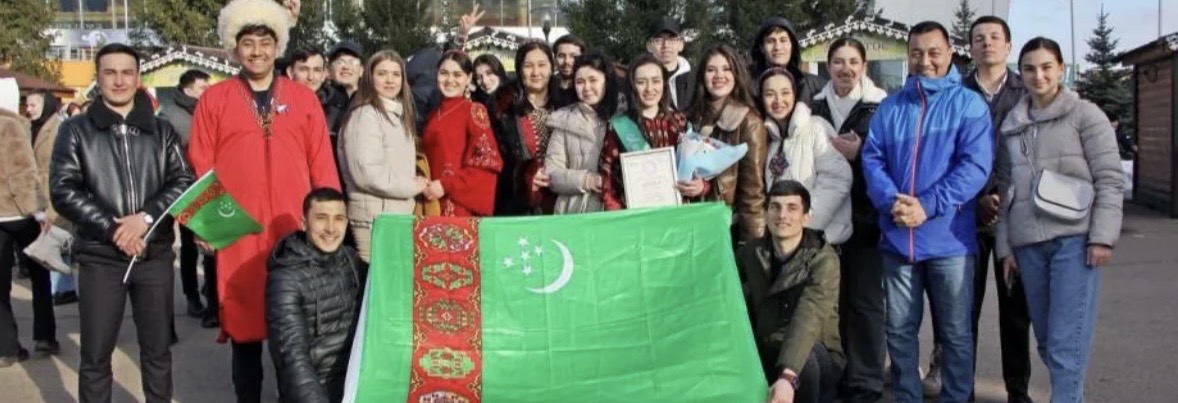
Turkmenistan Ranks Second in Number of Students Studying in Russia
11 May. 13:18Current educational statistics reveal that Turkmenistan remains one of the primary sources of international students for Russian higher education institutions. According to data from the Russian Ministry of Science and Higher Education, there are currently 57,060 Turkmen citizens enrolled in various academic programs across Russia. This figure places Turkmenistan in the second spot among all foreign nations represented in the Russian academic system.
Comparative data shows that Kazakhstan leads the ranking with 60,818 students, while China holds the third position with 56,766 representatives. Other nations significantly contributing to the international student body include Uzbekistan, India, Tajikistan, and Belarus. The diversity of the student population highlights Russia's role as a regional educational hub for Central and South Asia.
The total number of international students in Russia has seen a year-on-year increase of 7,000 people, reaching 402,000 individuals from 179 different countries. Government officials suggest that when accounting for all educational categories, the total figure could realistically reach 425,000. This trend underscores the growing appeal of the country's academic offerings on the global stage.
Projections for the next five years indicate a continued upward trajectory in international enrollment. Experts anticipate a 28% increase, which would bring an additional 93,000 foreign students into the university system. This expansion aligns with long-term strategic goals to enhance international cooperation in the fields of science and higher education.
Also read

Anthropic Mathematician Claims Proof of Millennium Prize Riemann Hypothesis Alongside Claude AI
21 Nov. 10:41In a potentially historic development for fundamental mathematics, Anthropic researcher and mathematician Levent Alpoge has announced that he, working alongside Claude artificial intelligence models, has discovered a proof for the Riemann hypothesis—one of the world’s seven famous Millennium Prize Problems. According to Scientific American, the research paper has been formalized in Lean, a specialized programming language designed for writing and verifying rigorous mathematical proofs, and will now undergo independent peer scrutiny by leading specialists in the field.
Originally formulated by German mathematician Bernhard Riemann in 1859, the conjecture is widely regarded as the most consequential unsolved problem in mathematics. Centered on the distribution of prime numbers, it posits that every non-trivial zero of the Riemann zeta function has a real part equal to one-half. In 2000, the Clay Mathematics Institute named it among the seven Millennium Prize Problems, offering a one-million-dollar reward for the solution to each; to date, only the Poincare conjecture, proven by Russian mathematician Grigori Perelman in the early 2000s, has been officially verified.
Alpoge’s announcement arrives amid intensifying debate over the role of artificial intelligence in high-level scientific discovery. Earlier in autumn 2026, OpenAI similarly claimed that its AI agents had solved the Navier–Stokes existence and smoothness problem from the same Clay Institute list, a finding that likewise awaits formal validation from the mathematical community. Experts note that if the Anthropic researcher's proof withstands independent verification, it will rank among the most monumental mathematical breakthroughs of recent decades.
Blitz