
Playlist
Turkmenistan Hosts the 5th Open International Internet Olympiad on Strength of Materials
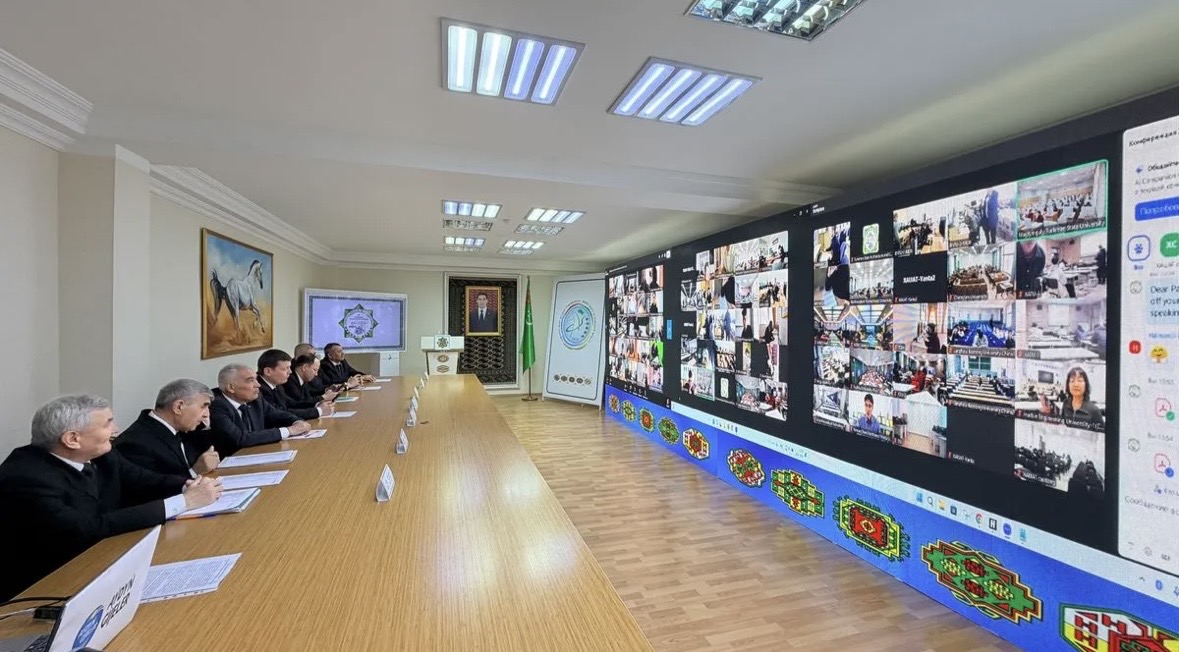
18 Mar. 13:51The Turkmen State Architecture and Construction Institute recently hosted the 5th Open International Internet Olympiad on the subject of "Strength of Materials." This prestigious academic competition, held remotely, brought together students from various higher education institutions across Turkmenistan and several foreign countries. The event was officially opened with a welcoming speech by M. Babayev, the Acting Rector of the Institute, who highlighted the crucial role of technical disciplines in fostering global innovation and development.
A total of 877 students participated in the competition, representing a wide array of nations, including the USA, Germany, China, Russia, Turkey, and Romania. The vast geographical reach of the Olympiad extended to participants from Australia, Malaysia, Belarus, Kazakhstan, Kyrgyzstan, Azerbaijan, Uzbekistan, Uganda, and Pakistan. This impressive turnout underscores the growing international interest in academic events organized by Turkmenistan and showcases the successful integration of local education into the global scientific community.
The Olympiad was conducted in a single round, where participants were challenged to solve six complex problems within a strict 120-minute time limit. These tasks were designed to test the students' analytical skills, theoretical understanding, and practical application of mechanical principles. To ensure transparency and maintain high academic standards, the judging panel consisted of experienced professors and experts from prominent international engineering and architectural universities.
According to the organizers, such international competitions are vital for strengthening educational partnerships, facilitating professional exchange, and identifying talented youth capable of solving intricate engineering challenges independently. These events not only promote scientific curiosity but also encourage students to engage in rigorous research and creative problem-solving. By utilizing digital platforms for this Olympiad, Turkmenistan continues to demonstrate its commitment to modernizing its educational infrastructure and fostering international scholarly dialogue.
Also read

Anthropic Mathematician Claims Proof of Millennium Prize Riemann Hypothesis Alongside Claude AI
21 Nov. 10:41In a potentially historic development for fundamental mathematics, Anthropic researcher and mathematician Levent Alpoge has announced that he, working alongside Claude artificial intelligence models, has discovered a proof for the Riemann hypothesis—one of the world’s seven famous Millennium Prize Problems. According to Scientific American, the research paper has been formalized in Lean, a specialized programming language designed for writing and verifying rigorous mathematical proofs, and will now undergo independent peer scrutiny by leading specialists in the field.
Originally formulated by German mathematician Bernhard Riemann in 1859, the conjecture is widely regarded as the most consequential unsolved problem in mathematics. Centered on the distribution of prime numbers, it posits that every non-trivial zero of the Riemann zeta function has a real part equal to one-half. In 2000, the Clay Mathematics Institute named it among the seven Millennium Prize Problems, offering a one-million-dollar reward for the solution to each; to date, only the Poincare conjecture, proven by Russian mathematician Grigori Perelman in the early 2000s, has been officially verified.
Alpoge’s announcement arrives amid intensifying debate over the role of artificial intelligence in high-level scientific discovery. Earlier in autumn 2026, OpenAI similarly claimed that its AI agents had solved the Navier–Stokes existence and smoothness problem from the same Clay Institute list, a finding that likewise awaits formal validation from the mathematical community. Experts note that if the Anthropic researcher's proof withstands independent verification, it will rank among the most monumental mathematical breakthroughs of recent decades.
Blitz