
Playlist
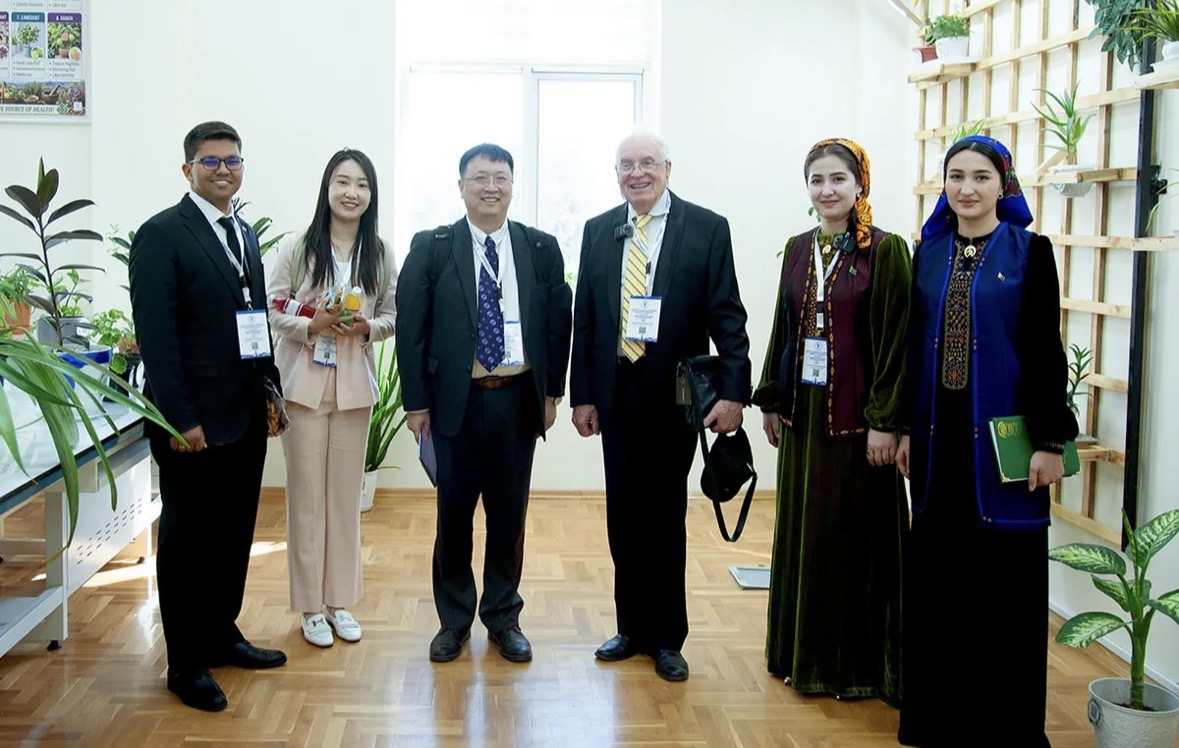
Turkmen Technical University Expands Global Network via Five New International Accords
12 Jun. 09:19On the occasion of Science Day, the Oguz Han Engineering and Technology University of Turkmenistan served as the venue for a high-level hybrid international conference. The key operational outcome of the forum was the formalization of five bilateral agreements between the host university and prominent foreign academic and corporate institutions. These documents aim to institutionalize long-term scientific collaboration, faculty-student exchange programs, and joint technological research.
Middle Eastern and Southeast Asian academic partnerships were reinforced through strategic agreements with specialized institutions. A Memorandum of Understanding was signed with the Doha University of Science and Technology in Qatar to foster educational cooperation. Simultaneously, an agreement focused on credit mobility and structured student exchange programs was finalized with Universiti Tenaga Nasional in Malaysia, enhancing cross-border academic integration.
Commercialization of biotechnology and practical industry-academia ties were established via an agreement with a Turkish private sector entity. The university entered into a Memorandum of Understanding with "METABIO Biotechnology," a company specializing in advanced biological solutions. This partnership is designed to bridge the gap between academic lab research and industrial implementation, providing students with access to real-world corporate R&D frameworks.
The institution also solidified its East Asian educational vector by concluding separate bilateral agreements with two prominent universities located in the People's Republic of China. Official partnerships were established with the Shanghai University of Science and Technology and Chang'an University. Collectively, these five newly signed regulatory frameworks establish a sustainable foundation for sharing technical expertise, developing innovations, and strengthening traditional bilateral state relations.
Also read

Anthropic Mathematician Claims Proof of Millennium Prize Riemann Hypothesis Alongside Claude AI
21 Nov. 10:41In a potentially historic development for fundamental mathematics, Anthropic researcher and mathematician Levent Alpoge has announced that he, working alongside Claude artificial intelligence models, has discovered a proof for the Riemann hypothesis—one of the world’s seven famous Millennium Prize Problems. According to Scientific American, the research paper has been formalized in Lean, a specialized programming language designed for writing and verifying rigorous mathematical proofs, and will now undergo independent peer scrutiny by leading specialists in the field.
Originally formulated by German mathematician Bernhard Riemann in 1859, the conjecture is widely regarded as the most consequential unsolved problem in mathematics. Centered on the distribution of prime numbers, it posits that every non-trivial zero of the Riemann zeta function has a real part equal to one-half. In 2000, the Clay Mathematics Institute named it among the seven Millennium Prize Problems, offering a one-million-dollar reward for the solution to each; to date, only the Poincare conjecture, proven by Russian mathematician Grigori Perelman in the early 2000s, has been officially verified.
Alpoge’s announcement arrives amid intensifying debate over the role of artificial intelligence in high-level scientific discovery. Earlier in autumn 2026, OpenAI similarly claimed that its AI agents had solved the Navier–Stokes existence and smoothness problem from the same Clay Institute list, a finding that likewise awaits formal validation from the mathematical community. Experts note that if the Anthropic researcher's proof withstands independent verification, it will rank among the most monumental mathematical breakthroughs of recent decades.
Blitz