
Playlist
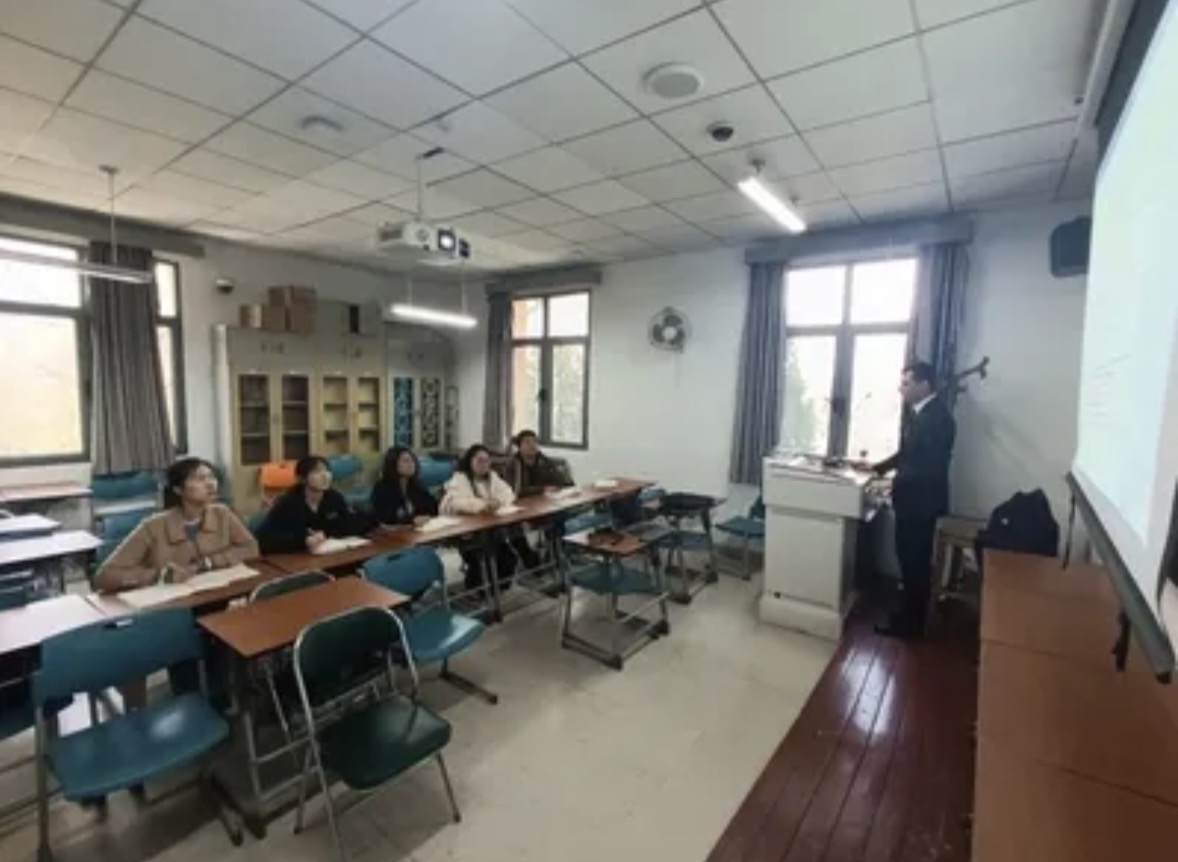
Starting March 1, 2026, Didar Amanmuhammedov, a lecturer from the Turkmen Language Department of Magtymguly Turkmen State University (TSU), has been conducting classes at the Beijing Foreign Studies University. This academic exchange marks a significant step forward in the bilateral educational partnership between Turkmenistan and China, aimed at fostering linguistic diversity and cultural understanding.
According to the Ministry of Education of Turkmenistan, this teaching mission is carried out under the "Memorandum of Cooperation between Magtymguly TSU and Beijing Foreign Studies University." Amanmuhammedov is currently instructing students enrolled in the specialized "Russian + Turkmen" linguistic program. In addition to language proficiency, his curriculum includes comprehensive overview sessions about Turkmenistan’s historical heritage, cultural identity, and modern social development.
The educational tenure of the Turkmen specialist in China is scheduled to last until July 29, 2026. During this period, Chinese students will have a unique opportunity to learn from a native speaker, gaining insights into the nuances of the Turkmen language. This program is expected to produce professionals who will serve as bridges in diplomatic and economic relations between the two nations in the future.
The introduction of Turkmen language studies in Beijing reflects the growing international interest in Turkmenistan’s academic contributions. As educational ties between Ashgabat and Beijing continue to strengthen, such initiatives play a vital role in promoting global cultural exchange and enhancing the strategic partnership between the two countries in the 21st century.
Also read

Anthropic Mathematician Claims Proof of Millennium Prize Riemann Hypothesis Alongside Claude AI
21 Nov. 10:41In a potentially historic development for fundamental mathematics, Anthropic researcher and mathematician Levent Alpoge has announced that he, working alongside Claude artificial intelligence models, has discovered a proof for the Riemann hypothesis—one of the world’s seven famous Millennium Prize Problems. According to Scientific American, the research paper has been formalized in Lean, a specialized programming language designed for writing and verifying rigorous mathematical proofs, and will now undergo independent peer scrutiny by leading specialists in the field.
Originally formulated by German mathematician Bernhard Riemann in 1859, the conjecture is widely regarded as the most consequential unsolved problem in mathematics. Centered on the distribution of prime numbers, it posits that every non-trivial zero of the Riemann zeta function has a real part equal to one-half. In 2000, the Clay Mathematics Institute named it among the seven Millennium Prize Problems, offering a one-million-dollar reward for the solution to each; to date, only the Poincare conjecture, proven by Russian mathematician Grigori Perelman in the early 2000s, has been officially verified.
Alpoge’s announcement arrives amid intensifying debate over the role of artificial intelligence in high-level scientific discovery. Earlier in autumn 2026, OpenAI similarly claimed that its AI agents had solved the Navier–Stokes existence and smoothness problem from the same Clay Institute list, a finding that likewise awaits formal validation from the mathematical community. Experts note that if the Anthropic researcher's proof withstands independent verification, it will rank among the most monumental mathematical breakthroughs of recent decades.
Blitz